
twitter_sim: Decoding the Mechanics of Bot Disinformation Maneuvers
Agent Based Simulation of Bot Disinformation Maneuvers in Twitter
The paper introduces twitter sim, a specialized Agent-Based Model (ABM) designed to simulate disinformation maneuvers on Twitter. It leverages social influence theory and explicit Twitter mechanics (retweets, mentions, following) to evaluate the impact of bot operations like "backing" and "bridging" on community beliefs.
TL;DR
Researchers at Carnegie Mellon University have developed twitter sim, a high-fidelity Agent-Based Model (ABM) that moves beyond simple viral spread models. By simulating actual Twitter behaviors—like scrolling speed, login frequency, and following patterns—they’ve identified that the "battle for truth" hits a tipping point when bots exceed 12% of the population.
Background Positioning
In the landscape of social cybersecurity, this work sits between theoretical epidemiology (SIR models) and empirical data mining. It is a methodological bridge, providing a "virtual laboratory" where researchers can ethically test "What-if" scenarios regarding disinformation impact that would be impossible in the real world.
The "Why": Why Existing Models Fail
Traditional models of rumor spreading often treat humans like passive "infected" nodes in a network. However, humans on social media are:
- Selectively Active: We don't see every tweet; we only see what happens when we log on.
- Attention-Capped: Even when online, we only scroll through a small portion of our feed.
- Biased (Homophily): We are more likely to be influenced by people who follow the same accounts we do.
Methodology: Engineering the Virtual Twitter
The core of twitter sim is its adherence to the technical constraints of the platform. Unlike abstract models, it implements:
- Discrete Event Simulation: Uses an exponential distribution to model when a user next checks their phone.
- The Follower Constraint: A user’s feed is only populated by those they follow, not those who follow them. This creates an "embedding challenge" for malicious bots.
- Belief Dynamics: Belief is a continuous variable (0 to 1), influenced by the Jaccard similarity between the sender and receiver.
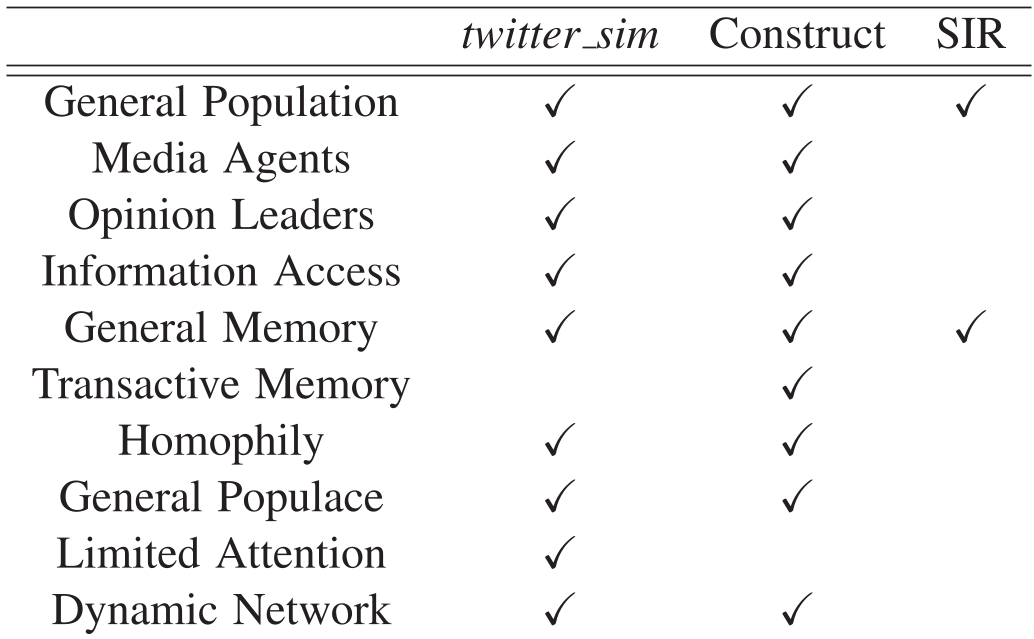 Above: The hierarchy of twitter_sim compared to legacy SIR and Construct models.
Two Fatal Maneuvers: Backing and Bridging
The paper explores two specific tactics from the BEND framework:
- Backing: Bots find a high-influence human and "back" them by retweeting and following, effectively boosting that person's "prestige" to spread a message further.
- Bridging: Bots act as a "connective tissue" between two isolated echo chambers. They embed in Group A and then slowly introduce the ideas of Group B.
Key Insight: The 12% Stalemate
The researchers found a critical threshold in their simulations. In a network where 10% of users are "Truth Defenders" (Stiflers), they can successfully counter disinformation—until the bot population hits 12%. At this magnitude, the volume of bot activity overwhelms the network’s natural immune system.
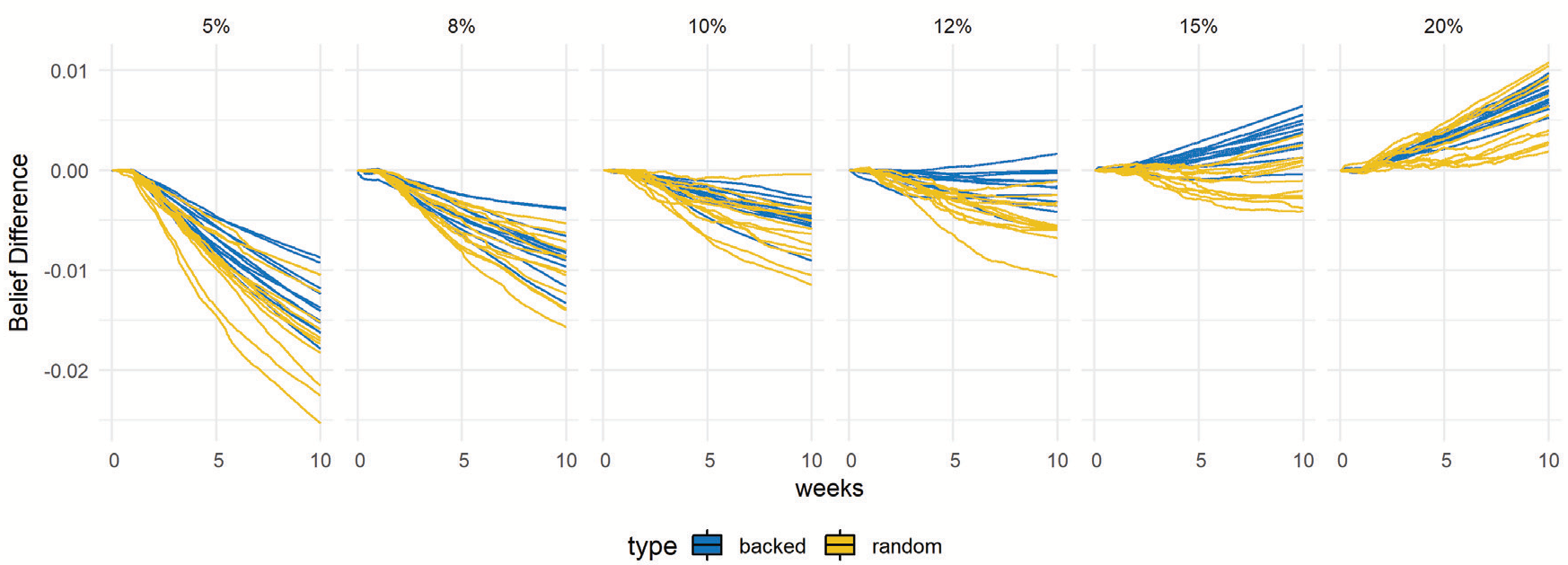 Graph: The point at which bot percentage overcomes truth defense systems.
Empirical Validation
To ensure the simulation wasn't just "junk in, junk out," the authors validated their agent parameters against 41 million real tweets from the 1% Twitter sample and the 2018 Midterm elections. This data-driven approach allowed them to accurately set λ (mean hourly login rate) and the number of tweets read per session.
Critical Analysis & Conclusion
Takeaway
The study demonstrates that positioning matters more than volume. A bot that fails to embed (gain real followers) has zero impact, no matter how much it tweets. However, once bots successfully "bridge" communities, they can shift the mean belief of an entire population by simply normalizing extreme content.
Limitations & Future Work
The primary limitation is the focus on scale-free networks which, while realistic, may not capture the "hyper-local" nuances of private groups or encrypted platforms. Future iterations could integrate LLM-based agents to simulate more persuasive, personalized disinformation rather than just high-frequency "noise."
This research serves as a stark warning to platform moderators: identifying bots is not enough; identifying where bots are bridging communities is the real key to social resilience.