
Simulating the Social Fabric: How Cultural Events Shape Social Capital Dynamics
Agent-Based Simulation of Cultural Events Impact on Social Capital Dynamics
This paper presents a multidisciplinary Agent-Based Model (ABM) to simulate the impact of cultural events on social capital dynamics. By integrating the Axelrod model with CIDOC-CRM methodology and OECD metrics, it identifies how cultural participation drives societal patterns of cohesion, clustering, or radicalization.
TL;DR
This research bridges the gap between sociology and computer science by using Agent-Based Modeling (ABM) to simulate how cultural events influence the "glue" of society—Social Capital. By evolving the classic Axelrod model, the authors demonstrate that while similar-minded groups tend to cluster and polarize, broad cultural "broadcasting" and physical neighborhood ties are critical for global social convergence and the prevention of radicalization.
Problem & Motivation: The Vaguery of Cultural Impact
In an era of rapid globalization and increasing radicalization, understanding how cultural activities form social cohesion is no longer a purely philosophical exercise—it is a matter of policy and security. However, "culture" is notoriously difficult to model.
Prior work, specifically Axelrod’s Dissemination of Culture model, provided a foundation but suffered from limitations:
- Spatial Constraints: Agents only interacted with immediate physical neighbors.
- Dimension Poverty: Culture was often represented as simple integers (traits) rather than complex social metrics.
- Lack of Mass Influence: There was no mechanism for "one-to-many" influences like mass media or large-scale festivals.
The authors’ Insight: Transitioning from a 2D physical grid to a Social Capital Hyperspace based on OECD metrics (Trust, Norms, Networks) allows for a more realistic simulation of human interaction in the digital age.
Methodology: The Architecture of Cultural Dynamics
The model is built on three cornerstones: CIDOC-CRM (for semantic mapping), OECD metrics (for quantifying social capital), and a modified Axelrod interaction rule.
1. The Social Capital Hyperspace
Each agent is defined by a feature vector representing four key dimensions:
- Personal relationships
- Social network support
- Civic engagement
- Trust and cooperative norms
2. Interaction Mechanisms
The model introduces two distinct ways agents change:
- Broadcasting: A "creator" agent generates a cultural event. Other agents attend based on physical distance and cultural similarity, shifting their features toward the creator’s values.
- Local Interaction: Agents pair up with either physical neighbors or "cultural neighbors" (those close in the hyperspace) to share and converge on social capital traits.
 Figure 1: Conceptual framework linking agents, creators, and cultural events via the CIDOC-CRM methodology.
3. Mathematical Interaction Rule
The probability of interaction is inversely proportional to the Euclidean distance between agents in the cultural space: This ensures that agents who are already similar are more likely to interact, mirroring the real-world "echo chamber" effect.
Experiments & Results: Localization vs. Globalization
The researchers conducted three primary experiments by varying the weight of Cultural Similarity (SN) versus Physical Neighborhood (FN) interactions.
- Scenario A (100% SN): When agents only interact with those similar to them in the social capital space, the society fragments into extreme, isolated clusters. This is the recipe for Radicalization.
- Scenario B (80% SN / 20% FN): Introducing objective physical ties (like family/coworkers) creates turbulence and begins to break down the rigid isolation of clusters.
- Scenario C (50% SN / 50% FN): A balanced interaction leads to Global Convergence. Physical proximity forces interaction between different types of people, bridging the gaps between distant social clusters.
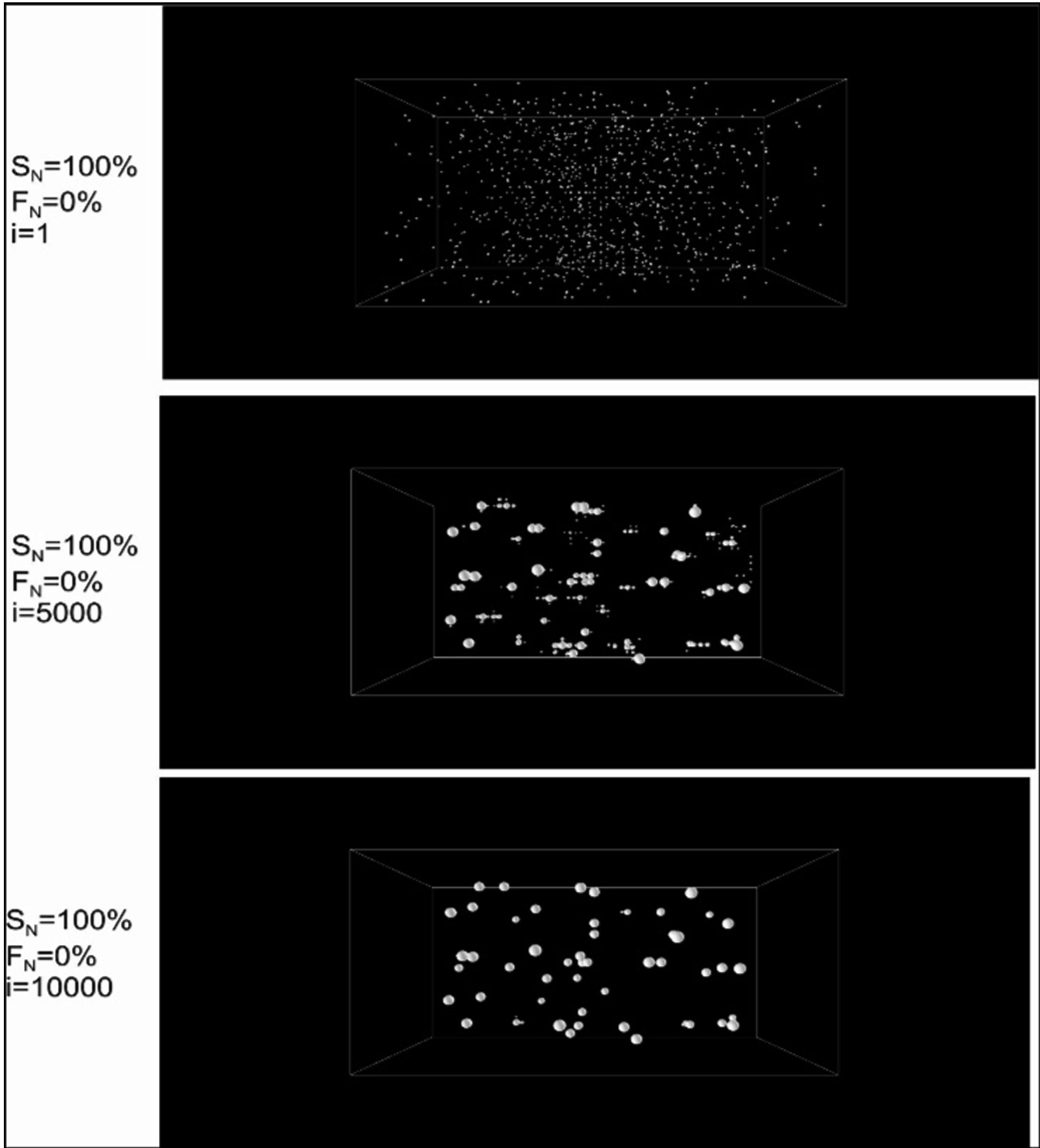 Figure 2: Distribution of agents in social capital space showing cluster formation over 10,000 iterations.
Critical Analysis & Conclusion
The study provides a powerful quantitative argument for the value of "broadcasting" cultural events. It suggests that:
- Mass Media as a Stabilizer: Contrary to some critiques, broad cultural broadcasting acts as a globalizing factor that fosters cultural similarity and prevents extreme polarization.
- The Danger of Purely Algorithmic Socializing: If social interactions are driven purely by similarity (as in many modern social media "bubbles"), society naturally drifts toward fragmentation.
Limitations: The current model is "abstract and deductive." It does NOT yet model individual creative acts (like writing a book) or the chaotic "phase transitions" caused by highly controversial/innovative events.
Future Outlook: The next step is calibrating the model with real-world empirical data from the UK, Belgium, and Lithuania to validate if these simulated patterns hold true in specific national contexts. This could revolutionize how governments allocate cultural budgets to maximize social harmony.