
Are We Ready for Agent-Native Memory? A Data Management Deep Dive
Are We Ready For An Agent-Native Memory System?
The paper presents a systematic experimental study of agent memory from a data management perspective. It introduces a modular framework decomposing memory into Representation, Extraction, Retrieval, and Maintenance, evaluating 12 major systems (e.g., MemGPT, Zep, MemOS) across 5 benchmark workloads to identify the most robust agent-native architectures.
TL;DR
As LLM agents move from simple chatbots to autonomous systems, their "memory" is evolving from simple RAG into complex data management systems. This paper systematically decomposes 12 representative memory systems (like MemGPT, Zep, and MemOS) to reveal that structure matters more than size, and raw evidence preservation often beats sophisticated abstraction.
The "Black Box" Problem
Until now, we have judged agent memory by high-level scores like F1. But for a production-grade agent, we need to know: Is it fast? Does it hallucinate stale facts after an update? Does it collapse over 100 sessions? The authors argue that current memory systems are fragmented and lack a unified architectural understanding.
Methodology: The Four Pillars of Agent Memory
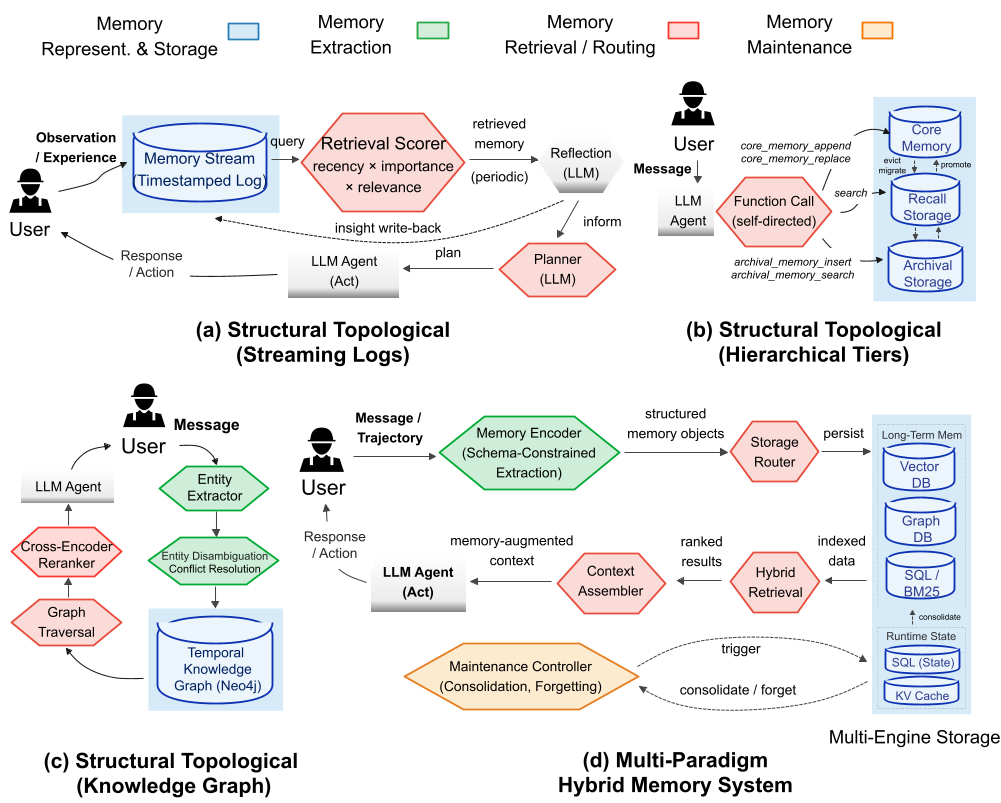
The paper proposes a taxonomy that treats memory as a database system rather than just a prompt-engineered trick.
1. Representation & Storage
Systems range from Token-Level Sequences (flat text) to Topological Graphs (entities and relations).
- Insight: While graphs (like Cognee) are better for temporal reasoning, they require complex Cypher queries and physical backends like Neo4j.
2. Extraction
How do we turn a mess of dialogue into memory?
- Heuristic vs. LLM-driven: The study finds that "Raw Sequence Concatenation" (keeping the original text) surprisingly outperforms LLM-summarized memory in many reasoning tasks because abstraction often discards critical "minor" details.
3. Retrieval & Routing
- Agentic Routing: Systems like Letta use the LLM to decide when to search archival storage.
- Hybrid Execution: Combining vector search (semantic) with BM25 (keyword) and Graph traversal (topological) is the current SOTA for high-fidelity retrieval.
4. Maintenance
This is the "lifecycle" of memory.
- Conflict Resolution: How to handle a user saying "I moved to London" after previously saying "I live in Paris." Structured multi-versioning is the only reliable way to prevent "hallucinations of the past."
Experimental Battleground: Who Wins?
Workload Alignment (RQ1)
There is no "silver bullet."
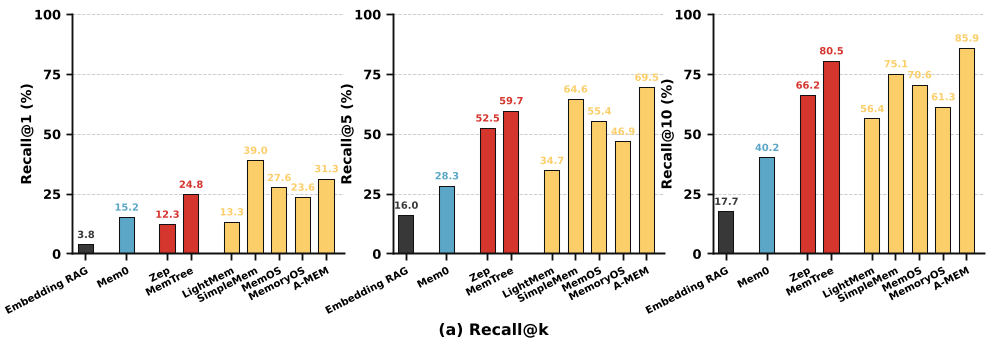
- Long-session reasoning: Use Zep or Cognee (Graph-aware).
- Stateful tool execution (DB-Bench): Use MemoChat or raw context.
- Accuracy: MemOS and MemoryOS are the most robust all-rounders.
The Cost of Intelligence (RQ5)
The study reveals a massive trade-off. Highly structured systems (Zep, Cognee) incur orders-of-magnitude higher latency due to graph construction and LLM-based cleaning.
- Winning Strategy: Localized Maintenance. Updating only the relevant piece of a tree or graph is far more efficient than global re-summarization.
Critical Analysis: The "Late Filtering" Principle
One of the most important takeaways is Finding 7: The Late Filtering Principle. Many developers try to save tokens by having an LLM summarize every dialogue turn before saving it. This is a mistake. The authors prove that "Coverage-Preserving Extraction" (Raw text) provides a more stable balance for downstream reasoning. Abstraction is a one-way street; once a detail is summarized away, the agent can never "re-reason" about it in a new context.
Conclusion: Are We Ready?
We have the components, but we lack the integration. The "Agent-Native Memory" of the future will likely be a Hybrid-Engine System that:
- Stores Raw Traces for fidelity.
- Builds Incremental Graphs for temporal logic.
- Uses Autonomous Planning for retrieval.
If you are building an agent today, the advice is clear: Don't over-summarize, and choose a memory structure that mimics your specific workload bottleneck (Temporal vs. Factual vs. Procedural).
Code and Benchmarks available at: https://github.com/OpenDataBox/MemoryData