
Agent-World: Evolving General Intelligence through Scalable Real-World Environments
Agent-World: Scaling Real-World Environment Synthesis for Evolving General Agent Intelligence
Agent-World is a self-evolving training arena designed to advance general agent intelligence through large-scale environment synthesis and reinforcement learning. It leverages 1,978 realistic environments and over 19,000 tools to enable agents to outperform proprietary models like GPT-4 and Gemini on 23 challenging benchmarks including MCP-Mark and BFCL V4.
TL;DR
Agent-World is a breakthrough training framework that moves beyond static datasets by creating a self-evolving arena of 1,978 realistic environments. By mining the web for actual databases and executable tools (over 19,000 in total), it allows agents to train via Multi-Environment RL. The system doesn't just train—it diagnoses its own weaknesses and synthesizes new, harder tasks to fix them, leading to performance that rivals or exceeds proprietary giants like GPT-4o and Claude 3.5 Sonnet.
Background: The "Environment Gap" in Agent Intelligence
Most modern LLMs are "text-rich but experience-poor." While they excel at reasoning in a vacuum, they often crumble when interacting with stateful, real-world systems like databases, file systems, or enterprise APIs. Current solutions generally fall into two traps:
- Hallucinated Simulators: LLMs pretending to be a system, which often lack the rigid logic of real code.
- Static Benchmarks: Fixed sets of tools that agents eventually overfit to.
Agent-World bridges this gap by treating the entire web as a source for Environment Discovery, turning raw PRDs (Product Requirement Documents) and tool documentations into executable sandboxes.
Methodology: The Engines of Evolution
1. Agentic Environment-Task Discovery
The researchers didn't manually write code for 2,000 environments. Instead, they built a "Research Agent" that:
- Mines real-world themes from MCP (Model Context Protocol) servers and industrial documents.
- Builds topic-aligned databases using search, browsers, and code compilers.
- Generates and verifies tool interfaces (e.g., Python functions) that interact with these databases.
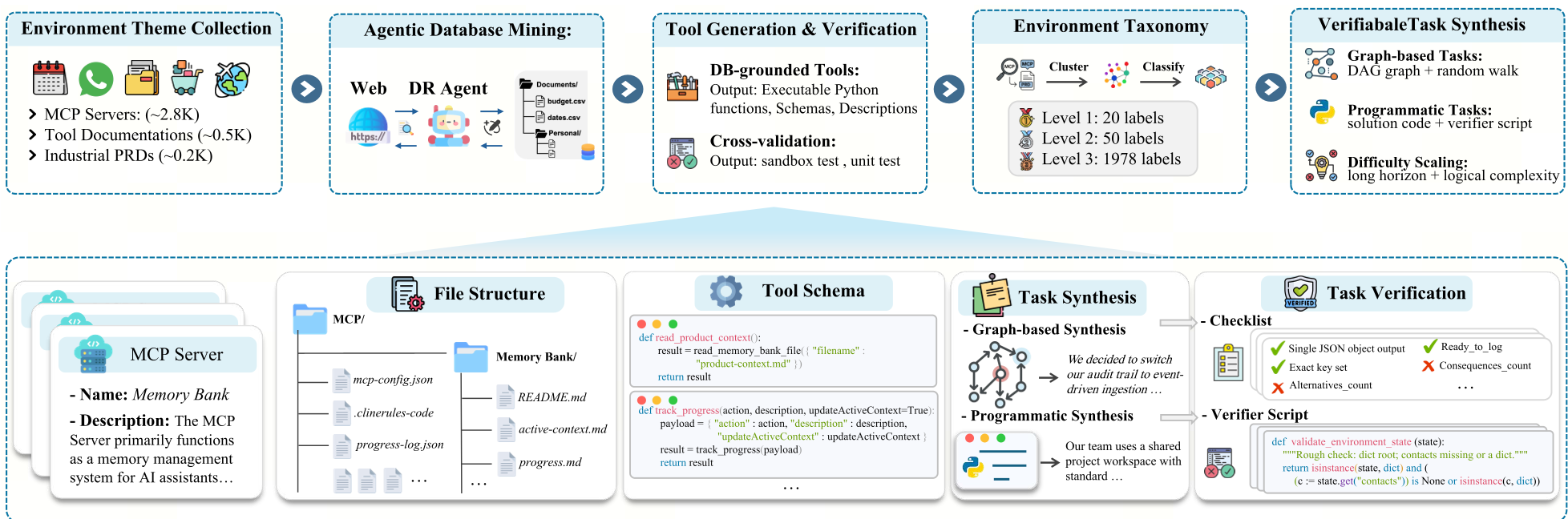 Figure 1: The automated pipeline from raw web themes to verified, executable toolsets.
2. Verifiable Task Synthesis
To train the agent, the system generates two types of tasks:
- Graph-Based: Modeling sequential dependencies (e.g., "Find an order ID, then check items, then initiate return").
- Programmatic: Requiring complex logic like loops and conditional branching. Crucially, every task is verified by a "Solution Script" in a sandbox—if even a SOTA model can't solve it with the ground truth, the task is discarded or refined.
3. Continuous Self-Evolving Training
The "Secret Sauce" is the feedback loop. Rather than one-pass training, Agent-World uses a Diagnostic Agent to analyze interaction logs.
- Evaluation: The agent is tested in the "Arena."
- Diagnosis: If the agent fails at "Financial Analysis," the system identifies that it struggles with "Aggregating SQL results."
- Expansion: The system generates more SQL-heavy environments and tasks to specifically target this weakness.
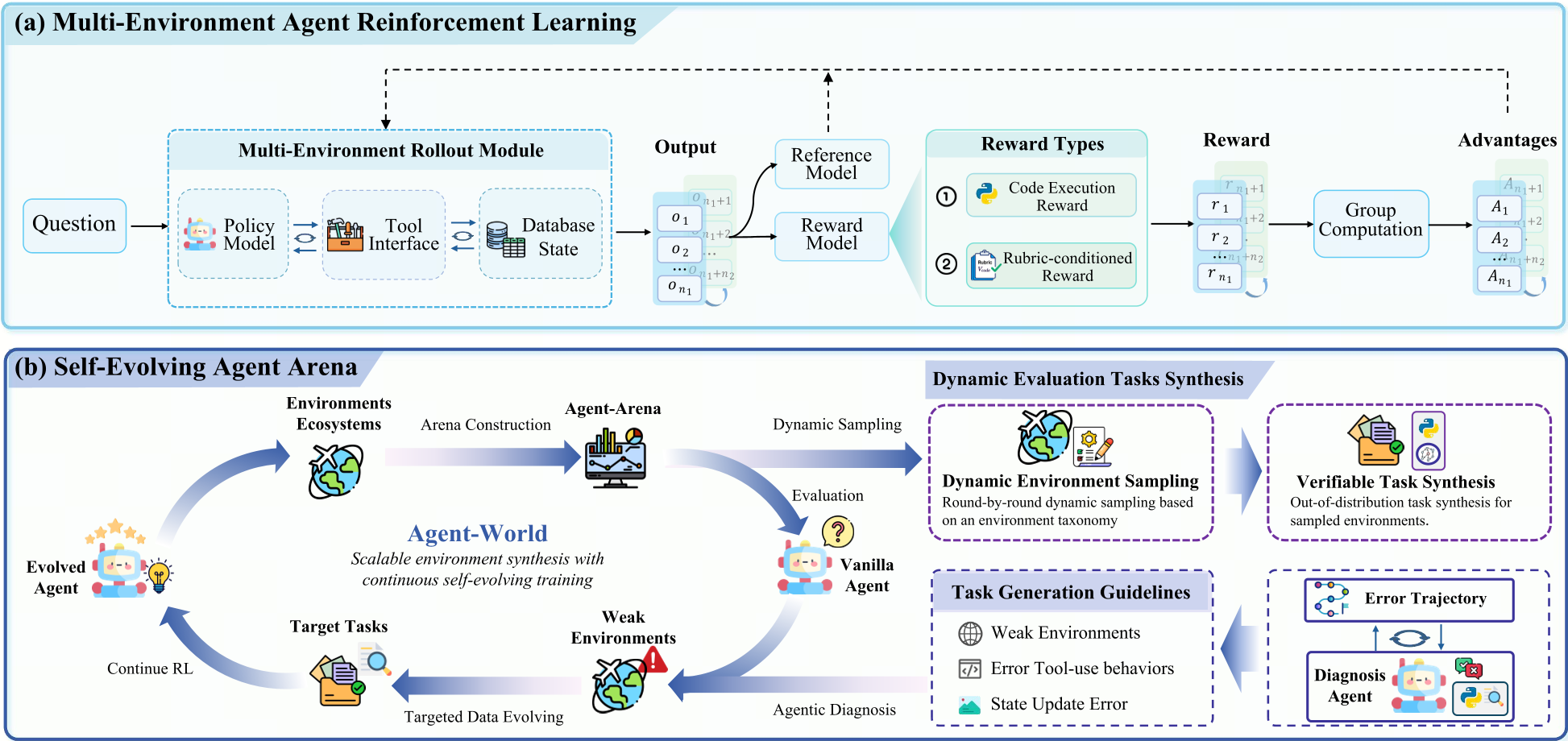 Figure 2: The Multi-Environment RL loop coupled with the diagnostic arena.
Experiments: Breaking SOTA
The researchers evaluated Agent-World across 23 benchmarks, ranging from general reasoning (MATH, GSM8K) to deep agentic tasks (SWE-Bench, MCP-Mark).
| Benchmark | Agent-World-8B | Qwen3-8B (Base) | GPT-5.2 High |
|---|---|---|---|
| MCP-Mark (Avg) | 8.9% | 2.4% | 53.1% |
| BFCL V4 (Avg) | 51.4% | 40.4% | 62.9% |
| τ2-Bench (Avg) | 61.8% | 26.2% | 80.2% |
While there is still a gap compared to flagship proprietary models in some areas, Agent-World-14B effectively closes the gap with DeepSeek-V3.2-685B and other massive open-source models, despite being significantly smaller in parameter count.
The Power of Scaling
One of the most striking findings is the "Environment Scaling Law." Performance across all sub-domains grows steadily as the number of environments increases from 0 to 2,000, suggesting we haven't yet hit the ceiling for agent intelligence via environment scaling.
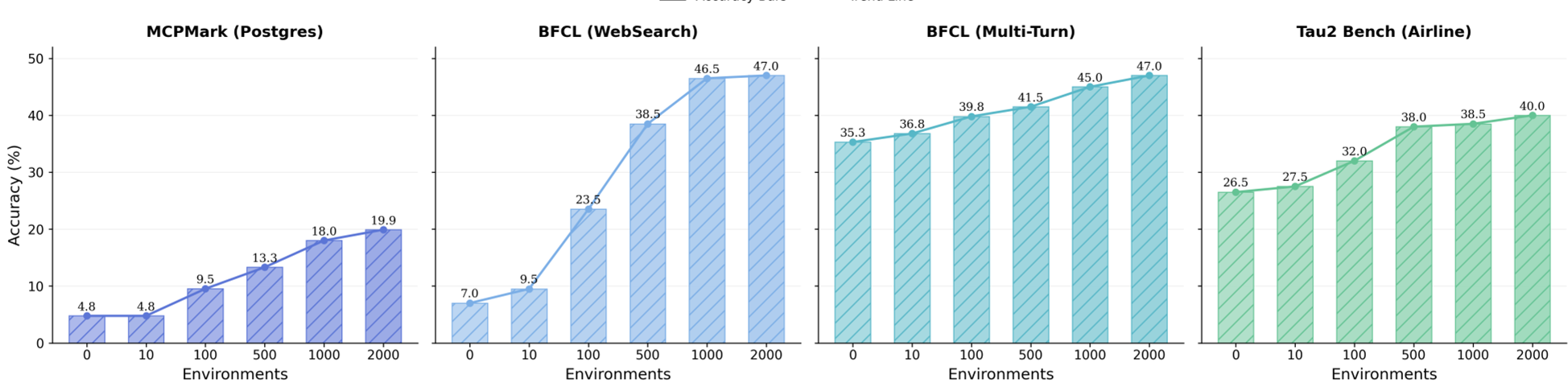 Figure 3: Downstream performance scales positively with the diversity of training environments.
Critical Insights & Future Outlook
The success of Agent-World proves that interaction data is more valuable than static text data for general-purpose assistants. The "Self-Evolving" nature of the arena mirrors how humans learn: not by reading every book at once, but by attempting a task, failing, and receiving targeted practice on their specific weak points.
Limitations: Despite the massive scale, the system still struggles with "Long-Horizon Execution" in extremely complex environments (like GitHub and Notion), where state transitions are highly non-linear. Future work will likely need to integrate multimodal feedback (seeing the screen) alongside the structured tool-calling used here.
Final Takeaway: Agent-World moves us closer to a future where AI agents aren't just chatbots trapped in a window, but capable operators navigating the complex "World Model" of the internet.