
The paper presents a position on agentic AI development, arguing that while Large Language Models (LLMs) need not be internally Bayesian, the orchestration and control layers of agentic systems must be Bayes-consistent. It proposes a framework where a Bayesian controller manages uncertainty over task-level latent variables, tool reliability, and utility-aware action selection.
TL;DR
In the rush to build "autonomous agents," we have hit a wall: LLMs are brilliant predictors but erratic decision-makers. This position paper, authored by a coalition of top AI researchers, argues that we should stop trying to make LLMs "Bayesian" internally. Instead, we should build a Bayesian Control Layer that treats LLMs as noisy sensors and uses rigorous Bayesian decision theory to orchestrate their actions.
Context: The Decision Bottleneck
As we transition from simple chatbots to Agentic AI—systems that use tools, call experts, and manage budgets—the evaluation metric shifts. It is no longer about how "plausible" a sentence sounds; it is about the utility of a decision.
Current systems struggle because:
- Syntactic vs. Semantic Uncertainty: A model might be 100% sure about the next word but 0% sure about the underlying truth of the task.
- Cost Asymmetry: Calling a specialized API costs money/time; failing a safety check costs reputation. LLMs don't inherently "understand" these trade-offs.
- Correlated Errors: Tool calls often share the same training data or retrieval pipelines, leading to "echo chamber" hallucinations.
The Core Insight: The Control Layer Strategy
The authors propose a clean separation of concerns:
- LLMs & Tools: Predictive engines (The "Sensors").
- Bayesian Controller: The Decision Maker (The "Brain").
The controller maintains a Belief State (a probability distribution) over what matters for the task—for instance, "Will this code pass the unit test?" or "Is Hypothesis A the root cause of the server failure?"
Methodology: How Bayesian Orchestration Works
The system follows a principled update loop. When an agent produces a message (), the controller updates its belief using a reliability-weighted version of Bayes' rule:
Here, is a crucial "tempering" parameter. If an agent is known to be overconfident or redundant, the controller dampens its influence.
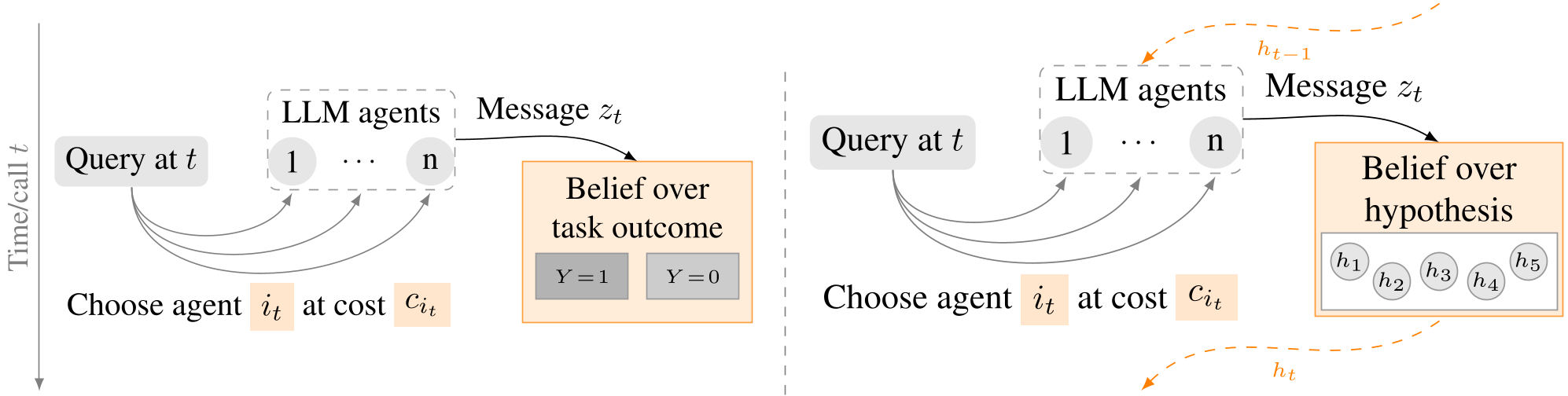 Figure 1: Comparison of Task-oriented Orchestration vs. Multi-agent Deliberation.
Two Key Design Patterns
1. Multi-Agent Code Generation
Instead of blindly trusting LLM-generated code, the Bayesian controller maintains a posterior on the outcome (Pass/Fail). It only triggers another "Retry" or a "Safety Check" if the Value of Information (VoI) exceeds the cost of the token usage.
2. Bayesian Routing
The controller tracks "competence profiles" for various tools across thousands of tasks. It uses Thompson Sampling (a classic Bayesian bandit strategy) to decide which tool is best for a specific user query, balancing the need to explore new tools with the need to exploit known reliable ones.
Why This Matters for the Industry
This isn't just academic theory; it's a blueprint for production-grade AI:
- Low Overhead: Updating a small probability distribution is infinitely faster than fine-tuning a 70B parameter model.
- Human-in-the-Loop: Human feedback is simply treated as another "high-reliability" observation in the Bayesian update.
- Multimodal Ready: Whether the evidence is text, an image, or a log file, the controller treats them all as probabilistic inputs to the same belief state.
Critical Perspective: The Road Ahead
While the position is robust, the authors acknowledge a major hurdle: Model Misspecification. If our "observation models" (how we interpret LLM messages) are wrong, the Bayesian posterior will be overconfident. The paper calls for "Reliability Modeling" and "Likelihood Tempering" as urgent research priorities to prevent agents from being "wrong with high confidence."
Conclusion
The "Agentic AI" era requires more than just scaling. It requires a principled control plane. By adopting Bayes-consistency at the orchestration level, we can build systems that don't just "predict" but "deliberate," managing uncertainty and costs with the rigor required for high-stakes deployment.