
ViLoMem: Teaching MLLMs to Learn from Both Perceptual Traps and Logical Fallacies
Agentic Learner with Grow-and-Refine Multimodal Semantic Memory
ViLoMem is a dual-stream agentic learning framework that mimics human semantic memory by separately storing and refining visual distraction patterns and logical reasoning errors. By implementing a "grow-and-refine" cycle, it enables Multimodal Large Language Models (MLLMs) to achieve SOTA performance on benchmarks like MathVision (+6.48%) and MMMU without catastrophic forgetting.
TL;DR
Standard MLLMs are "forgetful" solvers—they tackle every new image-text pair from scratch, often repeating the same perceptual and logical mistakes. ViLoMem (Visual-Logic Memory) changes this by introducing a dual-stream semantic memory. It separates "visual distraction" patterns from "logical reasoning" errors, allowing models to refine their strategies over time. The result? A massive boost in complex reasoning tasks, with up to a 6.48% improvement on the grueling MathVision benchmark.
The "De Novo" Problem: Why MLLMs Keep Failing
Despite their power, modern MLLMs suffer from a lack of multimodal semantic memory. Current memory-augmented agents (like Reflexion or ACE) typically store only text-based "thought traces."
The authors identify a critical "cascading failure" pattern:
- Visual Perceptual Error: The model looks at the wrong part of a diagram (e.g., misreading a tick mark on a log scale).
- Logical Hallucination: Based on that wrong data, the model applies a correct formula to incorrect inputs.
Logic-only memory can't fix a "where to look" problem. ViLoMem bridges this gap by mimicking the human brain's focus—specifically the anterior temporal lobe's role in integrating modality-specific "spokes" of knowledge.
Methodology: The Grow-and-Refine Architecture
ViLoMem operates on a closed-loop Memory Cycle. When the system fails a task, it triggers an "Error Attribution" phase.
1. Dual-Stream Generation
- Visual Memory: An MLLM analyzes the failed attempt to see if the error was perceptual. It then generates a "Visual Guideline" (e.g., "When object surfaces are reflective, treat them as metallic").
- Logical Memory: An LLM analyzes the reasoning chain for computational or formula-based errors, creating "Logic Guidelines."
2. Specialized Retrieval
Retrieving visual memory is harder than text. ViLoMem uses a two-stage pipeline:
- Stage 1: Multimodal image-embedding similarity to find visually similar cases.
- Stage 2: Text-based reranking using a modified "enriched query" that adds problem-subject analysis to the search.
3. Visual Attention Maps
Perhaps the most "human-like" feature is the use of Question-Aware Attention Maps. The system uses retrieved visual memories to highlight "trapped regions" in the current image—literally pointing the model's eyes to the right spot.
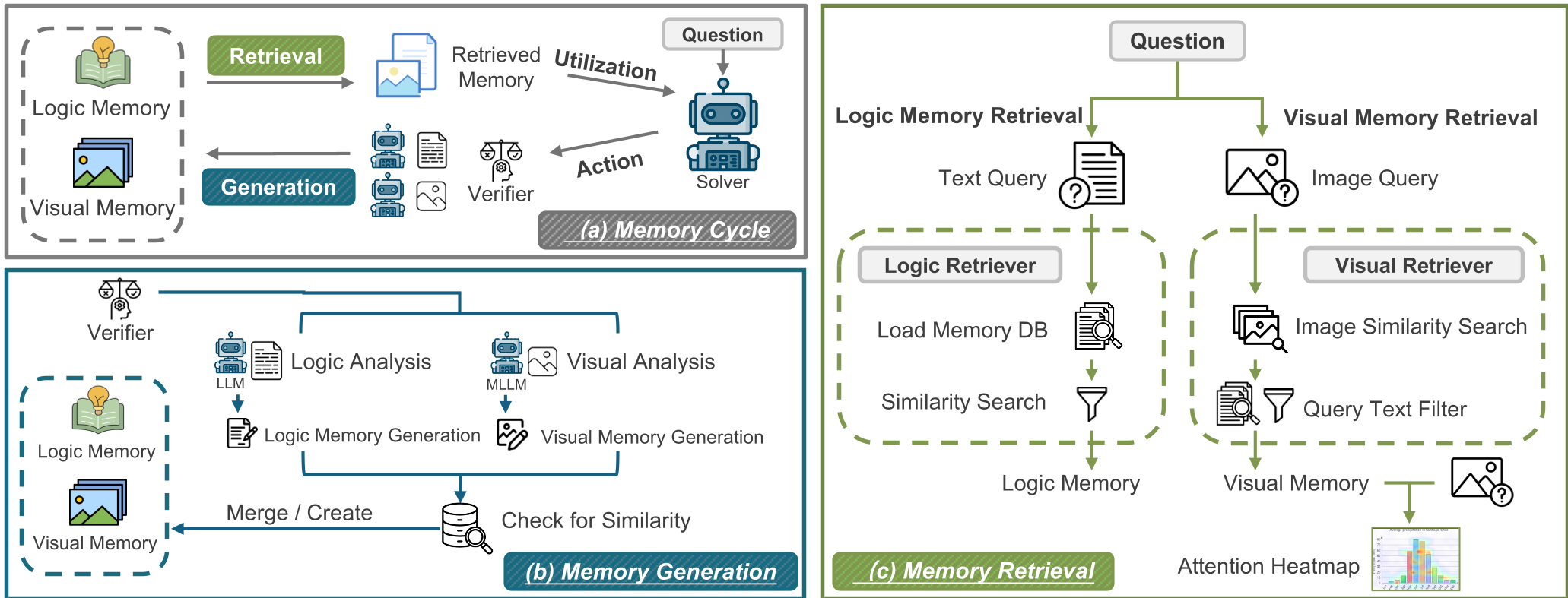 Figure 1: The ViLoMem Cycle, showing the parallel generation and specialized retrieval of visual and logical streams.
Experimental Performance: From Math to Real-World QA
The authors tested ViLoMem across six major benchmarks using models ranging from Qwen-8B to GPT-4.
- Mathematical Superiority: The framework excelled in MathVision and MathVista. In these domains, diagram misinterpretation is the #1 killer of accuracy. ViLoMem’s ability to recall "how to read this specific type of chart" was the game-changer.
- Cross-Model Transfer: In a fascinating experiment, the researchers took memory banks generated by GPT-4 and plugged them into the smaller Qwen-8B. The 8B model's performance skyrocketed, proving that dual-stream memory can act as a lightweight form of knowledge distillation.
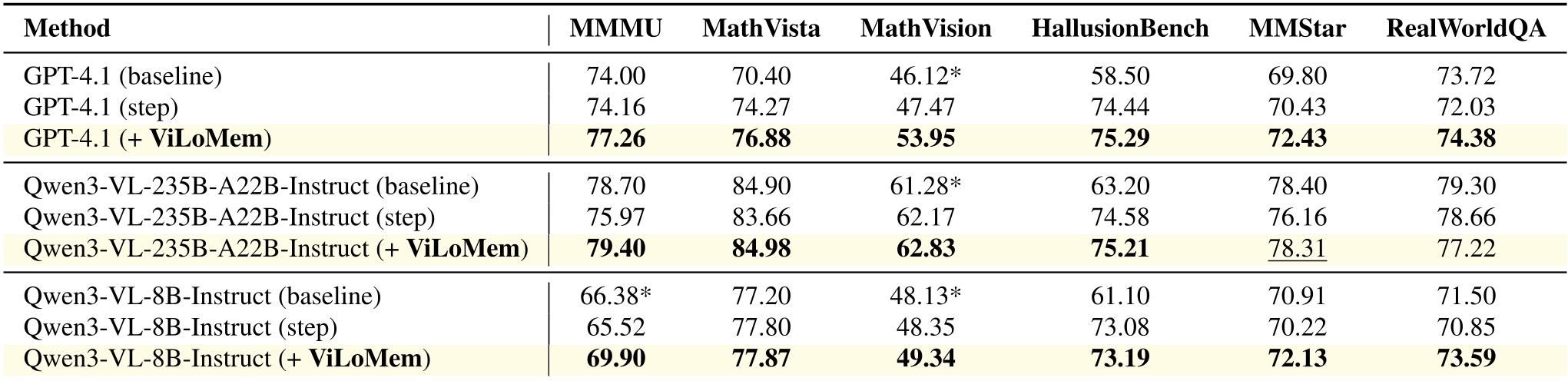 Figure 2: Performance gains across benchmarks. Note the consistent uplift when +ViLoMem is added to the baseline.
Deep Insight: Visual vs. Logical Dominance
Ablation studies revealed that different disciplines rely on different memory streams:
- Tech & Engineering: Heavily dependent on Visual Memory (+9.8 improvement) to interpret complex circuit schematics and engineering drawings.
- Health & Medicine: Reached SOTA via Logical Memory (+8.1), as the bottleneck there is often the complex diagnostic reasoning chain rather than simple perception.
Critical Analysis & Future Outlook
Limitations:
- Visual Precision: While attention maps help, they struggle with "micro-details," like individual vertices in a dense geometric proof.
- Textual Bias: If a model is too "stubborn" and relies only on its internal text weights (ignoring the image), the verifier finds it hard to generate a quality visual memory.
The Takeaway: ViLoMem proves that we cannot achieve "Agentic General Intelligence" through text-only reflection. Future AI agents must "remember" how to see just as much as they "remember" how to think. This work sets a new standard for lifelong learning in multimodal agents by treating vision as a refined, historical skill rather than a static input.
For more details, visit the ViLoMem Project Page.