
From Plausible Pixels to Autonomous Revision: The Rise of Agentic World Modeling
Agentic World Modeling: Foundations, Capabilities, Laws, and Beyond
This paper introduces "Agentic World Modeling," a unifying framework that taxonomizes environment dynamics modeling as a tiered capability hierarchy (L1 Predictor, L2 Simulator, L3 Evolver) across four governing-law regimes (Physical, Digital, Social, Scientific). It synthesizes over 400 works to bridge the gap between generative modeling, reinforcement learning, and autonomous agents, establishing testable boundary conditions for each capability level.
TL;DR
The term "World Model" has become a buzzword, but its meaning varies wildly between a video generator and a robot controller. This landmark survey by Chu et al. provides a rigorous taxonomy—the L1-L2-L3 hierarchy—to evaluate whether an AI truly understands the world or is just guessing the next frame. It moves the conversation from visual realism to Decision-Usability and Autonomous Revision.
The Problem: The Semantic Gap in "World Modeling"
We are currently in a "Generative Revolution" where models like Sora or GPT-4 can produce breathtakingly realistic outputs. However, as the authors point out, there is a fundamental difference between prediction and simulated understanding.
Current systems suffer from a phenomenon the authors call "Epistemic Drift." A simulator might be great at predicting the shadows on a wall (visual frames) without ever understanding the 3D fire (physical laws) casting them. When an agent tries to use these "plausible" but "law-breaking" simulations to plan a real-world task, it fails.
The Framework: Levels × Laws
The core contribution of this work is a two-axis coordinate system for World Models.
1. The Capability Ladder (L1 → L2 → L3)
- L1: Predictor (Hume’s Pattern Matcher): Focuses on local, one-step transitions. Given and , what is ? It captures statistical co-occurrences but lacks long-term coherence.
- L2: Simulator (Lewis’s Possible Worlds): This is where "imagination" happens. It supports multi-step, action-conditioned rollouts. A true L2 model must satisfy three boundary conditions:
- Long-horizon Coherence: The rollout doesn't turn into "soup" after 5 steps.
- Intervention Sensitivity: If you change an action, the future changes proportionally.
- Constraint Consistency: It respects gravity, API rules, or social norms.
- L3: Evolver (Lakatos’s Paradigm Shifter): The most advanced level. Here, the system realizes its model is wrong and autonomously revises it. It uses a "Design–Execute–Observe–Reflect" loop to update its own "hard core" logic.
2. The Four Governing-Law Regimes
The "rules of the game" change depending on where the agent operates:
- Physical: Geometry, kinematics, and contact.
- Digital: API contracts and determinism.
- Social: Beliefs, intentions, and "Theory of Mind."
- Scientific: Hidden causal mechanisms (e.g., protein folding).
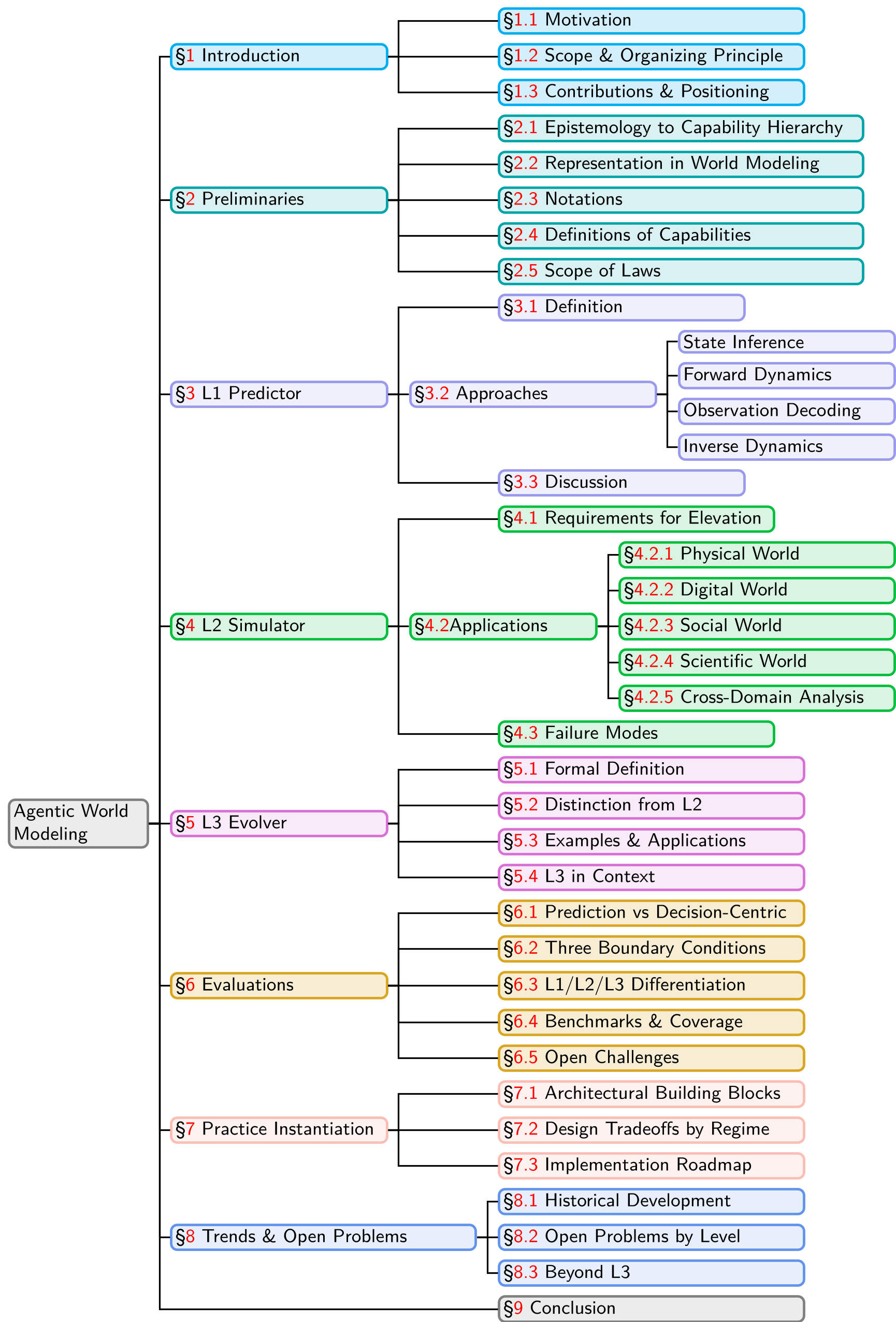 Figure 1: The organizational structure of the survey, mapping capability levels against governing regimes.
Methodology: What Makes a Model "Decision-Usable"?
The authors argue that we should stop evaluating world models using visual metrics like FID or FVD. Instead, we need Decision-Centric Evaluation:
- Action Success Rate (ASR): Does planning in the model actually lead to success in the real world?
- Counterfactual Outcome Deviation (COD): Does the model respond meaningfully to "what if?" queries?
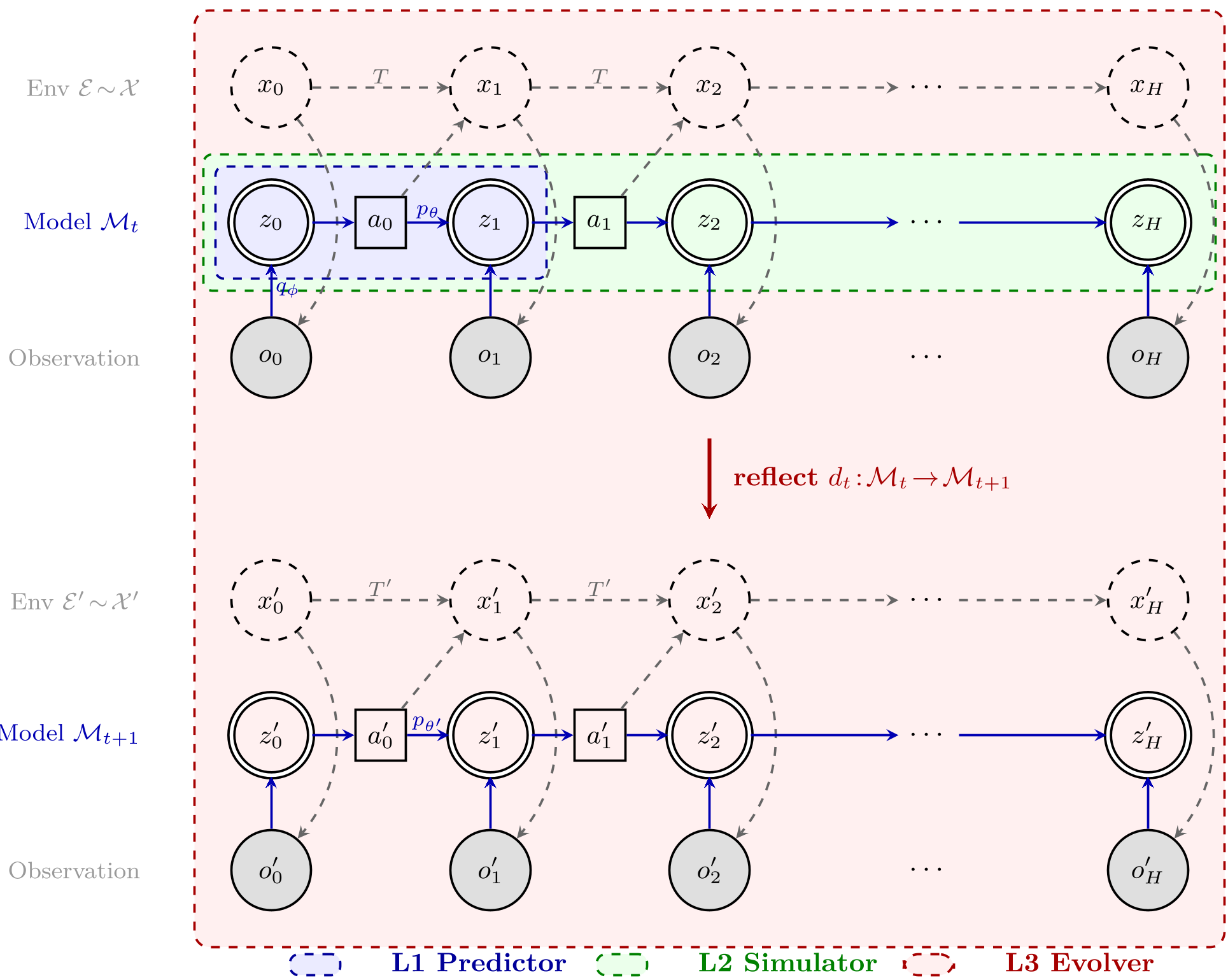 Figure 2: A unified POMDP graphical model. L1 acts on local edges; L2 operates on the trajectory; L3 reflects and revises the entire model stack ().
Deep Insight: L3 is the New Frontier
While we have many L2 simulators (like MuZero or physics engines), true L3 Evolvers are rare outside of "AI for Science." In autonomous labs, systems like A-Lab or CAMEO already design experiments, observe failures, and update their internal chemistry models.
The survey challenges us to bring this L3 capability to the Digital and Social worlds. For example, a web agent shouldn't just keep retrying a failed button click; it should realize its "DOM world model" is outdated and autonomously revise its understanding of the website's structure.
Future Outlook & Challenges
The paper concludes by identifying a major bottleneck: Symbolic vs. Latent representations. Latent vectors (standard in Deep Learning) are great for L1/L2, but they are incredibly hard to "revise" in an L3 loop. The authors suggest a Neuro-Symbolic future where neural networks learn the dynamics, but the "laws" are stored in a symbolic, modifiable format.
Key Takeaway
We are moving away from "next-token prediction" toward "environment-reshaping agents." The next generation of world models won't just predict the future; they will learn the laws of the universe by trying to break them and improving themselves through the shards of their failures.
For a full list of the 400+ papers synthesized, see the official repository.