
Reasoning about Sentiment: How Agents Process Knowledge in Digital Echo Chambers
Agents for Social Media
This paper introduces Network Knowledge Bases (NKBs), a framework for modeling sentiment and knowledge diffusion across integrated social networks using a Multi-Agent Systems (MAS) approach. The authors leverage belief revision operators to handle information flow and report preliminary experiments on Twitter data to categorize agent-specific reactions to social stimuli.
Executive Summary
TL;DR: This research bridges the gap between graph theory and symbolic logic by introducing Network Knowledge Bases (NKBs). It treats social media users as autonomous agents with unique "belief bases," using belief revision theory to explain why different people react to the same tweet in radically different ways.
Background: Positioned at the intersection of Multi-Agent Systems (MAS) and Social Network Analysis, this work moves beyond simple "influence" models to a more nuanced epistemic model of social interaction. It provides a formal framework to study how individual internal logic interacts with global network structures.
Problem & Motivation: Beyond Simple Nodes and Edges
Most social network models view users as simple nodes that either "infect" or "are infected" by an idea (similar to epidemiological SIR models). However, human behavior is dictated by internal logic, prior beliefs, and the level of trust in the source.
The authors identify a critical gap: Prior work lacks individual knowledge bases. If Alice already believes Candidate A is good, she won't simply "capture" a negative sentiment from George; she will process it, likely reject it, or perhaps even unfriend him—a process traditional graph models cannot formally represent.
Methodology: The NKB Framework
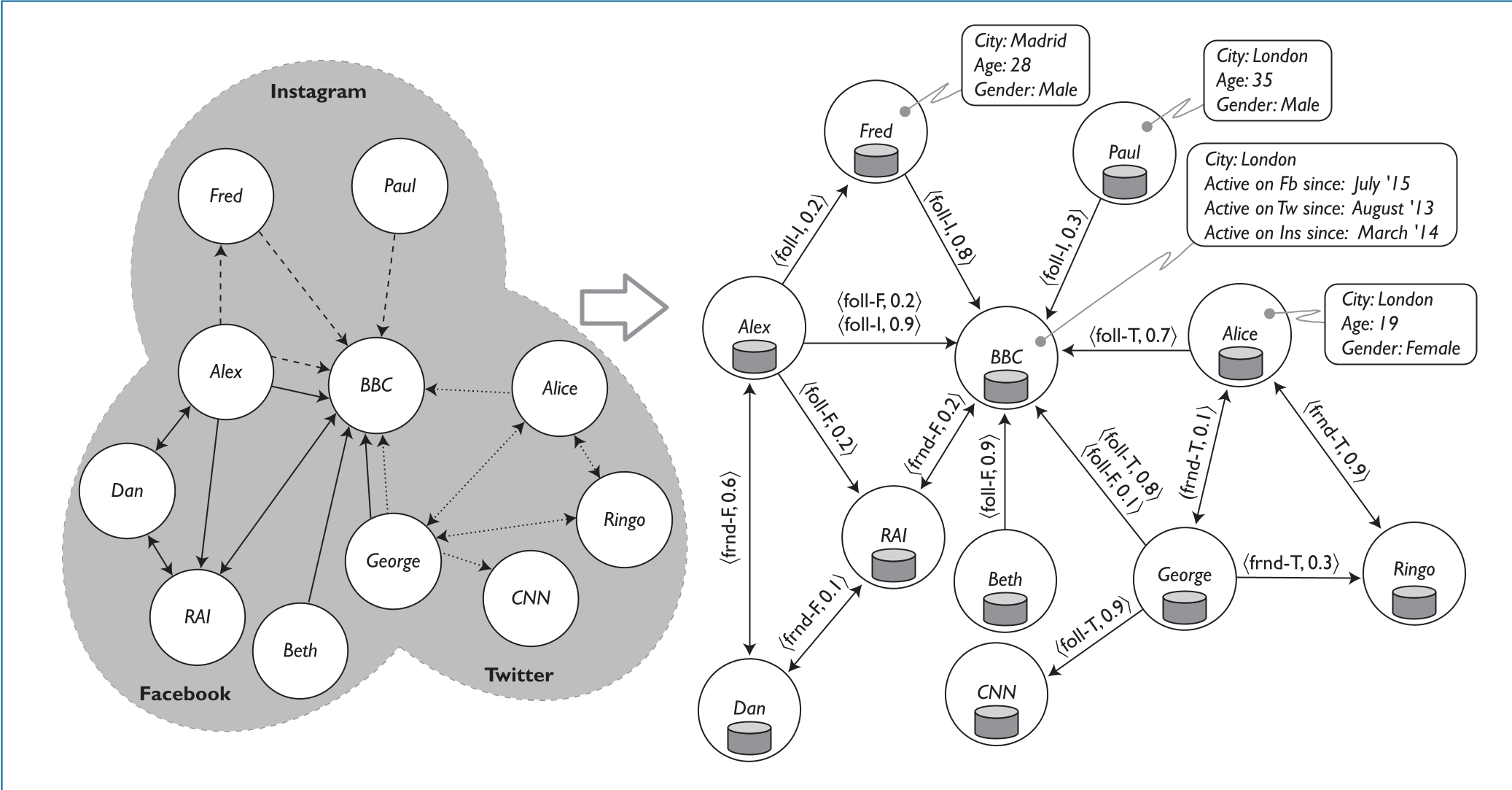
The core innovation is the Network Knowledge Base (NKB). An NKB is a directed graph where:
- Vertices (): Represent agents, each possessing a Local Knowledge Base (propositional logic).
- Edges (): Represent relationships with specific weights (strength of influence).
- Labels: Store metadata (age, gender, platform source).
- Integrity Constraints: Global rules (e.g., "Two close friends should not have conflicting beliefs on core topics").
The Revision Loop
The system operates in a dual-phase cycle:
- Local Revision: Agents receive "News Items" . They apply social revision operators to integrate or reject this info based on personal traits.
- Global Revision: An administrator-level operator reconciles the network to ensure no integrity constraints are violated (e.g., triggering a "disconnect" if a disagreement is too sharp).
Social Revision Postulates
The authors redefine classical logic "postulates" (like Success or Consistency) for a social setting. Two standout additions are:
- Majority: You change your mind if the number of people saying "X" outweighs those saying "not X."
- Weighted Majority: You only change your mind if the people you trust most say "X."
Experiments: Identifying "Personality" in Data
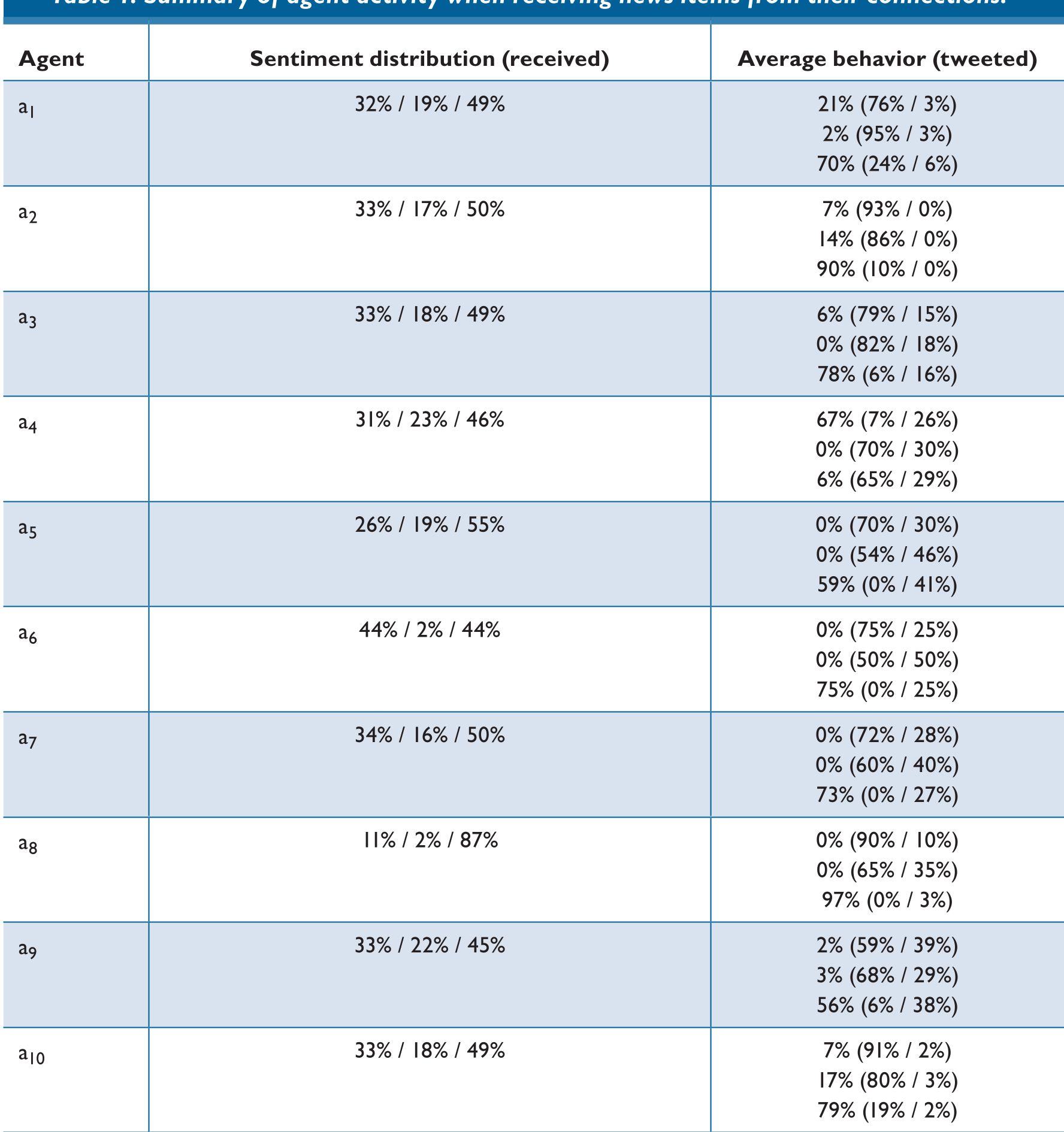
Using a massive Twitter dataset (18M+ tweets), the authors analyzed how the top 50 hashtags propagated. By comparing the sentiment received in a user's feed versus the sentiment produced in their own tweets, they identified distinct agent archetypes:
| Agent Type | Characteristic |
|---|---|
| Credulous | Adopts all new knowledge immediately. |
| Herd Behavior | Follows the crowd once a threshold is reached. |
| Self-Confident | Prioritizes existing beliefs over new evidence. |
| Adversarial | Frequently responds to input with the opposite sentiment. |
Key Result: The Behavioral Matrix
The table below highlights how "Agent a8" acts as a self-confident or adversarial node—rarely adopting the sentiment it receives, instead projecting its own consistent (or contrary) view.
Critical Insight & Conclusion
The significance of this work lies in its structural preservation versus local effect balance. It acknowledges that social media isn't just a place where information is shared, but a theater of epistemic conflict.
Limitations: The current model assumes synchronicity (everyone revises at once) and uses hashtags as a proxy for knowledge, which may oversimplify complex political discourse.
Future Outlook: By formalizing these operators, we could build "digital twin" simulations of networks to predict how "fake news" might cascade relative to different network topologies and agent distributions. The transition from "what happened" to "how the logic changed" is the next frontier for social AI.