
Reasoning in the Social Wild: How Network Knowledge Bases Track Sentiment Cascades
Agents for Social Media
The paper introduces Network Knowledge Bases (NKBs), a formal framework for modeling sentiment and knowledge diffusion across integrated social networks. Using a multi-agent system (MAS) approach and belief revision operators, the authors categorize and predict how different agent types (e.g., self-confident, credulous) process and propagate information.
TL;DR
Social media is more than just a graph of "follows"; it is a massive, distributed reasoning engine. This paper introduces Network Knowledge Bases (NKBs), a framework that treats every user as an autonomous agent with its own internal logic. By applying belief revision operators—mathematical rules for how we change our minds—the authors identify distinct "personality types" in Twitter data, providing a roadmap for predicting how information and sentiment actually flow through society.
Background: Beyond Simple Graphs
Most social network analysis treats users as simple nodes that either "catch" a virus-like piece of information or don't. This ignores the human element: Why do some people ignore facts while others flip their opinions instantly? The authors argue that we need to view social media through the lens of Multi-Agent Systems (MAS), where each user has a local Knowledge Base (KB) and a set of internal rules for processing "News Items."
The Core Innovation: Network Knowledge Bases (NKBs)
The NKB is a directed graph where:
- Vertices (Agents) are labeled with attributes (age, gender, political views).
- Edges (Relations) have weights representing trust or closeness.
- Local KBs store the agent's current beliefs in propositional logic.
- Global Constraints ensure the whole system makes sense (e.g., "Two close friends shouldn't radically disagree on a core topic").
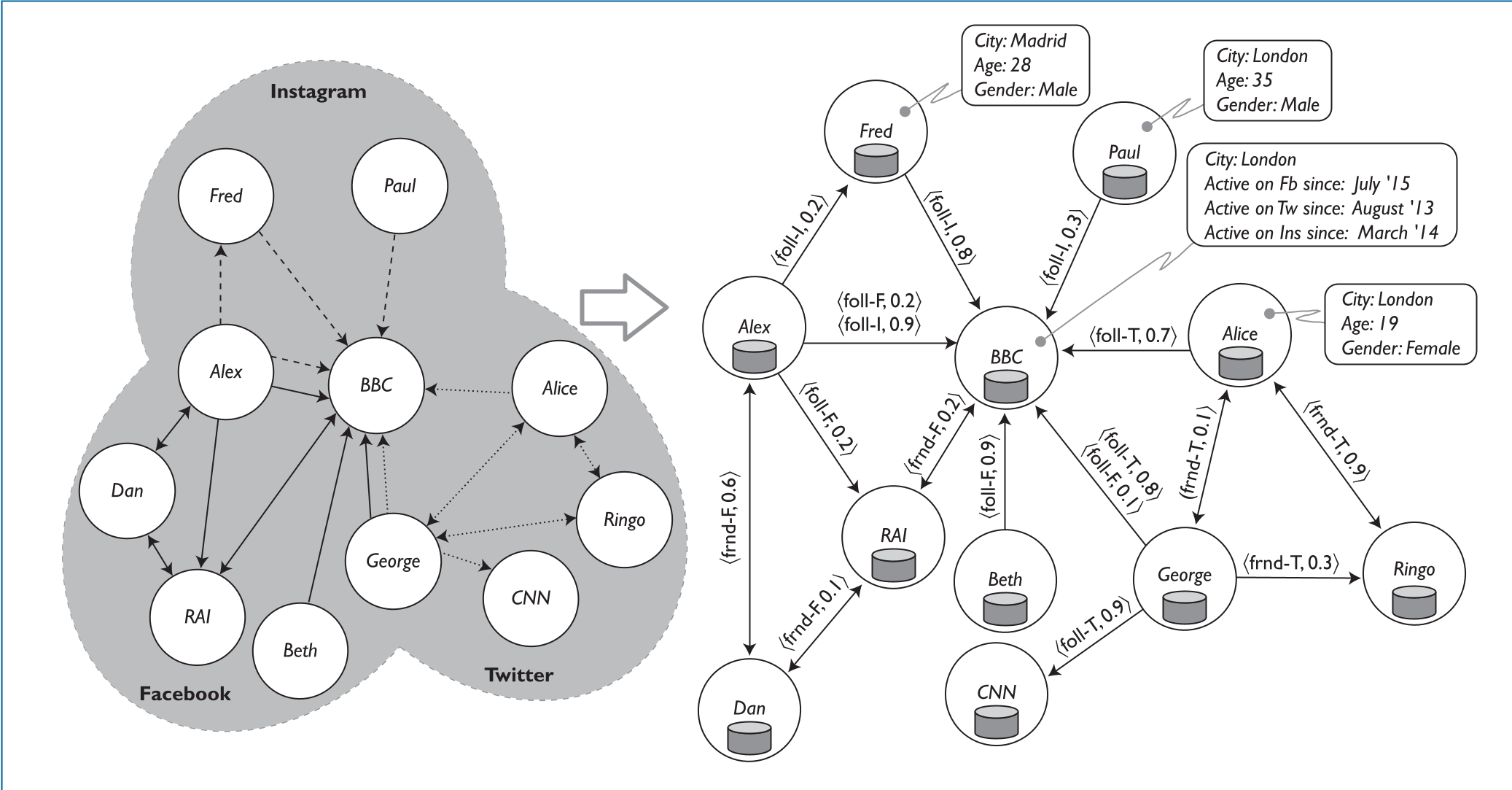
The figure above illustrates how data from Instagram, Twitter, and Facebook are integrated into a single NKB, where individual nodes (like George or Paul) maintain their own epistemic states.
Methodology: The Logic of Changing Minds
How does an agent react when they see a tweet that contradicts their beliefs? The authors define Social Revision Operators and 14 desirable properties ("postulates"). Key ones include:
- Majority / Weighted Majority: Does the agent follow the crowd or just the people they trust?
- Success: Does the agent always accept new information (Credulous)?
- Inclusion: Does the agent avoid adding "random" info not present in the input?
The Agent Personality Spectrum
Based on these logical constraints, the paper identifies several agent "species":
- Credulous: "I believe everything I see."
- Incredulous: "I don't care what you say; I'm not changing."
- Herd Behavior: "I'll believe it if everyone else does."
- Self-Confident: "My previous beliefs are more valuable than new data."
Experimental Results: Twitter in the Real World
The authors tested their framework on a massive dataset of 18 million tweets from Indian election cycles. By performing sentiment analysis on hashtags, they tracked how users' sentiments changed (or didn't) after seeing posts from their connections.
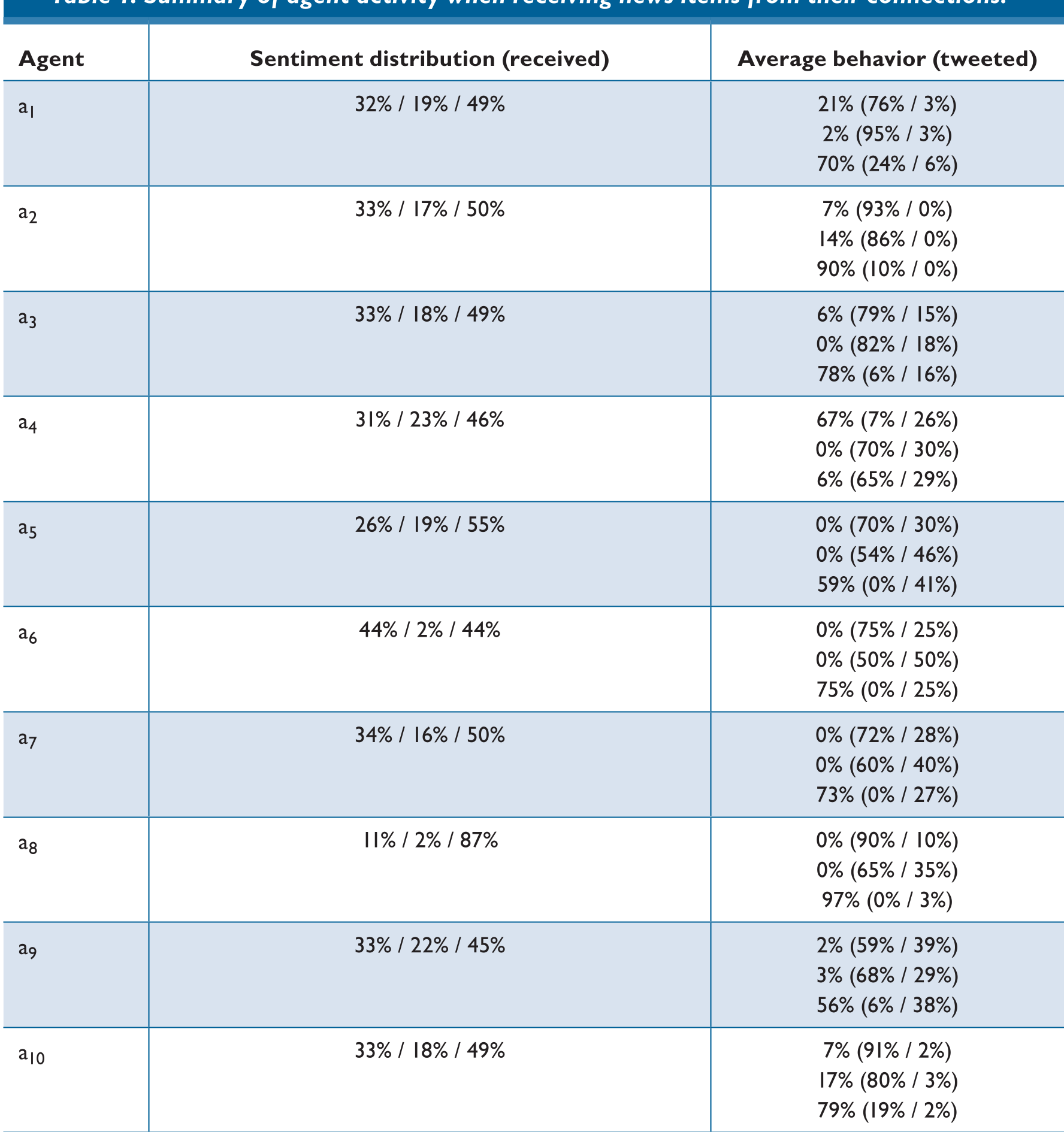
Table 1 (above) shows the "fingerprints" of different users. For example, Agent a8 is a classic 'Self-Confident' type, changing the sentiment of received hashtags over 90% of the time to match their own internal bias.
Key Findings:
- Adversarial vs. Conciliatory: Highly active users (influencers) are often "adversarial," meaning they actively flip the sentiment of the news they receive.
- Dead-Ends: Many users consume information but never propagate it, acting as "sinks" for sentiment diffusion.
Critical Insight & Future Outlook
This work moves us from descriptive social media analysis (what happened?) toward predictive analysis (how will this group react?). By identifying a user's "Revision Operator" type, we can simulate how a piece of news—or a "fake news" story—will be transformed as it moves through a specific network cluster.
The limitation of this current iteration is its reliance on propositional logic, which can't easily capture the nuance of natural language. However, the integration of these Postulates with modern LLMs could lead to highly sophisticated "Digital Twins" of social networks, enabling researchers to stress-test the impact of political campaigns or public health messaging before they go live.
Conclusion
The NKB framework provides the mathematical "scaffolding" needed to model the messy, illogical, and highly personal ways people process information online. It proves that in social networks, the structure of the connection is only half the story—the logic of the agent is what determines the cascade.