
Diversity as a Stabilizer: Aggregated Modeling of Distributed Solar Populations
Aggregated Markov Models of a Heterogeneous Population of Photovoltaic Panels
The paper introduces a Markov chain modelling framework for the aggregated quantitative analysis of a heterogeneous population of photovoltaic (PV) panels connected to a power grid. It proposes two discrete-time Markov models—a detailed -state model and a compact 3-state abstract model—to capture the collective impact of PV power injection on grid frequency stability.
TL;DR
As solar power shifts from niche household setups to a pillar of national energy grids, the "swarm behavior" of millions of PV panels becomes a critical stability factor. This paper proposes a Markovian framework to model these populations as a single dynamical entity. The surprising insight? The more different panels are from one another, the safer the grid is.
Motivation: The Nightmare of Synchronized Disconnection
In March 2015, a solar eclipse in Europe threatened a sudden 30 GW drop in power—ten times the capacity of a standard blackout contingency. Why? Because PV panels are programmed to "trip" (disconnect) if grid frequency deviates from a narrow window (typically around 50 Hz).
If every panel in Germany or France has the exact same 49.5 Hz cutoff, a minor disturbance could cause a synchronized mass-exit of power, leading to a total grid collapse. To study this, we need models that capture heterogeneity—the reality that every manufacturer and inverter generation reacts slightly differently.
Methodology: From Millions to Three States
The authors move away from simulating individual agents (which is computationally expensive) by defining an aggregated probability of being "ON."
1. The Physical Intuition
A single PV panel is simple:
- ON to OFF: Instantaneous if frequency exits the safety interval .
- OFF to ON: Requires frequency to stay in for a specific delay (typically ~20 seconds) to avoid "chattering."
2. The Markov Chain Abstraction
The paper proposes two key models. The first uses states to represent the internal "waiting" counter of the panels. The second, even more elegantly, collapses these into a 3-state model:
- ON: Injecting power.
- OFF: Not injecting, frequency out of bounds.
- WAITING: Frequency is safe, but the internal "safety timer" is still counting down.
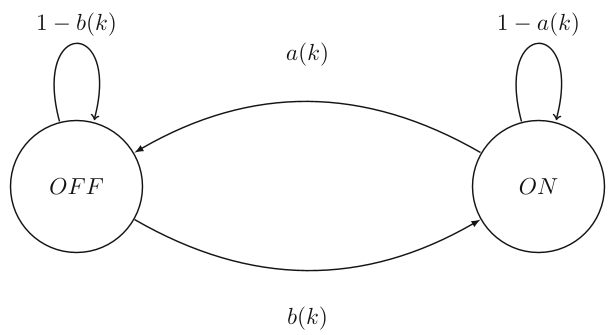 Fig 1: The simplified 2-state Markov transition without delays.
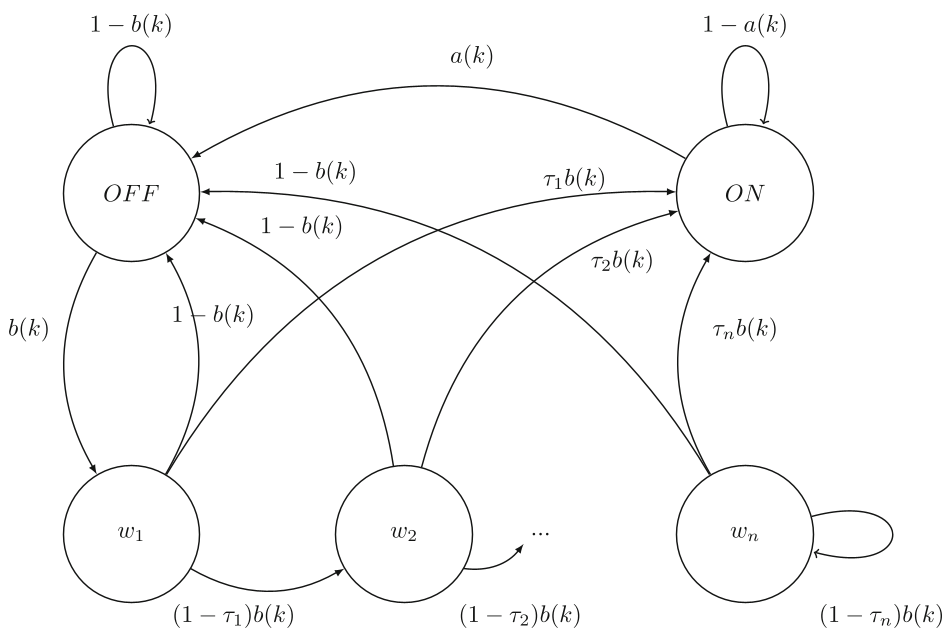 Fig 2: The -state model capturing the heterogeneous internal counters of the population.
The transition probabilities and are not fixed; they are integrals of the population's threshold distributions. This allows the model to "sense" how many panels will drop out at a specific frequency.
Experimental Results: Precision and Stability
The researchers compared their abstract models against an "explicit model" (simulating 1 million individual panels).
Accuracy
The 3-state model performed exceptionally well, acting as a low-pass filter of the million-panel complex system. The error in predicting the portion of active panels remained under 2%, proving that high-dimensional complexity can be condensed into simple state-space equations.
The "Heterogeneity Benefit"
The most striking finding comes from the Second Scenario. By varying the standard deviation () of the frequency thresholds, the authors showed that a "diverse" population (high variance) absorbs shocks much better than a "uniform" one.
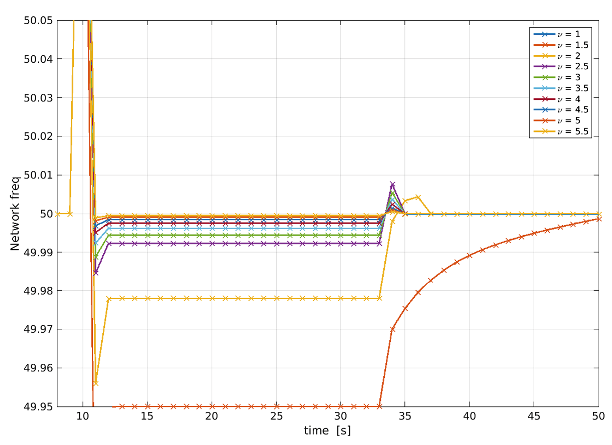 Fig 3: Network frequency response comparison. The Markov models (green/red) closely track the explicit ground truth (blue).
When the variance is high, only a small fraction of panels disconnect at any single frequency "dip," allowing the grid's primary control to compensate. When variance is low, the panels disconnect in a massive wave, causing severe frequency oscillations.
Critical Insights & Future Work
Takeaway: This work provides a rigorous mathematical proof for a counter-intuitive policy: Standardization can be dangerous. If grid regulators mandate perfectly uniform response settings for all household inverters, they inadvertently create a fragile system.
Limitations:
- The current model assumes constant power output. In reality, clouds and weather introduce stochastic noise to .
- The model assumes frequency thresholds and time delays are independent, though they might be correlated in specific inverter brands.
Future Outlook: The next step is integrating these models into Global Control Schemes. Instead of panels being passive agents, can we use this Markovian framework to "nudge" the population into providing synthetic inertia to the grid?