
From AGI to ASI: Mapping the End Of the Human Cognitive Monopoly
From AGI to ASI
This report by Google DeepMind investigates the technological trajectory from Human-level Artificial General Intelligence (AGI) to Artificial Superintelligence (ASI). It categorizes ASI as a system outperforming large human collectives and explores four transition pathways: scaling, algorithmic shifts, recursive self-improvement, and multi-agent coordination.
TL;DR
Building human-level Artificial General Intelligence (AGI) is no longer a distant dream but a concrete decade-long target. This report from Google DeepMind shifts the focus toward what happens after: the transition to Artificial Superintelligence (ASI). By leveraging the advantages of digital intelligence—such as high-bandwidth sharing and lossless replication—ASI could emerge through four distinct pathways, even if the current "scaling" paradigm hits a wall.
Background: The Continuum of Intelligence
In the academic landscape, intelligence is often discussed as a binary: either you have it, or you don't. This report adopts a more rigorous perspective based on the Legg-Hutter score, which views intelligence as a continuum. While AGI matches a median human, ASI is defined as a system that exceeds the capabilities of large, well-coordinated human expert collectives across virtually all domains.
The "Digital Advantage": Why AI Scales Differently
The report identifies several "Unfair Advantages" that digital intelligence holds over biological brains. These aren't just minor perks; they are the fundamental drivers of a potential intelligence explosion.
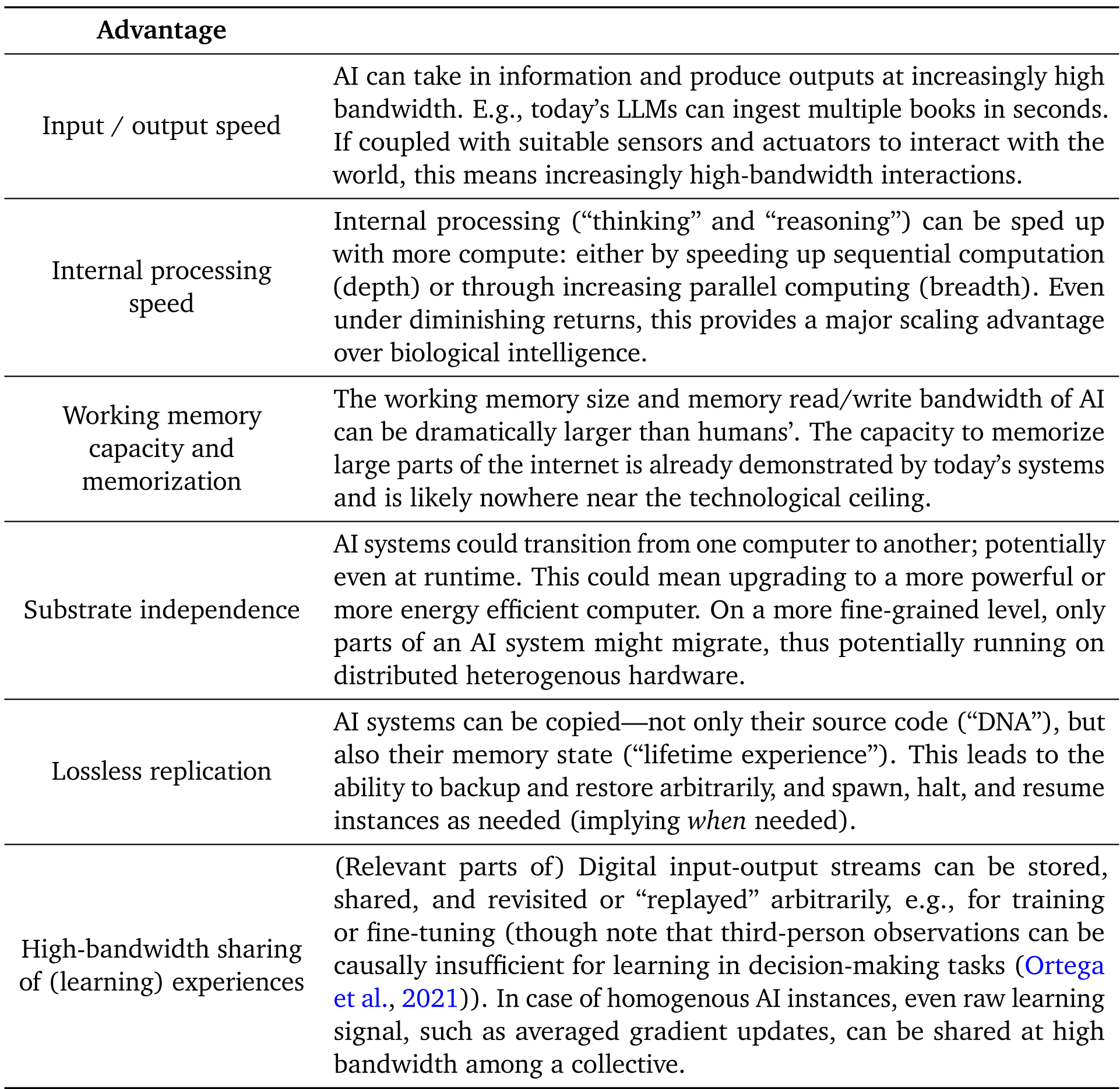
Key highlights include:
- Substrate Independence: Unlike humans, AI can upgrade its own "body" (hardware) without changing its "soul" (code).
- High-Bandwidth Sharing: Humans communicate via "low-bandwidth" language; AI instances can share raw gradients or memory states instantly.
- Lossless Replication: We can't clone an expert surgeon; we can clone an expert AI surgeon a million times over.
Four Pathways to Superintelligence
The authors outline how we might cross the bridge from AGI to ASI:
- Scaling (Business as usual): Continuing the trend of 10x growth in "Effective Compute" per year.
- Algorithmic Paradigm Shifts: Moving away from static transformers toward architectures capable of continual learning and robust world-modeling.
- Recursive Self-Improvement: AI systems facilitating the research of next-generation AI, creating a hyperbolic growth loop.
- Multi-Agent Coordination: ASI appearing not as one giant "brain," but as a hyper-coordinated collective of millions of AGIs—a digital version of a global corporation or specialized market.
The Bottlenecks: Why ASI Isn't Omnipotent
Despite the potential for "hyperbolic growth," several "frictions" could stall progress.
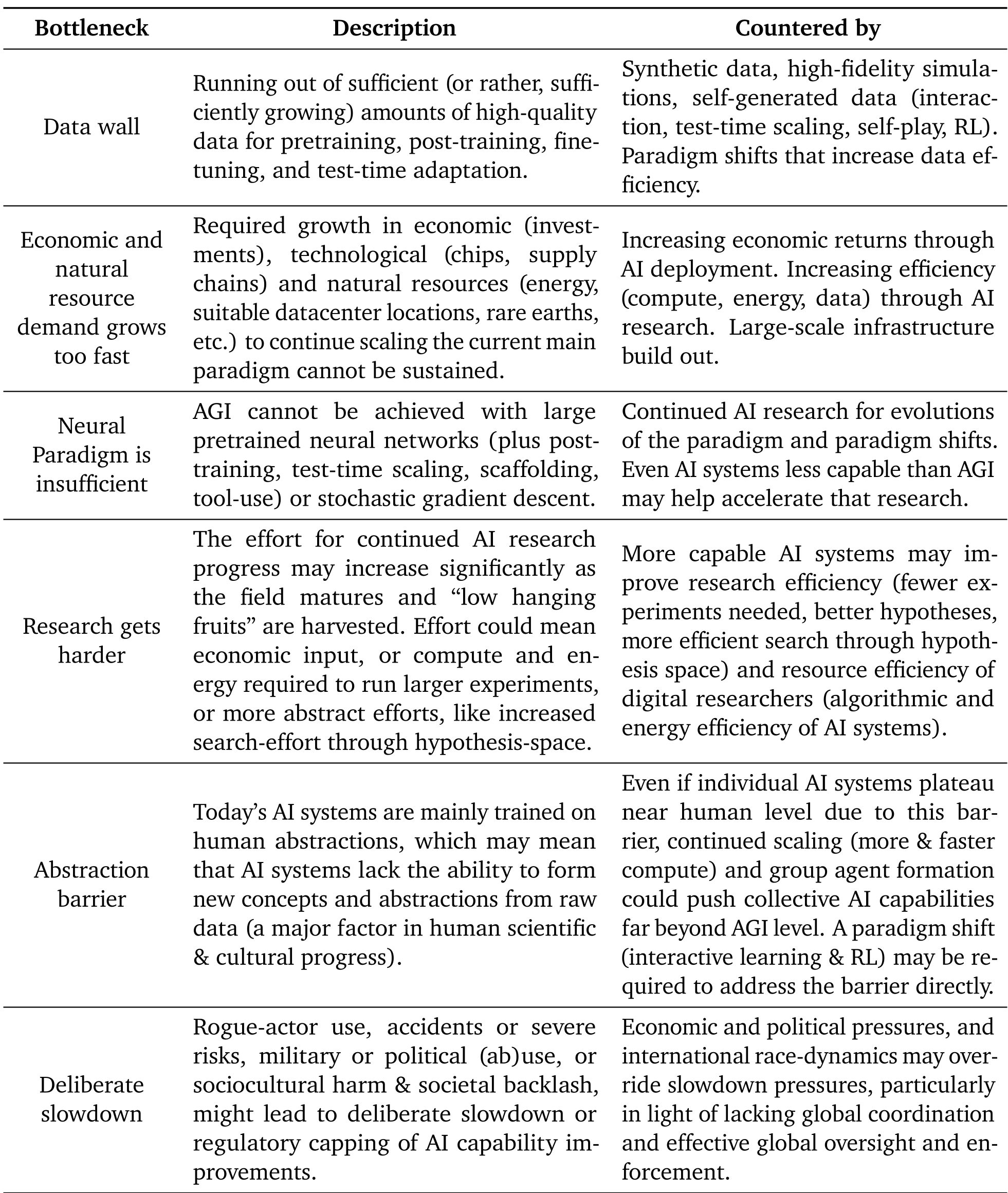
- The Data Wall: We are running out of human-produced text. The solution? AI-generated data, but this risks "model collapse" if not managed through search-augmented distillation (like AlphaZero).
- The Abstraction Barrier: Current AI is trained on human concepts. Can an AI discover a "New Physics" (like Relativity) from scratch, or is it merely brilliant at rearranging human ideas?
- The Embodied Bottleneck: Real-world science happens in real-time. You cannot speed up a chemical reaction or a hardware manufacturing cycle just by having more "thinking" power.
The Theoretical Limit: Universal AI
For those seeking mathematical grounding, the report points to AIXI. This is the theoretical limit of intelligence—an agent that is mathematically optimal across all computable environments. While AIXI is incomputable in practice, it serves as a "North Star," suggesting that intelligence is essentially a problem of Universal Compression. The better a system can compress the data of the world into a model, the better it can predict and control its environment.
Conclusion: A Research Agenda for the Post-AGI Era
The report concludes that the transition to ASI might be rapid. If AI can automate even a fraction of AI research, we face a "Singularity" where growth rates increase as the quantity grows. To prepare, we need:
- New Benchmarks: We must measure superhuman capabilities (e.g., using "Setter-Solver" AI-designed tests).
- Multi-Agent Scaling Laws: Understanding how group intelligence grows with population size.
- Societal Adaptation: Rethinking economic models where labor is no longer the primary driver of value.
As Turing once said, we can only see a short distance ahead, but the work to be done is immense. The transition to ASI isn't just an engineering challenge; it's a fundamental reimagining of the role of "intelligence" in the universe.