
From AGI to ASI: Mapping the Landscape of Superintelligence
From AGI to ASI
This report by Google DeepMind researchers explores the transition from human-level Artificial General Intelligence (AGI) to Artificial Superintelligence (ASI). It categorizes ASI as a system outperforming large human-expert collectives and evaluates four technological pathways—scaling, algorithmic shifts, recursive self-improvement, and multi-agent coordination—while framing universal intelligence through the formal AIXI framework.
TL;DR
Building human-level Artificial General Intelligence (AGI) has shifted from a far-fetched dream to a concrete decade-long target. This landmark report from Google DeepMind moves the goalposts further, investigating the transition from AGI to Artificial Superintelligence (ASI). It posits that even if individual model progress stalls, the world is likely to see a "step change" driven by effective compute growth, recursive self-improvement, and multi-agent collectives.
The Intelligence Continuum: Why AGI is Not the Finish Line
In the academic community, "intelligence" is often a fuzzy term. The authors ground this discussion in the Legg-Hutter score, which defines intelligence as the average performance across all computable tasks.
From this perspective, AGI is merely a pitstop—a point where a machine matches a median human. ASI is the next phase: a system capable of outperforming entire organizations of human experts. The ultimate theoretical limit is Universal AI (AIXI), an incomputable but mathematically optimal agent that serves as the "North Star" for the entire field.
The Four Pathways to ASI
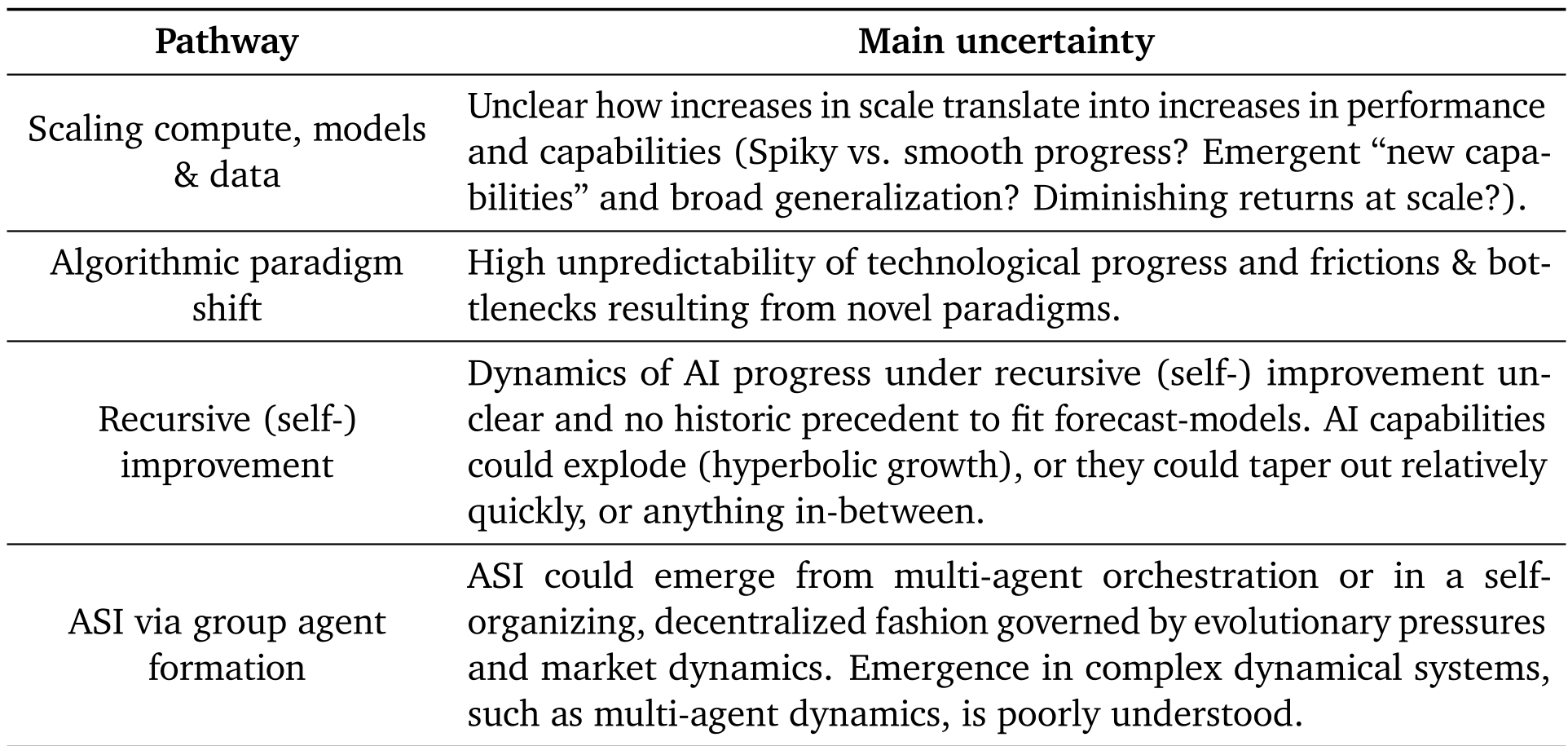
The report identifies four distinct, potentially parallel routes to superintelligence:
- Scaling Compute, Models, and Data: The "Business as Usual" path. If "Effective Compute" (a mix of better chips and better code) continues to grow 10x annually, we reach a factor of 10,000x improvements within this decade.
- Algorithmic Paradigm Shifts: Moving beyond current Transformer architectures to "linear-time" sequences (like Mamba) or systems with unbounded reasoning horizons through retrieval-augmented memory.
- Recursive Self-Improvement: The most "explosive" path. AI systems assist in designing better AI chips and writing better research code, creating a positive feedback loop that could lead to a Singularity.
- Multi-Agent Coordination: Superintelligence might not be one giant brain, but a "Borg-like" collective of millions of AGI instances specialized in different domains, sharing knowledge at high-bandwidth digital speeds.
Frictions: What Could Stop the Explosion?
The transition isn't guaranteed. The authors highlight several "bottlenecks" that could act as a brake on progress:
- The Data Wall: We are running out of high-quality human text. The solution? Synthetic data and self-play. Just as AlphaZero improved by playing itself, future ASIs may improve by simulating millions of "thinking" hours in virtual worlds.
- The Abstraction Barrier: Current AI is trained on human concepts. Can a machine discover a new law of physics (like General Relativity) if it only re-combines existing human knowledge? This "Concept Discovery" remains the ultimate test for "true" ASI.
- The Embodied Bottleneck: Real-world scientific progress requires physical experiments. You can't simulate a new chemical reaction with 100% accuracy without running it in a lab. Digital "thinking" is fast; physical "doing" is slow.
Critical Insight: The "Digital Intelligence" Advantage
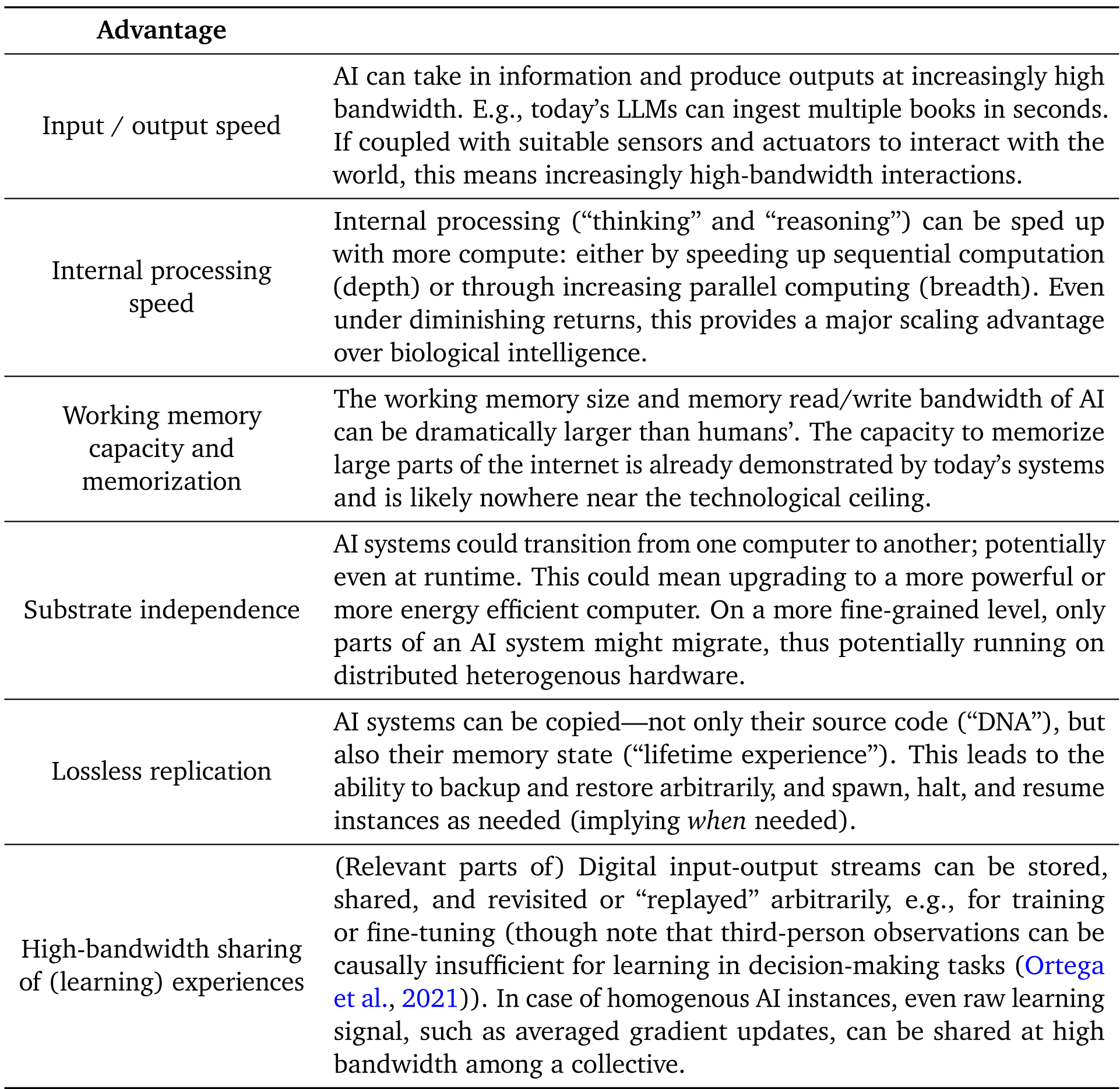
Why should we expect machines to surpass us? The authors point to six fundamental advantages that biological brains can't match:
- Substrate Independence: An AI can be "upgraded" to a new GPU; you can't upgrade your neurons.
- Lossless Replication: We can copy a trained "Doctor AI" in seconds. Training a human doctor takes 20 years.
- High-Bandwidth Sharing: AI instances can share raw gradients or "learning signals" instantly. Humans are stuck with the "low-bandwidth" bottleneck of speech and text.
Conclusion: A Massively Interdisciplinary Endeavour
The report concludes that the image of a single "AGI moment" is likely inaccurate. Instead, we are entering a series of transformative societal changes. Preparing for ASI requires a global effort to solve Group Alignment—ensuring that a collective of superintelligent agents remains compatible with human flourishing.
As the authors quote Alan Turing: "We can only see a short distance ahead, but we can see plenty there that needs to be done."