
Algorithm SS: Breaking the Label Bottleneck in Social Media Framing Detection
Agile detection of framing rhetoric in social media
The paper introduces "Algorithm SS," a semi-supervised text classification method designed for the agile detection of framing rhetoric in social media. By modeling data as a bipartite graph of documents and words, it achieves SOTA-level accuracy (95.1%) using only a small lexicon of keywords and zero labeled documents.
TL;DR
Researchers have developed a new computational method, Algorithm SS, that can detect persuasive "framing" rhetoric in social media with high precision (95.1%) without requiring a single labeled training document. By leveraging a small keyword lexicon and the underlying structure of document-word relationships, it matches the performance of "gold standard" supervised models while offering unprecedented agility for security informatics.
Background: The Cost of Intelligence
In social theory, a frame is a lens of interpretation. Movements use frames to define problems, suggest solutions, and motivate action. For security analysts, identifying these frames is crucial for predicting social unrest or cyber threats. However, the bottleneck has always been data labeling. Training a standard classifier usually requires thousands of manually audited examples—a luxury analysts don't have during rapidly evolving global events.
Problem & Motivation: Why Generalization is Hard
Existing methods, like supervised Logistic Regression (LR), are highly accurate but "brittle" in new domains. If a new crisis emerges in a different language or context, the model must be retrained with new labeled data. The authors' insight is that we don't need labeled documents if we understand the latent structure between words and the documents they inhabit.
Methodology: The Power of Bipartite Graphs
The core of the paper is the transition from simple keyword counting to Graph-Based Semi-Supervised Learning.
1. The Bipartite Model
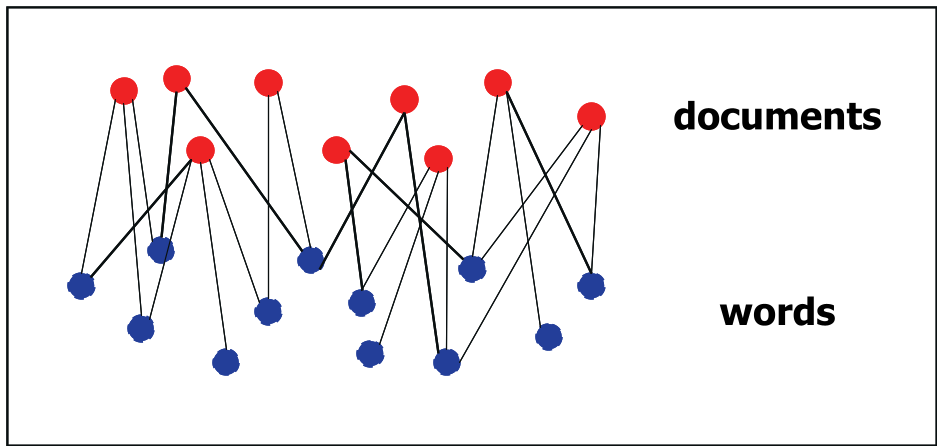
The authors model the corpus as a bipartite graph . In this graph:
- Vertices: Represent both documents (red) and words (blue).
- Edges: Connect a document to the words it contains, weighted by frequency.
2. The Optimization Logic
Instead of training a model to recognize patterns from scratch, Algorithm SS uses a Normalized Laplacian () to propagate "labels" through the graph. If a document contains several "framing" words from a small pre-defined lexicon, the algorithm infers that the document—and the other words within it—are likely related to framing.
The mathematical objective minimizes the difference between estimated labels and known lexicon labels while ensuring smoothness across the graph:
Experiments & Results: Matching the "Gold Standard"
The authors tested the method on a climate change dataset, comparing it against:
- Lexicon-Only (LO): Simple keyword matching.
- Logistic Regression (LR): A fully supervised "Gold Standard" (trained on 800 documents).
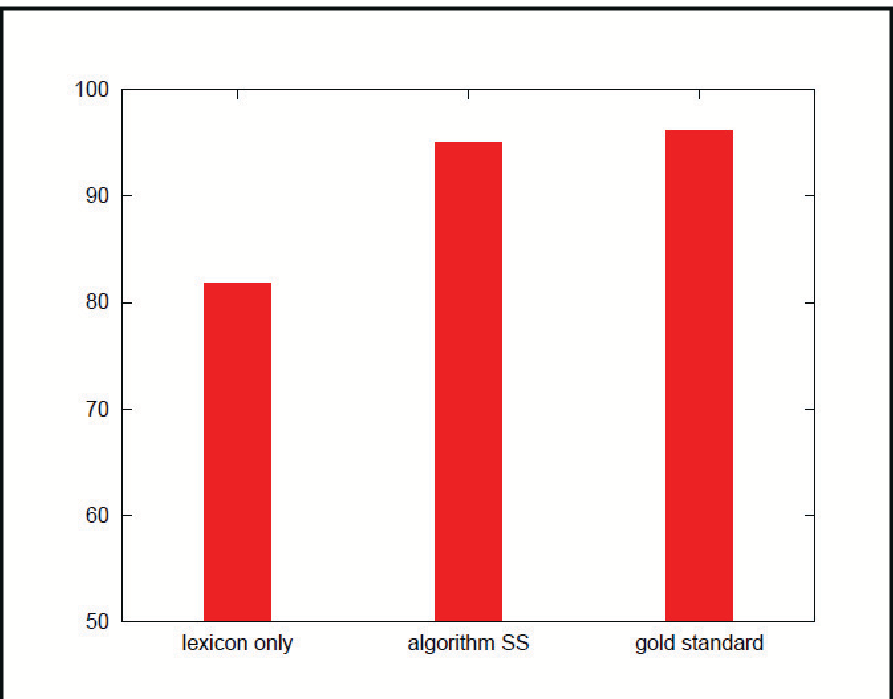
The Result: Algorithm SS achieved 95.1% accuracy, effectively closing the gap with the supervised model (96.2%) despite having zero access to labeled documents. This proves that the unlabeled data itself contains enough structural information to guide the classification process.
Deep Insight: Beyond the Keyword
The true value of this work was demonstrated in a real-world security application: monitoring social media after the 2008 Israel-Gaza air strikes.
- Cross-Lingual Agility: By simply translating the framing lexicon into Arabic and Indonesian, the researchers identified posts calling for cyber-attacks.
- Predictive Power: The algorithm successfully flagged blog posts containing hacking tools and instructions that preceded actual reported cyber incidents.
Summary & Outlook
Algorithm SS represents a paradigm shift for "agile" text analysis. By treating the relationship between words and documents as a geometric manifold rather than a simple table, researchers can extract high-level rhetorical insights in hours rather than weeks.
Limitations: The performance still relies on the quality of the initial "seed" lexicon. While the graph provides robustness, a poorly chosen lexicon could theoretically lead to biased label propagation.
Future Work: The logical next step is integrating this graph-based approach with large language model (LLM) embeddings to further enhance the semantic understanding of "framing" across diverse cultural contexts.