
Bridging the Data Silos: Semantic Integration for Sustainable Agriculture in France
Towards the Integration of Agricultural Data from Heterogeneous Sources: Perspectives for the French Agricultural Context Using Semantic Technologies
This paper presents a framework for integrating heterogeneous agricultural data from IoT sensors, social media (Twitter), and official French Plant Health Bulletins (BSV). By leveraging Semantic Web technologies and Ontology Learning, the authors aim to build a global knowledge base for sustainable smart farming in the French context.
TL;DR
To achieve truly sustainable "Smart Farming," we must look beyond isolated sensor data. This paper outlines a semantic framework to fuse IoT data, official French plant health bulletins (BSV), and social media streams into a unified knowledge base. By utilizing Ontology Learning and NLP, the researchers aim to move from fragmented data to actionable, real-time agricultural intelligence.
The "Information Gap" in Modern Farming
Precision agriculture has no shortage of data. Drones assess soil, IoT sensors monitor moisture, and satellite imagery predicts weather. However, for a French farmer, some of the most critical information is trapped in:
- Semi-structured reports: The Bulletin de Santé du Végétal (BSV) contains decades of expert crop health observations but is difficult to query at scale.
- Unstructured social signals: Twitter and farmer forums provide "on-the-ground" anecdotal evidence of pest outbreaks long before official reports are filed.
The problem is Heterogeneity. Existing systems cannot easily link a tweet about a pest in Reims with a technical PDF report and a sensor reading of high humidity.
Methodology: The Semantic Bridge
The authors propose a sophisticated pipeline designed to transform raw text into a structured "Linked Data" graph.
1. Linguistic Preprocessing & NER
Using tools like Stanford NLP and GATE, raw text is cleaned and tokenized. To identify "Natural Hazards" (pests, diseases, climate spikes), the authors suggest using BiLSTM-CRF models—a state-of-the-art Deep Learning approach—to recognize specific agricultural entities in messy Twitter data.
2. The Core Architecture
The system operates on an iterative loop where the ontology (the "map" of concepts) and the extraction process (the "harvester" of facts) improve each other.
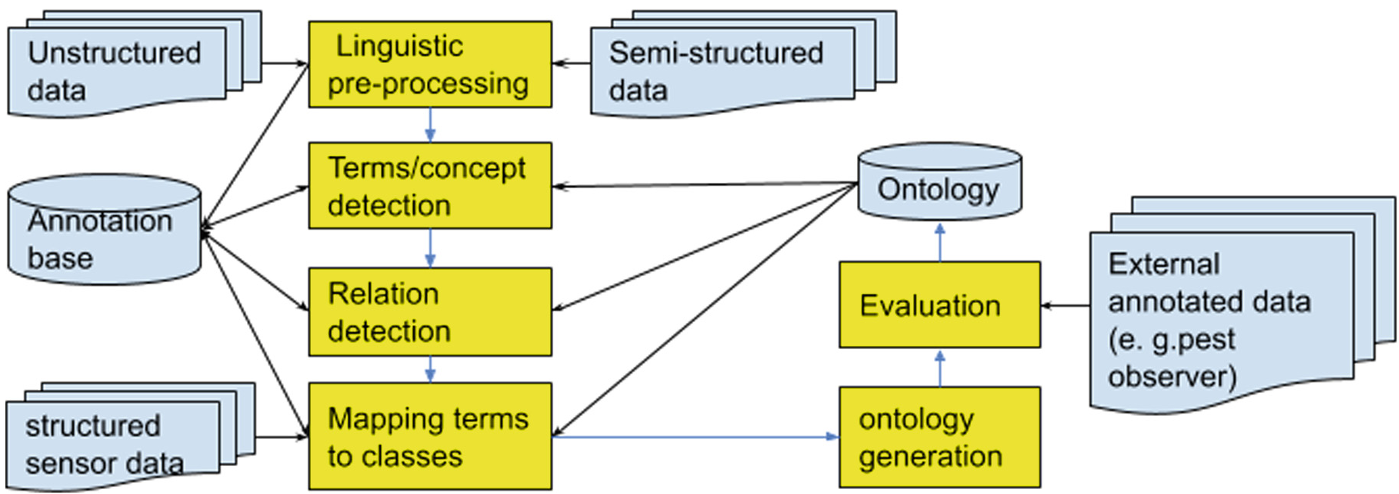
- Relationship Detection: Using Modified Open Information Extraction (MOIE), the system looks for patterns between terms (e.g., "Pest X affects Crop Y") to automatically build a "Crop-Pest" ontology that currently doesn't exist in a comprehensive French format.
- Triplification: Using the CODA architecture, extracted information is converted into RDF triples, making it part of the Linked Open Data (LOD) cloud.
Why This Matters: From Theory to Field
The integration of these sources allows for Cross-Validation. For instance:
- Twitter detects a localized pest surge in a specific terroir.
- The Knowledge Base checks the BSV archives for historical patterns in that region.
- IoT Sensors confirm that the current humidity levels match the growth threshold for that specific pest.
- Result: An early-warning alert is sent to farmers before the damage becomes irreversible.

Critical Insight & Future Outlook
While the paper focuses on the French context, its implications are global. The transition from manual ontology curation to automated ontology learning is the only way to keep up with the explosion of "Big Data" in agriculture.
Limitations: The authors acknowledge that Multilingualism and Spatio-temporal contexts (tracking how a pest migrates over time) remain significant hurdles. Their next step involves "Ontology Alignment"—the tricky process of merging their newly "learned" rules with established international standards like AGROVOC.
Conclusion
By treating social media as a "virtual sensor" and plant bulletins as "historical ground truth," this research paves the way for a more resilient agricultural ecosystem. The value lies not in the data itself, but in the semantic links that turn data into foresight.