
Agriculture 4.0: A Digital Blueprint for Nigeria’s Food Sovereignty
Agriculture 4.0: An Implementation Framework for Food Security Attainment in Nigeria’s Post-Covid-19 Era
This paper presents a comprehensive implementation framework for "Agriculture 4.0" in Nigeria to combat food insecurity in the post-Covid-19 era. It proposes transitioning from traditional small-scale farming to a digitized agri-food supply chain integrating IoT, robotics, and Big Data to achieve UN Sustainable Development Goals (SDG 2, 3, and 8).
TL;DR
The post-Covid-19 era has exposed the fragility of Nigeria's food systems. This paper proposes a radical transition to Agriculture 4.0—a digitised, information-driven framework that moves beyond traditional subsistence farming. By integrating IoT, Robotics, and Blockchain across the agri-food supply chain, Nigeria can transform from a net importer into a sustainable agricultural powerhouse, aligning with UN Sustainable Development Goals.
The Paradox of Nigerian Agriculture
Nigeria faces a staggering contradiction: while nearly 73% of its labor force is engaged in farming, the nation remains a net importer of food. In contrast, the US utilizes only 1% of its workforce to become the world’s largest food exporter. The culprits?
- Low Mechanization: Tractor density is six times lower than recommended levels.
- Massive Wastage: Approximately 25% of food is lost due to poor "Cold Chain" logistics and processing.
- Insecurity: Regional conflicts (Boko Haram, Herdsmen-farmer clashes) have made traditional farming lands dangerous and unproductive.
Methodology: The Core of Agriculture 4.0
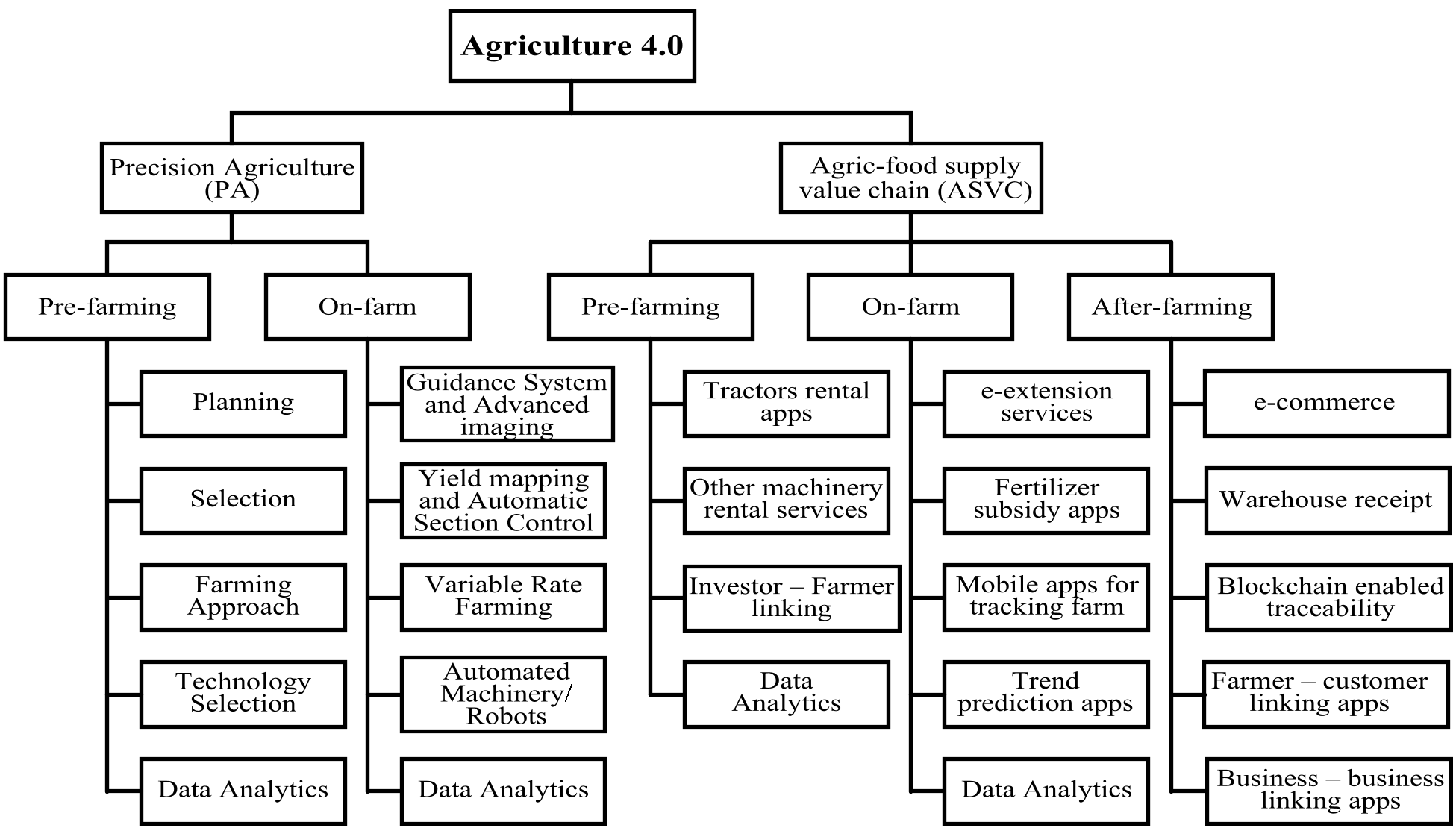
Agriculture 4.0 isn't just about "using tractors." It represents a systemic shift toward Precision Agriculture (PA) and digital supply chain management.
1. Precision Agriculture (PA)
The framework utilizes digital technologies to manage spatial and temporal variability in fields.
- Sensors and IoT: Real-time monitoring of soil pH, humidity, and temperature.
- Advanced Imaging: Using drones and multispectral imaging to detect pests and nutrient deficiencies before they become visible to the human eye.
- Variable-Rate Technology (VRT): Applying water and fertilizer only where needed, significantly reducing costs and environmental impact.
2. The Digital Supply Chain
Agriculture 4.0 extends to "after-farming" operations:
- Blockchain Traceability: Eliminating food fraud and ensuring transparency from "Farm to Fork."
- Smart Logistics: Solar-powered cold storage (e.g., ColdHubs) to preserve perishables.
- E-extension Services: Bridging the gap where one extension officer currently serves 50,000 farmers via mobile apps and USSD.
Phased Implementation Strategy
The authors propose a "Food Load Center" approach. Instead of a scattered rollout, the implementation should focus on high-demand urban hubs:
- Pilot Centers: Lagos, Kano, Port Harcourt, and Abuja.
- Resource Leveraging: Aligning crop production with ecological zones (e.g., Rice in the North, Cassava in the South).
- Advanced Tech Integration: Moving from leafy greens to more energy-intensive staple crops in controlled environments (Greenhouses).
Critical Insight: Why This Matters
The most profound takeaway is the shift in investment philosophy. The paper argues that it is far more effective for the government to provide security and infrastructure to concentrated commercial hubs rather than trying to protect and subsidize millions of geographically dispersed smallholder farms.
By treating agriculture as a high-tech "project" with distinct lifecycles (Initiation, Planning, Execution, Closing), Nigeria can apply modern project management principles to solve the age-old problem of hunger.
Future Outlook
The road to Agriculture 4.0 in Nigeria is blocked by hurdles such as high initial costs and an unstable power grid. However, the rise of Cellular Agriculture (lab-grown meat) and Vertical Farming offers a glimpse into a future where Nigeria is no longer at the mercy of climate change or land degradation.
Final Takeaway
Agriculture 4.0 is not an option; it is a necessity for national security. Digital transformation in farming is the only way to feed a population projected to double by 2050 while preserving the environment for future generations.