
Agentic Software: Moving Beyond Static Code to Runtime Reasoning
How AI Agents Are Restructuring the Software Paradigm
This paper introduces "Agentic Software," a new paradigm where AI agents function as the primary reasoning engines that dynamically generate and discard code at runtime. It formalizes the transition from deterministic, human-authored code to Agent-as-a-Service (AaaS), establishing "Agentic Engineering" as a distinct discipline for orchestrating multi-agent systems.
TL;DR
Software engineering is entering its third great paradigm shift: Agent-as-a-Service (AaaS). This paper argues that agents are not just tools to help humans write code faster, but are the software itself. By shifting from static, human-predefined logic to dynamic, LLM-generated reasoning, we are finally decoupling software complexity from the limits of human cognition.
Background: The Complexity Wall
For 50 years, the industry followed a simple rule: Humans decompose problems Humans write code Hardware executes code. However, as systems grow, the interaction surface between components grows at . We have reached a point where "Essential Complexity" outstrips human mental capacity.
The authors argue that the current trend of using AI to help humans write code (AI Software Result) is a half-measure. It leaves the human as the bottleneck and the static codebase as a liability.
The Core Shift: Agent-as-a-Software
The paper formalizes the difference between traditional systems and Agentic Systems:
- Traditional (S): Decision logic is deterministic and static.
- Agentic (A): Decision logic is generated at runtime by an LLM , using tools and planning .
In this new world, code is ephemeral. An agent might generate 1,000 lines of Python to solve a data problem, execute it, and then discard it. The "software" is the agent's ability to reason, not the artifact it leaves behind.
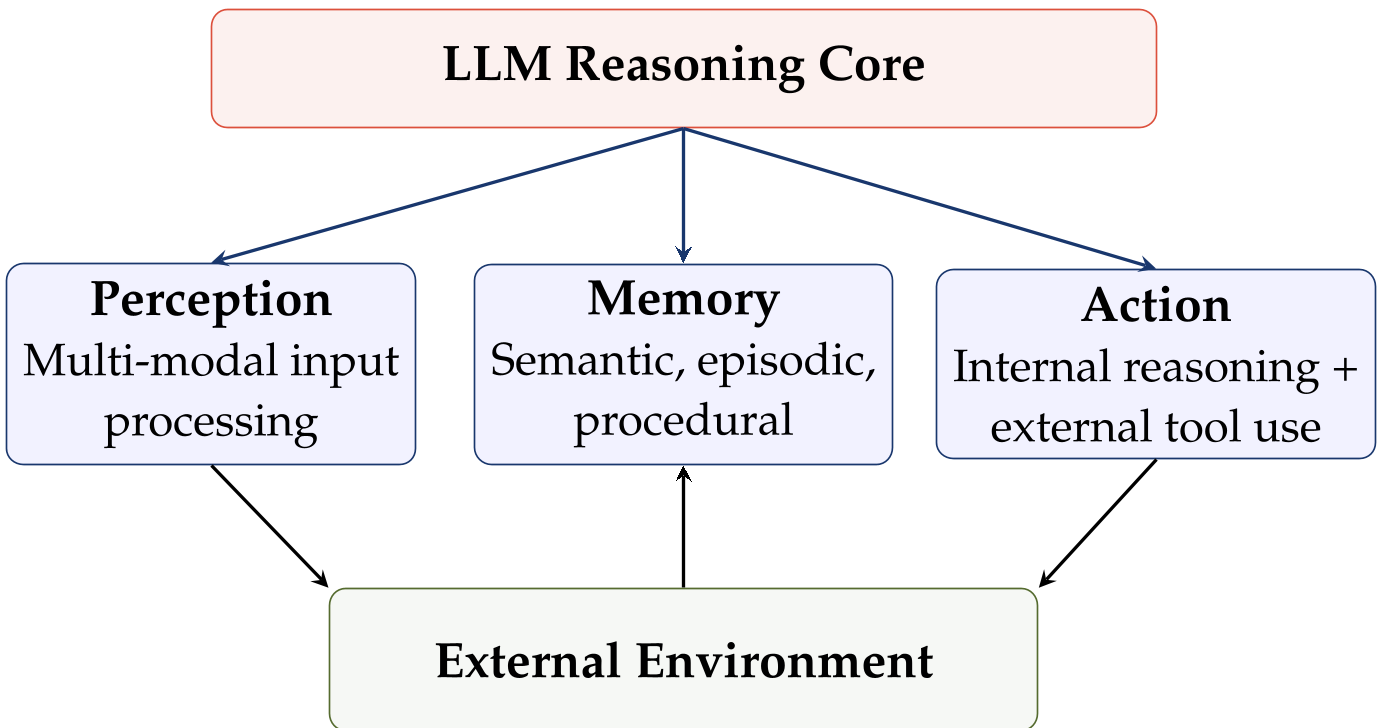 Figure 1: The standard framework for Agentic Engineering, including Multi-modal Perception, Memory Systems (Semantic/Episodic/Procedural), and the Action/Tool layer.
Methodology: From Coding to Orchestration
The paper introduces Agentic Engineering. Unlike traditional SE, where the human is the "Control Center," in Agentic Engineering, the human is the Intent Architect.
A standout example highlighted is the Hermes Agent. It utilizes a "closed learning loop" where, after completing a task, it autonomously creates a "Skill"—a reusable procedural module—that it can self-patch and improve over time. This is "Self-Evolving Software" in its literal sense.
| Dimension | Traditional SE | Agentic Engineering |
|---|---|---|
| Core Artifact | Source Code (Static) | Agent System (Dynamic) |
| Decision Mechanism | Pre-designed logic | Runtime-generated reasoning |
| Human Role | Code Author/Tester | Intent Architect/Auditor |
| Complexity Ceiling | Human Cognition () | Model Capacity (Growing with compute) |
Empirical Evidence: Breakthroughs and Reality Checks
The results are a mix of radical optimism and sobering reality:
- Efficiency: Multi-agent swarms reduced debugging time by 93% in enterprise environments.
- Capability: Open models like Lingma SWE-GPT are now matching GPT-4o in resolving real-world GitHub issues (~30% success rate).
- The "EvoClaw" Gap: This is the most critical insight. While agents score >80% on isolated tasks, their performance drops to <38% in "Continuous Evolution" (sustained development across multiple commits). Errors accumulate, and agents lose the "big picture."
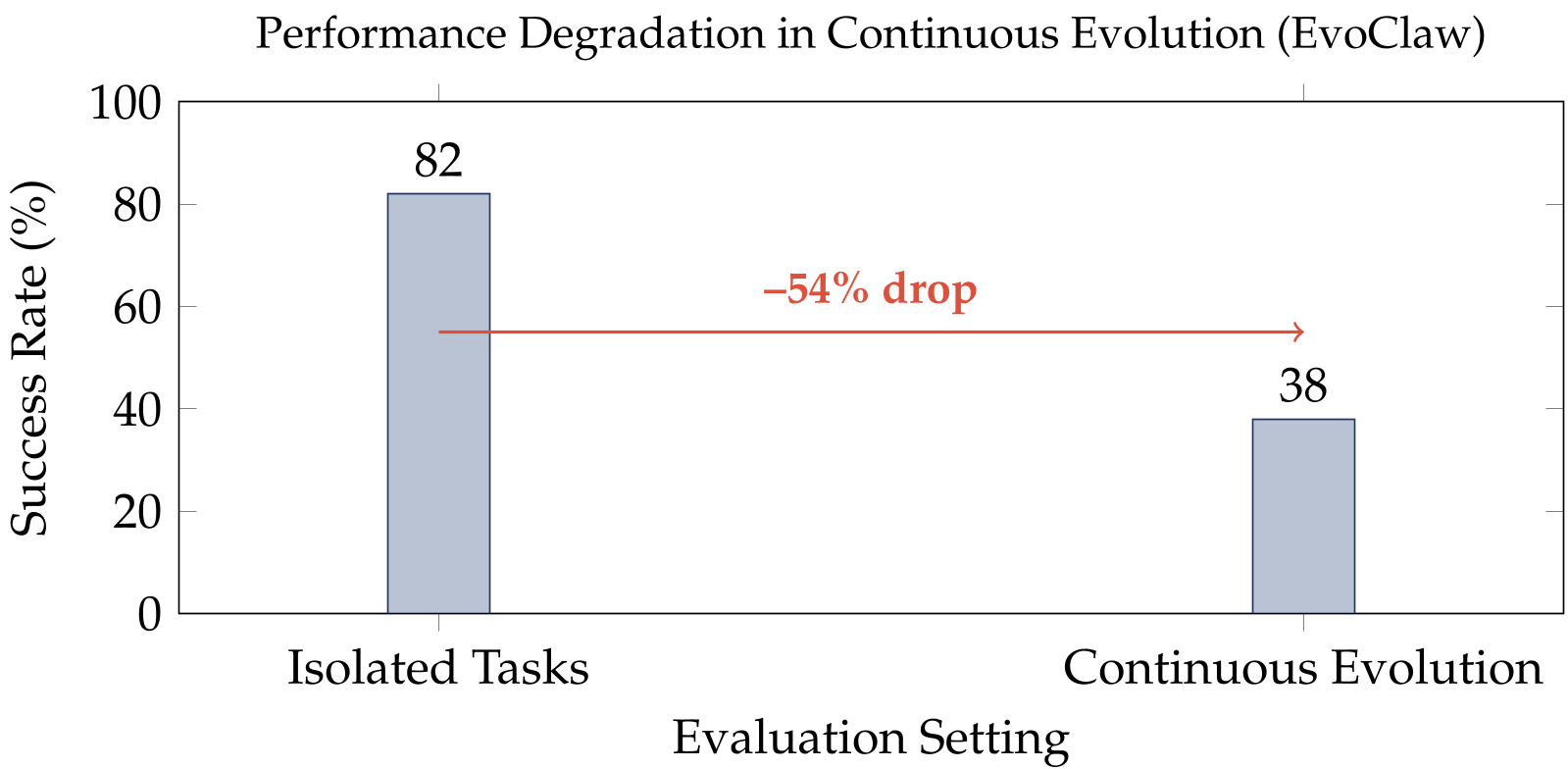 Figure 2: The performance cliff: Agents struggle with long-term maintenance and error propagation compared to isolated task completion.
The 4-Stage Roadmap
- Stage I (Tool-Augmented): Current state (Copilot/Claude).
- Stage II (Single-Task Autonomous): Agents like Devin owning end-to-end features.
- Stage III (Multi-Agent Teams): Coordinated swarms (PM agent + Dev agent + QA agent).
- Stage IV (Self-Evolving Ecosystems): Agents that modify their own architecture and "reproduce" better versions of themselves.
Critical Analysis & Conclusion
This paper correctly identifies that we are moving toward a decoupling of software capability from human cognitive limits.
Pros: The framework for AaaS provides a much-needed theoretical structure for the "Agent" hype. The focus on "Intent Articulation" as a core skill is a vital signal to the workforce.
Cons/Limitations: The 38% success rate on continuous evolution (EvoClaw) suggests that we are still years away from "fire-and-forget" autonomous engineering. Context drift and error propagation remain the "final bosses" of agentic research.
Final Takeaway: Stop training to be a better "coder." Start training to be an Intent Architect. The future belongs to those who can direct the swarms, not those who can type the fastest.