
Intelligent Teaming: Reforming Human Resources through AI & Blockchain Democracy
Artificial Intelligence and Blockchain Technology Adaptation for Human Resources Democratic Ergonomization on Team Management
This paper introduces an integrated framework combining Artificial Intelligence (AI) and Blockchain technology to enhance the "Democratic Teaming Model" (DTM). By leveraging AI (Machine Learning, Fuzzy Logic, Expert Systems) for member selection and Blockchain for secure, transparent data management, the model transitions team building from traditional seniority-based structures to dynamic, project-driven "Y-management" configurations.
TL;DR
In a world where diversity and agility are competitive necessities, the "status quo" of hierarchical team building is failing. This paper proposes a radical integration of AI (Expert Systems, Fuzzy Logic) and Blockchain to create a Democratic Teaming Model. By automating the matching of project requirements to the holistic potential of every employee—rather than just their job title—the framework promises to turn organizational "tacit knowledge" into a measurable, strategic advantage.
The "X vs. Y" Management Bottleneck
Managing human capital has historically been trapped between two poles:
- X-Management: Rigid, rank-oriented, and autocratic.
- Y-Management: Project-driven, flexible, but often hindered by the subjective biases and cognitive limits of human managers (the "Team Builder").
The authors argue that the missing link is Teaming Ergonomization. Why should a project lead spend hours cross-referencing resumes when an AI can objectively analyze a global pool of employees to find the "perfect fit" based on skills, behavior, and availability?
Methodology: The Triadic Coordinator Framework
The core of the paper lies in its "Triadic" approach. It isn't just about replacing managers with robots; it’s about a co-evolutionary relationship between three entities:
- AI Expert Systems: Acting as the "brain," it analyzes employee activities and behavior to propose multiple team configurations (v1, v2, ... vn).
- Blockchain: Acting as the "memory," it provides a secure, decentralized storage for performance data, ensuring that the "Socratic" questioning of the AI is based on unalterable and transparent history.
- The Team Builder: The human element who brings Emotional Intelligence and final judgment to choose the best configuration from the AI-suggested options.
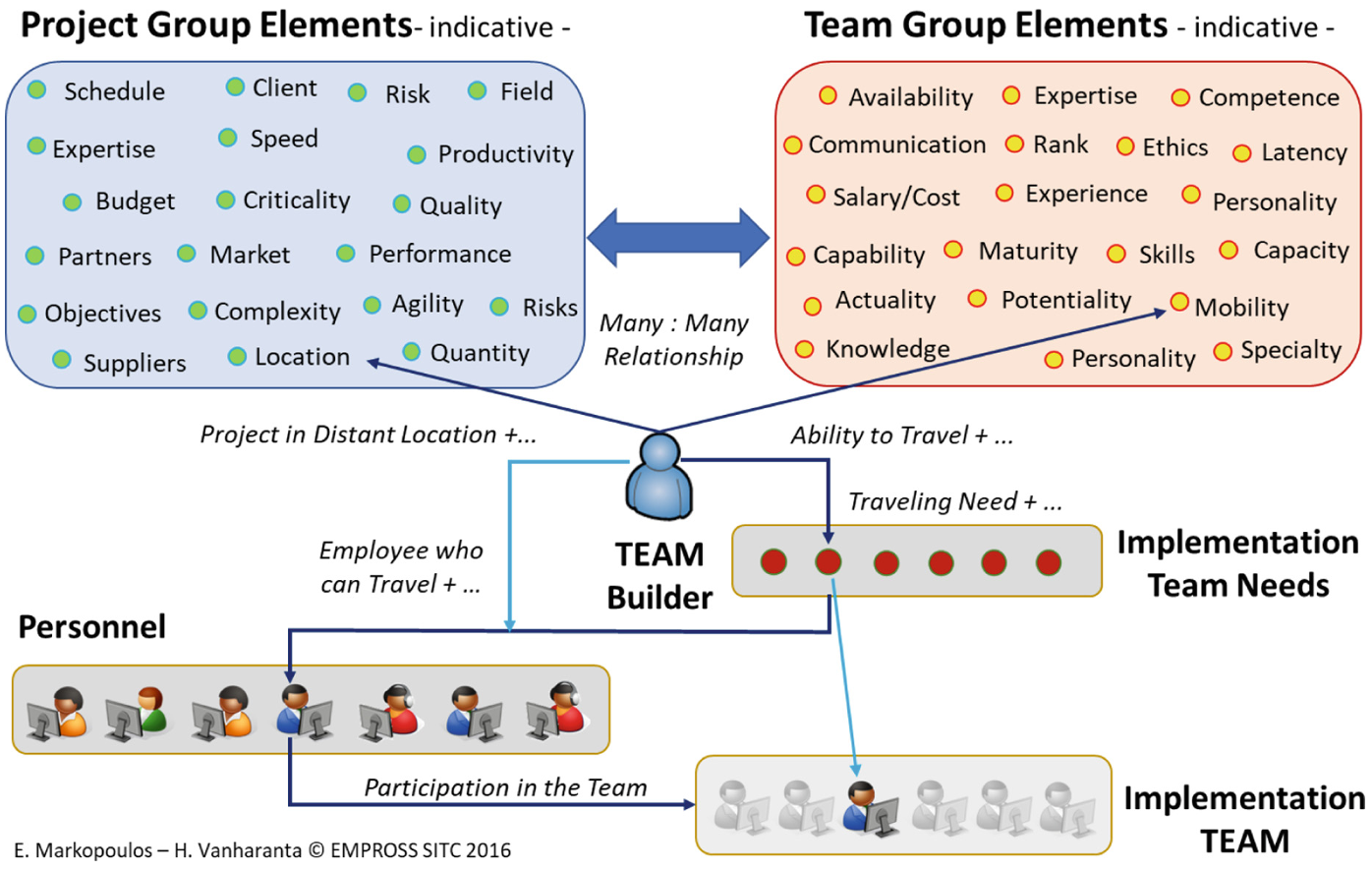 Figure: The role of the team builder shifts from manual searching to strategic selection within the democratic context.
From Fuzzy Requirements to Precise Execution
The model follows a 6-level pyramid structure derived from the Company Democracy Model.
- At Level 1, the project requirements are often "fuzzy" and the risk is high.
- By leveraging AI and Blockchain, the system continuously refines the data, moving towards Level 6, where the team reaches a "maturity" that sustains global competitive advantage.
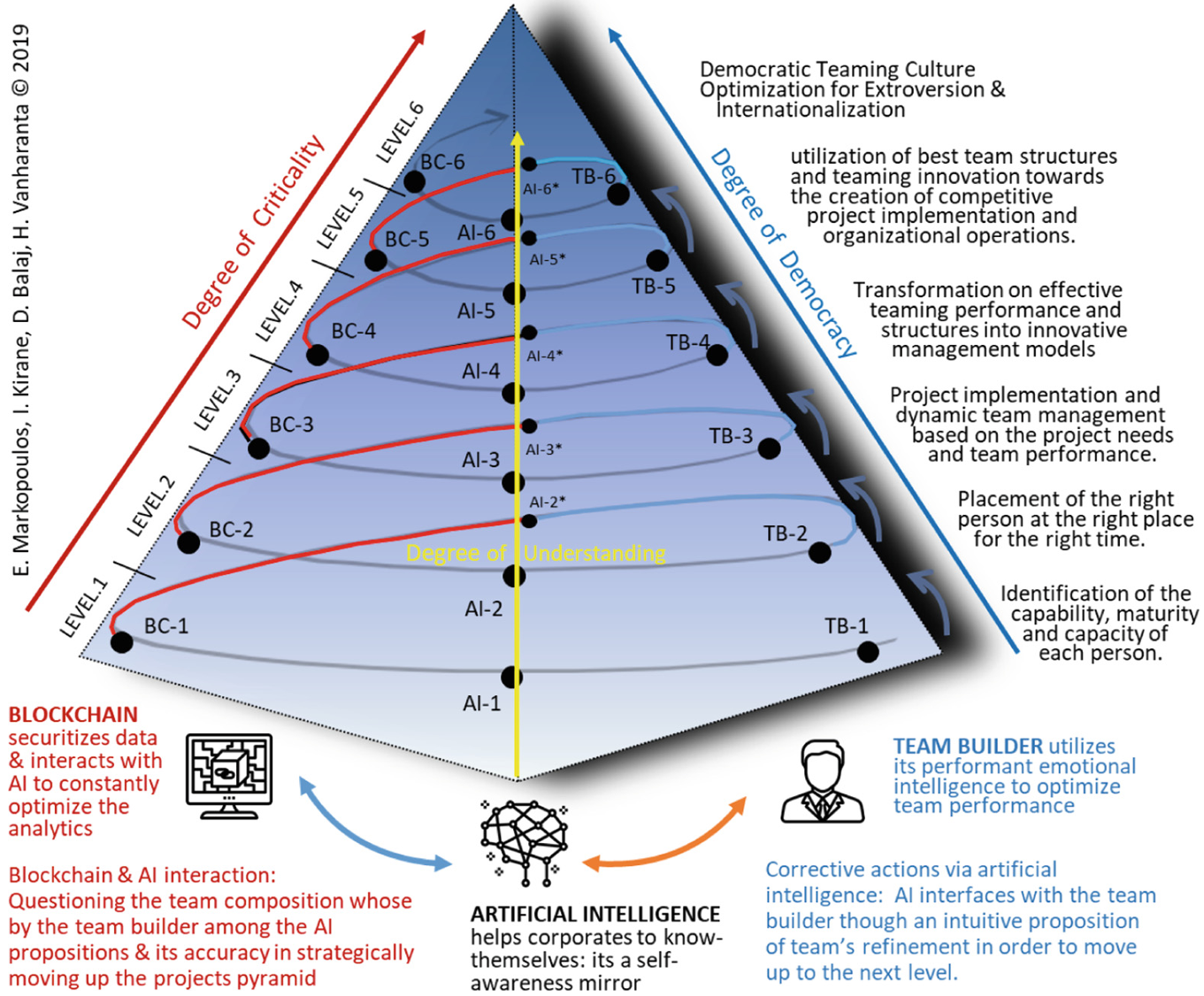 Figure: The Tech-based Teaming Ergonomization under the Democratic philosophy, illustrating the reduction of risk as complexity and data maturity increase.
Deep Insights: Why Not Just AI?
One might ask: why do we need Blockchain? The authors highlight that AI is only as good as its data. In corporate environments, performance data can be manipulated or siloed. Blockchain provides the Trust Infrastructure necessary for a democratic system. It enables a "Cloud Storage" logic where transactions between users and projects are verifiable and durable.
Furthermore, the inclusion of Fuzzy Logic allows the system to handle the "semantic" nuances of human qualities—like motivation and loyalty—which are often ignored by traditional SQL-based HR databases.
Critical Analysis & Conclusion
Takeaway
This paper provides a robust blueprint for Intellectual Capital Optimization. By removing seniority and popularity from the equation, organizations can achieve a "Blue Ocean" of internal innovation.
Limitations
While the theory is sound, the "Synthetic Match" suggested by AI still carries risks. What if the AI selects a team of people with identical personalities, leading to groupthink? The authors acknowledge this as the "uncertain level of synthetic match" and propose an agile "break-off analysis" to pivot team compositions if performance lags.
Future Outlook
This framework is particularly vital for high-stakes industries (Finance, Defense, Pharma) where the right combination of specialized personnel can be the difference between a breakthrough and a catastrophe. The next step for this research will likely be the real-world validation of these AI "version propositions" in large-scale enterprise environments.