
AI in Capital Structure: Is Traditional CAPM Dead?
The role of AI in capital structure to enhance corporate funding strategies
This study proposes integrating Deep Learning, specifically Long Short-Term Memory (LSTM) Recurrent Neural Networks, into the Capital Asset Pricing Model (CAPM) to estimate the cost of equity. By evaluating 10 high-tech companies from 2013 to 2019, the researchers demonstrate that AI-driven returns significantly outperform traditional linear models in accuracy.
Executive Summary
TL;DR: This paper challenges the decades-old dominance of the Capital Asset Pricing Model (CAPM) by introducing Deep Learning (LSTM) to forecast expected returns. By moving from linear regressions to non-linear neural networks, the study achieves a 60% improvement in cost of equity accuracy for high-tech firms.
Background Positioning: This work serves as a critical bridge between classic corporate finance theory and modern Machine Learning. It moves beyond simple stock "prediction" (a common AI task) to a higher-level application: redefining how corporations calculate their cost of capital (WACC) to make strategic funding decisions.
Problem & Motivation: The Failure of Linearity
For decades, CFOs have relied on CAPM to answer a fundamental question: What is the minimum return our shareholders expect? However, CAPM's core—the Beta ()—is fundamentally limited:
- The Linear Trap: It assumes a linear relationship between a stock and the market.
- Backward Looking: It relies heavily on historical averages, which often fail during market volatilities.
- Underestimation: As this paper proves, traditional CAPM consistently underestimates returns, meaning companies are operating on flawed financial "compasses."
The authors' insight is simple yet profound: If the market is non-linear and sequential, our pricing models must be too.
Methodology: The Power of RNN and LSTM
The researchers moved away from static statistics toward Recurrent Neural Networks (RNNs). Unlike standard feedforward networks, RNNs possess "memory," making them ideal for time-series financial data where today's price is intrinsically linked to yesterday's.
Architecture Highlights
To combat the "Vanishing Gradient" problem (where the network "forgets" distant but important data), they utilized Long Short-Term Memory (LSTM) units.
- Input: Adjusted closing prices of 10 tech giants (Apple, Amazon, etc.) and the S&P 500 index.
- Layers: A generic deep learning stack featuring three LSTM layers interspersed with dropout layers (20% rate) to prevent overfitting.
- Output: A single Dense layer to predict a specific future price point.
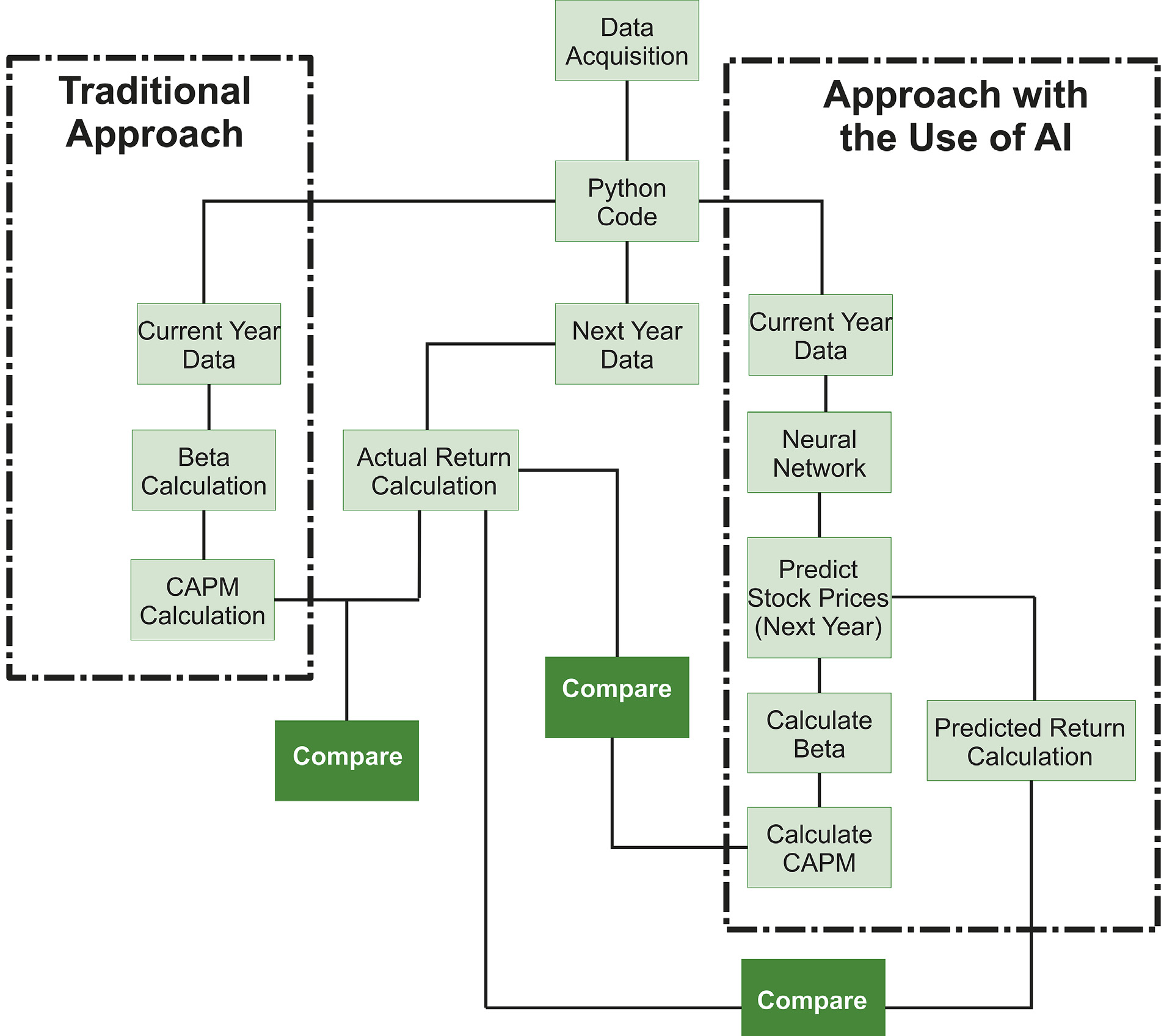 Figure 1: The dual-path methodology comparing traditional CAPM vs. AI-predicted returns.
Experiments & Results: A 60% Accuracy Leap
The results were nothing short of transformative for corporate finance metrics. The study compared three values against the actual realized returns:
- Traditional CAPM (Standard approach)
- AI-Predicted CAPM (Using AI data inside the CAPM formula)
- AI-Predicted Return (Direct output from the LSTM)
Key Findings
- Superior Accuracy: The AI-Predicted Return method was 60% more accurate than traditional CAPM.
- Volatility Reduction: AI predictions showed lower standard deviation (SD) in errors, suggesting more consistent performance across different stocks.
- Systemic Bias: Traditional CAPM was found to have an average error of 102%, primarily through underestimating the returns required by shareholders.
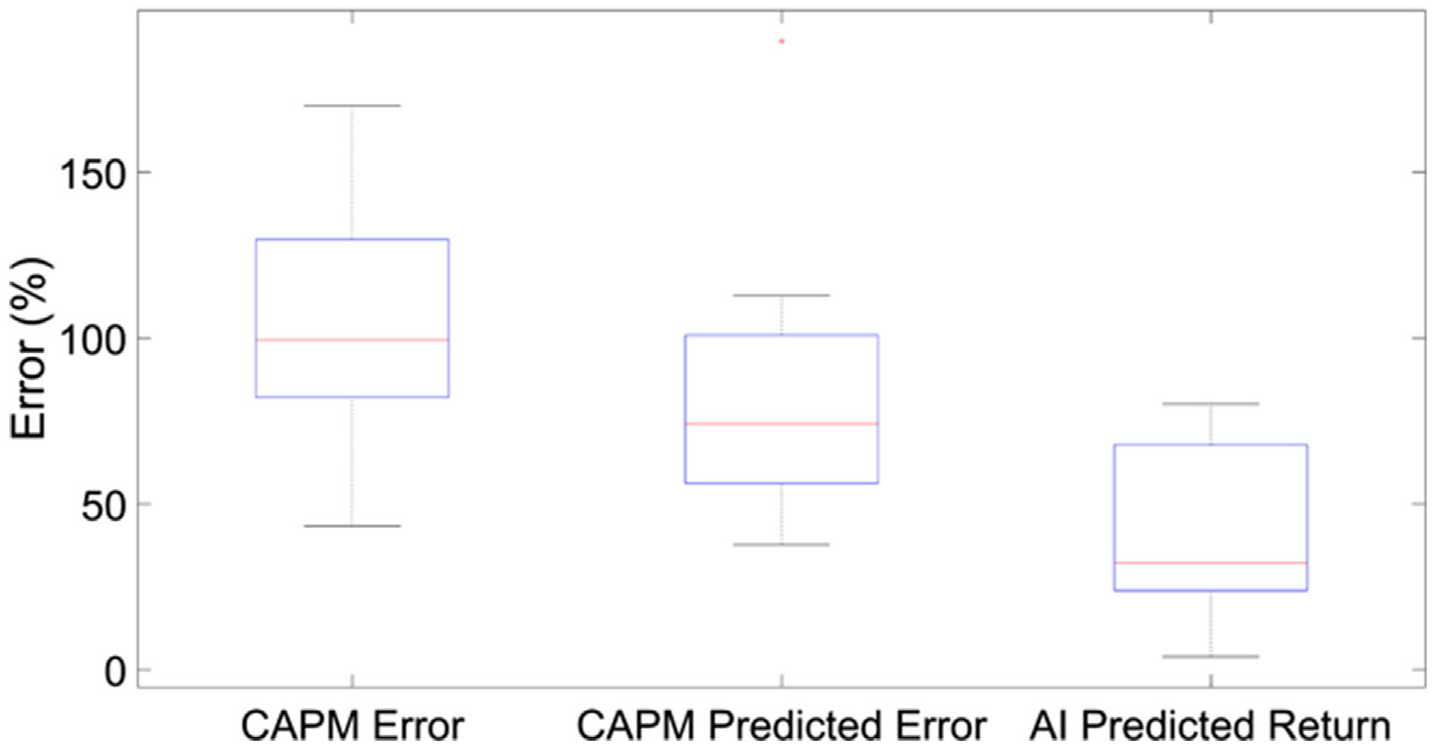 Figure 2: Statistical distribution of absolute errors—AI methods (right) clearly outperform Traditional CAPM (left) in both mean error and variance.
Critical Analysis & Conclusion
Takeaway
The study concludes that "Beta is essentially dead" in its traditional form. If future stock prices can be forecasted with reasonable accuracy using RNNs, the need for a market-relative risk coefficient () diminishes. This allows for a more "Absolute Pricing" approach rather than "Relative Pricing."
Limitations
- Hyperparameter Sensitivity: The authors used "generic" settings. In real-world trading, custom optimization for each stock would likely yield even higher accuracy.
- The "Infinite Loop" Risk: If every firm starts using AI to predict returns, the market will adapt (Adaptive Market Hypothesis), potentially creating a new era of high-frequency algorithmic volatility.
Future Outlook
For the modern CFO, the takeaway is clear: AI is no longer just for the IT department. Integrating Deep Learning into capital structure planning isn't just an "upgrade"—it's a necessary evolution to ensure the firm's growth isn't hampered by an undervalued cost of equity.