
Beyond Static Models: Active Learning and Multimodal Fusion in the Fight Against COVID-19
AI-Driven Tools for Coronavirus Outbreak: Need of Active Learning and Cross-Population Train/Test Models on Multitudinal/Multimodal Data
This paper proposes a framework for COVID-19 detection and forecasting using Active Learning (AL) and cross-population train/test models. It advocates for the integration of multitudinal and multimodal data (e.g., RNA sequences, CT scans, and X-rays) to overcome the scarcity of early-outbreak data, achieving up to 96% accuracy in specific diagnostic tasks.
TL;DR
In the early stages of the COVID-19 pandemic, the primary bottleneck for AI was the "data starvation" problem. This paper argues that instead of waiting for massive datasets, we must deploy Active Learning (AL) and Multitudinal/Multimodal models. By utilizing cross-population training—applying knowledge from one global region to another—and integrating diverse data like CT scans and RNA sequences, AI can provide high-accuracy (up to 96%) diagnostic support even with limited initial samples.
Problem & Motivation: The Failure of Passive AI
The standard paradigm of Deep Learning (DL) is data-hungry. To train a robust classifier, developers typically require thousands of annotated samples. During the emergence of a novel virus like COVID-19, this "Passive Learning" approach creates a deadly delay.
The author identifies three critical pain points:
- Data Shortage: Traditional AI tools are "proof-of-concept" because they lack enough real-world training data for novel illnesses.
- Single-Modality Bias: Decisions based solely on one data type (e.g., just symptoms or just one imaging type) may miss the complexity of the virus’s influence on the body.
- Geographic Specificity: Models trained in one location often fail to generalize to other populations due to differences in demographics or healthcare infrastructure.
Methodology: The Active and Multimodal Framework
The core insight of the paper is the transition from static, local models to dynamic, global ones.
1. Active Learning (AL) & Incremental Learning
Instead of a fixed training/validation/test split, the author proposes an Incremental Learning (IL) loop. The model learns "on-the-fly," adapting to new data as it arrives. Anomaly Detection (AD) is used to identify rare or unusual patterns in real-time data, which are then verified by experts to refine the model iteratively.
2. Multitudinal and Multimodal Integration
Diversity in data types—including RNA sequences, Electronic Health Records (EHRs), CT scans, and Chest X-rays—is fused to increase decision confidence. By looking at "multitudinal" (time-series) and "multimodal" (multi-source) data, the AI reduces the risk of skewing results based on a single outlier source.
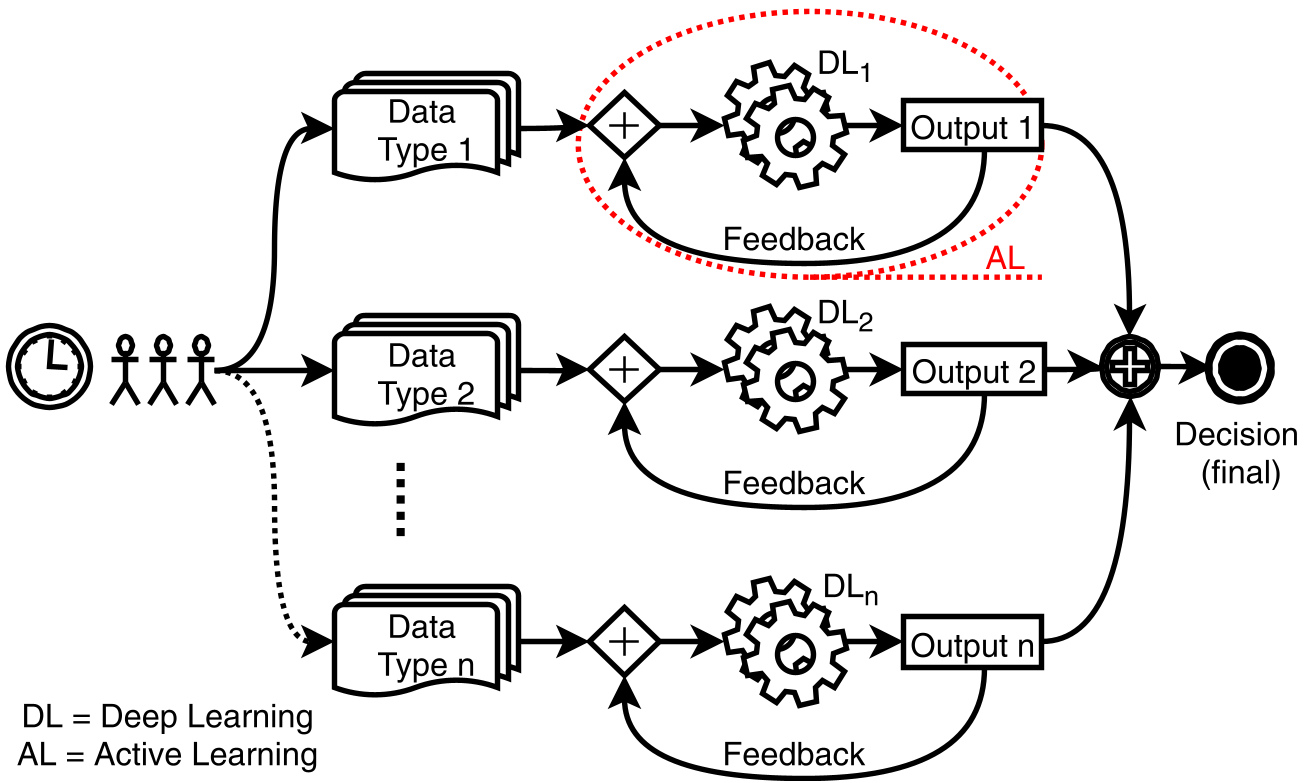 Figure: The Active Learning schema showing the fusion of DL from various data types with expert feedback loops.
3. Cross-Population Generalization
One of the most provocative suggestions is the cross-population train/test model. This involves taking a model trained in a region with an earlier outbreak (e.g., Wuhan, China) and immediately deploying it in a new region (e.g., Italy or the US) to bridge the data gap.
Experiments & Results: Diagnostic Precision
The paper highlights that while conventional tools struggle with small datasets, multimodal approaches show immediate promise:
- CT Scan Accuracy: Referencing Alibaba's AI system, the paper notes a 96% accuracy rate in detecting infections via CT scans.
- Diagnostic Complementarity: AI-driven CT analysis can effectively complement RT-PCR tests, which may sometimes yield false negatives or suffer from long processing times.
- Visual Evidence: The author provides examples of X-ray and CT findings, such as bilateral focal consolidation, which AI can detect as "anomalies" against a baseline of healthy lung images.
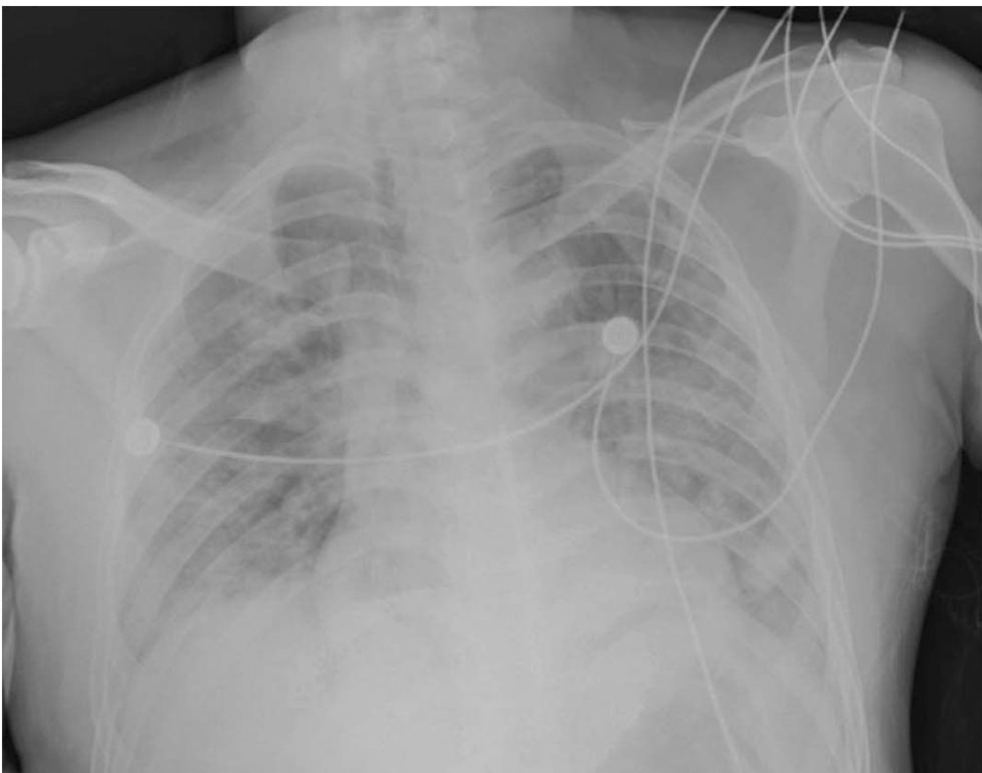 Figure: Chest X-ray showing patchy consolidation, a key feature for AI-driven anomaly detection.
Critical Analysis & Conclusion
Takeaway
The value of this work lies in its philosophical shift for medical AI. It moves away from the "wait and see" data collection strategy toward a proactive, expert-in-the-loop "Active Learning" framework. This is essential for future pandemics where time is the most expensive resource.
Limitations
- Expert Dependency: Active Learning requires continuous feedback from clinicians, who are often the most overworked during a pandemic.
- Standardization: Cross-population models assume that data formats (like CT scan parameters) are standardized across different countries, which is not always the case.
Future Outlook
This paper serves as a blueprint for "Augmented Intelligence"—where the machine does not replace the doctor but learns alongside them, becoming more robust as the crisis evolves. Future research should focus on automating the "cross-population" domain adaptation to handle different imaging hardware and clinical protocols automatically.