
AI-Enabled Governance: Beyond Efficiency Toward Resilient Social Innovation
AI-Enabled Innovation in the Public Sector: A Framework for Digital Governance and Resilience
The paper proposes a conceptual framework to analyze AI-enabled innovation within the public sector, specifically linking digital governance, social innovation, and welfare state resilience. It evaluates how AI national strategies impact policy-making and social value creation across different European administrative contexts.
TL;DR
Artificial Intelligence is rapidly entering the public sector, but is it actually improving society or just automating bureaucracy? This paper introduces a robust framework to evaluate AI's role in "Digital Governance." Through a study of Nordic and Continental European initiatives, the authors argue that for AI to foster true Social Innovation, governments must move beyond simple performance metrics toward radical inclusion and administrative reform.
The Problem: The "Digital Sclerosis" of E-Government
For decades, the public sector viewed digitalization as merely "digitizing procedures"—turning paper forms into PDFs. The authors identify two major pain points:
- The Rhetoric Gap: While many governments claim to be "open," they remain rigid and exclusive, focusing on internal efficiency rather than public value.
- Digital Sclerosis: The risk that outdated administrative structures, when powered by AI, become even more inflexible and detached from the changing needs of citizens.
Methodology: Mapping AI onto the Welfare State
The heart of this research is a multi-level interpretive framework. It bridges the gap between high-level policy and the micro-level "life stages" of citizens (childhood, adulthood, etc.).
The Core Framework
The model identifies four types of ICT-enabled innovation attitudes:
- Technical/Incremental: Small efficiency gains in existing processes.
- Organizational/Sustained: Significant changes to how agencies operate.
- Transformative/Disruptive: Creating new ways to deliver value that challenge existing norms.
- Transformative/Radical: Fundamental shifts in the relationship between state and citizen.
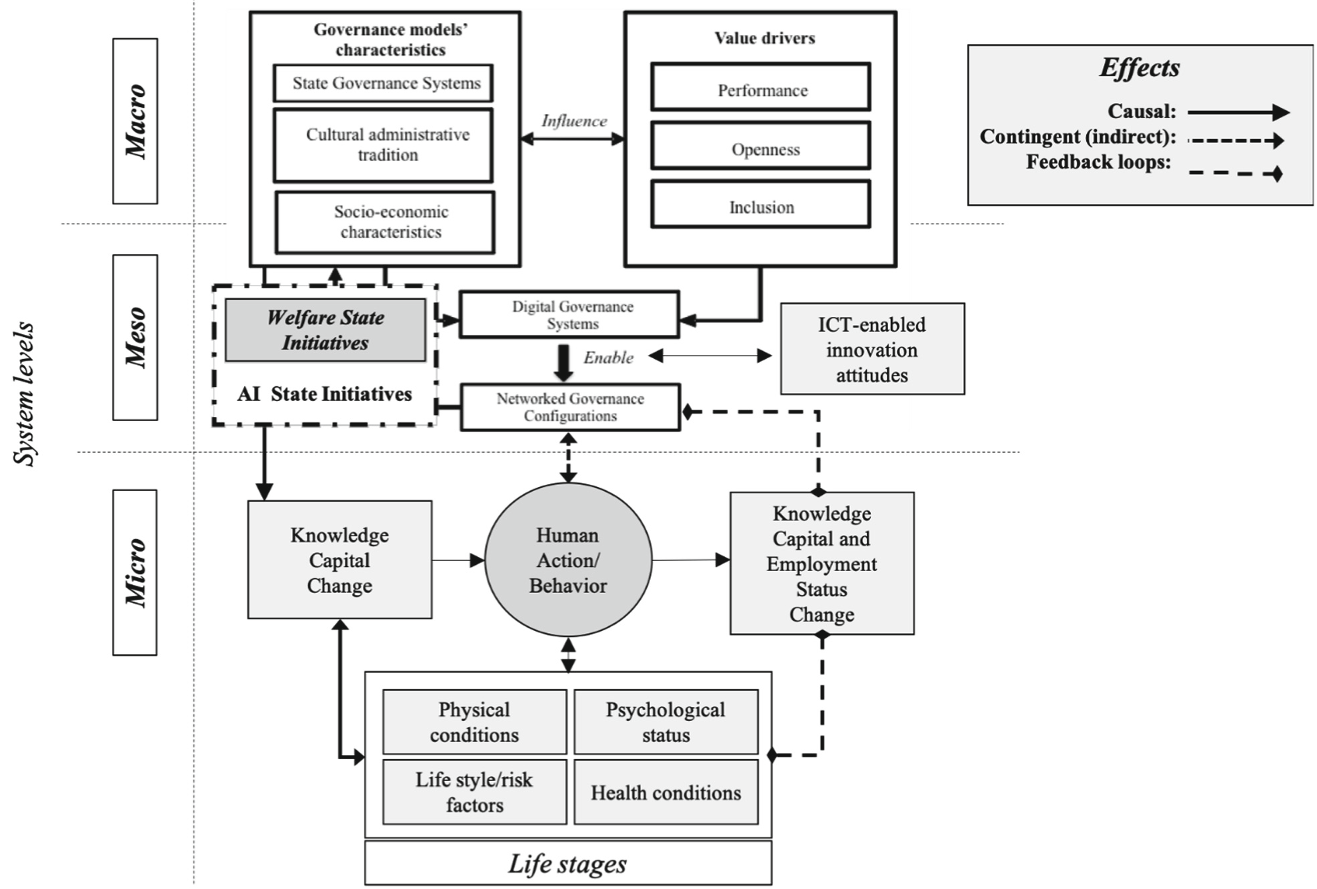
The authors emphasize that AI is not an independent variable; its success depends on the Cultural Administrative Tradition and the Socio-economic context of the country.
Experimental Evidence: Successes and Shadows in Europe
The framework was applied to four distinct AI initiatives:
- Belgium (Kind en Gezin): Uses predictive AI to identify day-care services needing inspection. (Focused on Social Protection).
- Sweden (Trelleborg): Implements Robotic Process Automation (RPA) for welfare payments. (Focused on Efficiency).
- Finland (Espoo): Uses data clustering to predict future service paths for residents. (Focused on Social Investment).
- Denmark (Gladsaxe): Developed a radical system to identify children at risk of abuse in "parallel societies." (Focused on Social Innovation).
Key Findings
The comparison highlights a sobering reality: most AI projects currently serve internal governance needs rather than external citizen engagement.
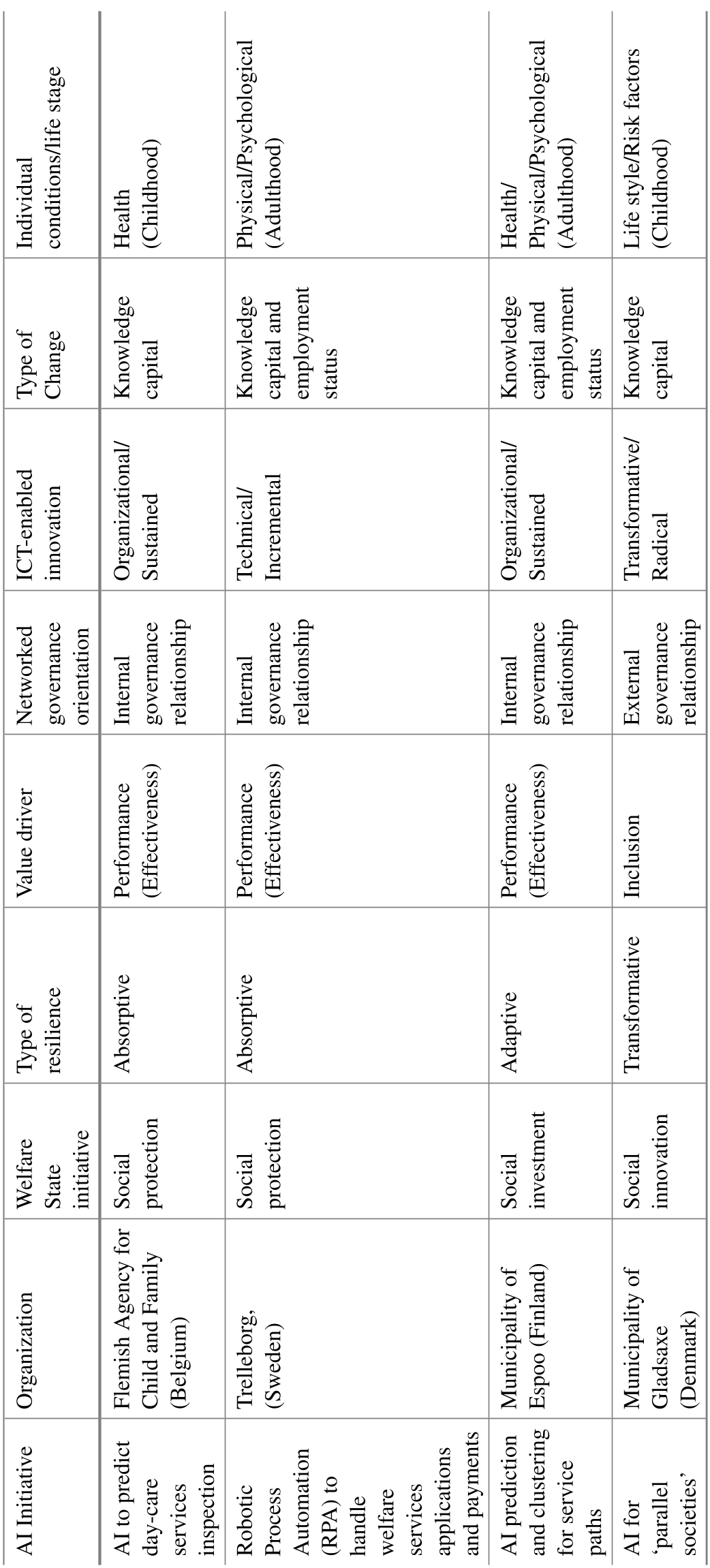
The Danish case, while arguably the most "innovative," highlights the risk of Algocracy—where the algorithm makes life-altering decisions (like child removal) based on data indicators, raising massive ethical concerns regarding privacy and bias.
Depth Insight: The Resilience Factor
The paper categorizes resilience into three types: Absorptive (maintaining the status quo), Adaptive (making incremental adjustments), and Transformative (reinventing the system). Most current AI implementations are merely absorptive or adaptive. The authors suggest that true "resilient social innovation" requires a transformative approach that prioritizes Inclusion and Openness over mere speed.
Conclusion & Future Outlook
The takeaway for policy-makers is clear: AI cannot be "bolted on" to 20th-century bureaucracy. Without a parallel reform in Knowledge Capital (the skills of public workers) and a focus on the ethical implications of "algorithmic welfare," AI might worsen social inequality even as it saves money.
The next frontier for this research is the longitudinal study of these European cases to see if "Transformative" AI leads to better social outcomes or simply more efficient state control.