
Why "Explainable AI" Might Be Hurting Patient Trust: Insights from a Large-Scale Radiology Study
Effect of AI Explanations on Human Perceptions of Patient-Facing AI-Powered Healthcare Systems
This study investigates the impact of AI explanations and model performance on healthcare consumers' perceptions of patient-facing AI systems for radiology report interpretation. Using a large-scale experiment (N=3,423), the researchers evaluated how local explanations and transparency levels affect trust, understandability, and perceived usefulness.
TL;DR
Is more transparency always better for AI in healthcare? Not necessarily. A massive study involving over 3,400 participants found that while high-performing AI naturally earns trust, adding detailed explanations to a weak or incorrect AI actually makes patients trust it less. While local explanations help patients understand the "how," they don't solve the "black box" problem of clinical reliability.
Problem: The Radiology Jargon Barrier
For most patients, reading a radiology report is like reading a foreign language. While "patient portals" have made data accessible, they haven't made it understandable. AI has been proposed as the bridge, but diagnostic medicine is high-stakes. If a patient doesn't understand why an AI labeled a finding "abnormal," they won't use the tool, rendering the technology useless.
The authors argue that current AI research ignores the human perception side of this equation—specifically for laypeople who aren't tech-savvy or medically trained.
Methodology: Testing Trust, Logic, and Performance
The researchers built a system to help users classify radiology report sentences as "Normal" or "Abnormal." They used a Support Vector Machine (SVM) to create two versions:
- Good AI: High accuracy (AUC 0.94).
- Weak AI: Lower accuracy (AUC 0.78).
They also varied the Transparency:
- Low Transparency: Showed only the prediction and a confidence score.
- High Transparency: Highlighted specific words (e.g., "thickened," "clear") that triggered the AI's decision.
 Figure 1: The interface showed how AI explanations highlighted specific "feature words" to justify its diagnosis.
Key Findings: The Performance-Trust Link
The results from 3,423 participants revealed a nuanced relationship between AI logic and human trust:
1. Performance is King
Users were highly sensitive to the AI's accuracy. A "Good" model significantly boosted perceived usefulness and trust. If the AI was accurate, patients were willing to overlook a lack of detailed explanation.
2. Information Overload vs. Trust
Surprisingly, providing word-level local explanations (High Transparency) did not increase trust. It helped people understand the AI's logic (Understandability), but it didn't make them feel the AI was more reliable.
3. The Negative Impact of "Bad" Explanations
This is the study's most critical insight: When the AI was wrong or when the human disagreed with the AI, high transparency significantly lowered trust (p < 0.001).
When an AI provides a nonsensical explanation for an incorrect prediction, it exposes its own "stupidity" to the user. In high-stakes healthcare, seeing the flawed "thought process" of a machine is more damaging than just seeing a wrong answer.
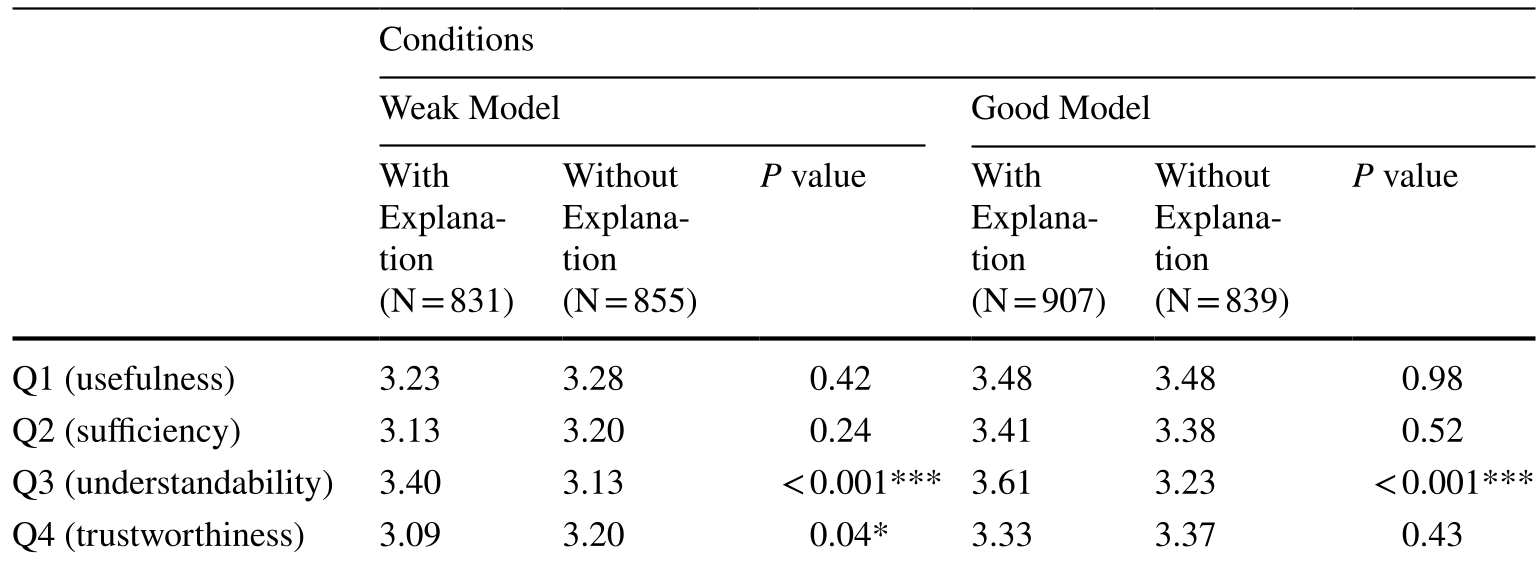 Table 2: Statistical breakdown showing that while Q3 (Understandability) rose with explanation, Q4 (Trustworthiness) actually dropped for weak models.
Critical Analysis: Implications for AI Design
The "Explainable AI" (XAI) movement often assumes that transparency is a universal good. This paper challenges that dogma for the healthcare sector.
- The Trust Calibration Gap: Patients use explanations to audit the AI. If the audit reveals a weak rationale, trust evaporates faster than if the system remained a "black box."
- Design Solution: Instead of just showing why a prediction was made, designers should focus on Confidence Calibration. For example, use clear visual cues (like red warning colors) when the AI is uncertain, helping patients know when to be skeptical.
- The Interpretability-Accuracy Trade-off: The study notes that high-accuracy models (like Deep Learning) are often the least interpretable. Moving forward, developers must balance making a model "smart" enough to be useful while keeping it "simple" enough for a patient to verify.
Conclusion
This research serves as a cautionary tale for medical AI developers. For a patient-facing system, transparency is a double-edged sword. If the model is weak, explaining its rationale doesn't help—it just confirms the patient's fears. The future of patient-centered AI lies not just in "showing the work," but in ensuring the "work" is accurate enough to stand up to scrutiny.
Takeaway: In healthcare AI, trust is built on proven reliability (Performance), while explanations primarily serve as a tool for error detection.