
AI-Fairness in Elder Care: Decoding Activity Recognition Across Physical Disabilities
AI-Fairness Towards Activity Recognition of Older Adults
This paper introduces a novel framework for Human Activity Recognition (HAR) specifically tailored for older adults, using a single wrist-worn wearable sensor. It combines a signal processing approach (sparse-deconvolution) with a Bi-directional LSTM (MM-RNN) to recognize concurrent hand gestures and postures while being the first to systematically address and mitigate AI biases related to age and functional disability.
TL;DR
Recognizing the daily activities of older adults using a single wearable is notoriously difficult due to "functional diversity"—the high variance in how someone walks with a walker versus a cane. This paper proposes a dual-path solution: a hardware-efficient Sparse-Deconvolution MM-RNN architecture for multi-label recognition and a rigorous AI-Fairness pipeline to ensure the model doesn't discriminate against the oldest or most disabled users.
Problem & Motivation: The Hidden Bias in Wearables
Standard Human Activity Recognition (HAR) assumes a "gold standard" for movement. However, for a 90-year-old using a walker, "walking" looks mechanically similar to "standing" or "shuffling" to a traditional AI. This leads to algorithmic unfairness: the person who needs the most monitoring (the disabled) receives the least accurate detection.
The author identifies two core gaps:
- Sensor Fatigue: Older adults refuse to wear multiple sensors; we must extract Upper Extreme (UE) and Lower Extreme (LE) data from a single wristband.
- Diversity Bias: Age and functional ability act as "protected attributes" that skew AI performance, potentially violating legal standards like the US Disability Discrimination Act.
Methodology: Physics-Inspired Signal Separation
The paper treats the human body as a Linear Time-Invariant (LTI) system. The core technical insight is that Lower Extreme (LE) movements (like walking) have a "sparse effect" on Upper Extreme (UE) nodes (the wrist).
1. Sparse Deconvolution
By assuming the wrist signal is a convolution of a hand gesture and a postural response, the author uses a sparse-deconvolution method to disaggregate the two. This allows a single sensor to "see" what the legs are doing while simultaneously tracking hand gestures.
2. MM-RNN Architecture
The separated signals are processed through a Multi-Input Multi-Task Recurrent Neural Network (MM-RNN).
- Input: Two time-series streams (Gestural + Postural).
- Middle: Three stacked LSTM layers for temporal dependencies.
- Output: Dual classification heads for concurrent activity labeling.
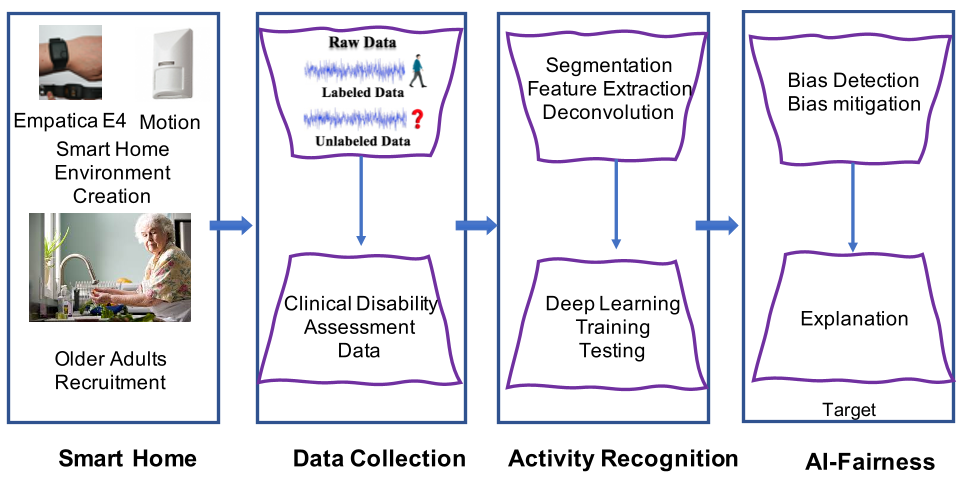 Figure 1: The architecture transition from signal deconvolution to deep multi-task learning.
Mitigating Bias: Fairness as a First-Class Citizen
The most significant contribution is the systematic evaluation of Bias Mitigation. The author tested three intervention points:
- Pre-processing: Reweighing samples to balance groups.
- In-processing: Adversarial debiasing to prevent the model from "learning" age-based shortcuts.
- Post-processing: Adjusting the decision boundary (Reject Option Classification).
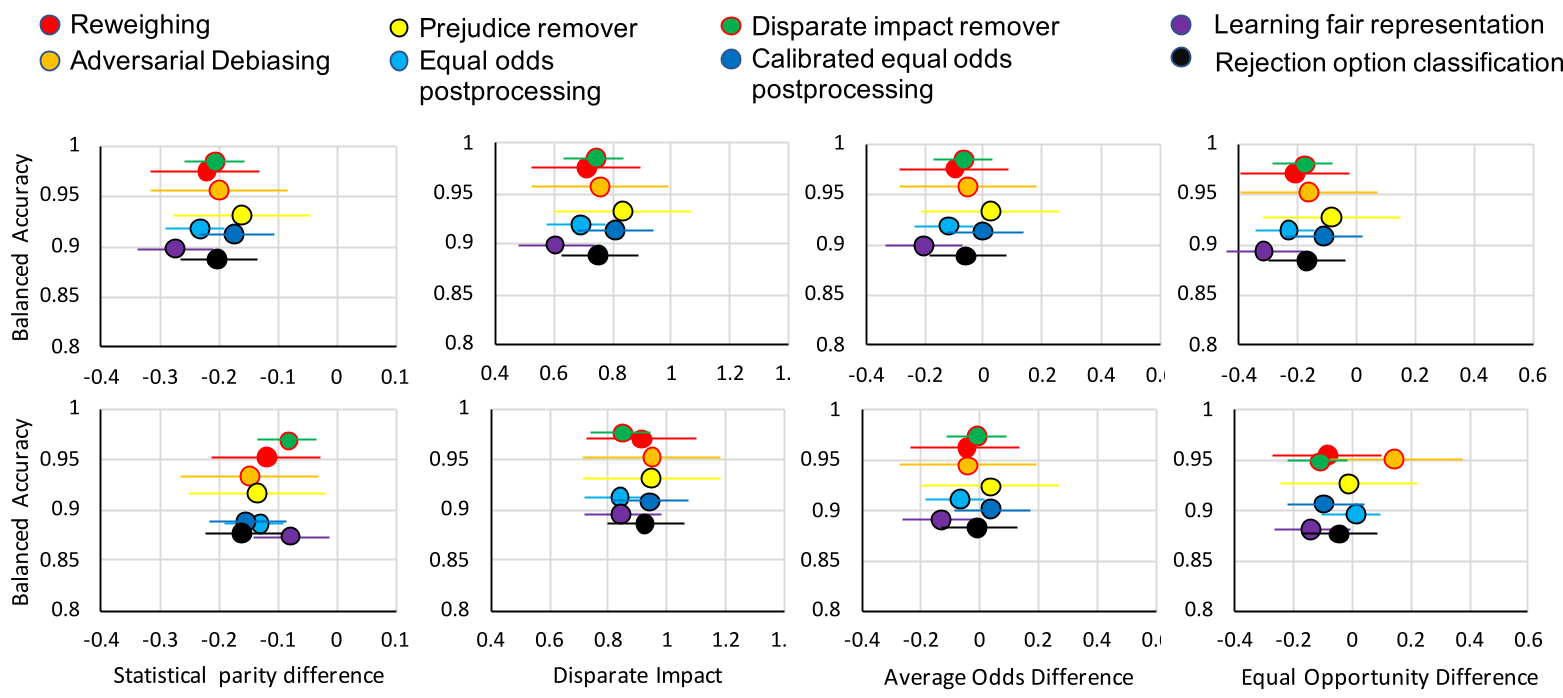 Figure 2: Evaluating different algorithms (Reweighing vs. Prejudice Remover) on fairness metrics like Statistical Parity and Equal Opportunity.
Experiments & Results
The study involved 22 participants (mean age 85.5) in a retirement community.
- Raw Performance: The MM-RNN achieved 97.5% accuracy, beating Feature Weighted Naive Bayes (FWNB) and SVMs.
- Fairness Gains: For the protected attribute "Age," the Reject Option algorithm achieved a "4 out of 4" fairness score (perfect across all metrics) with a negligible 0.5% accuracy loss.
- Challenge of walking aids: Accuracy for "Normal Walking" was near 100%, but dropped significantly for "Walking with Walker" (approx. 80.7%), highlighting why specialized bias mitigation is necessary.
Critical Insight & Conclusion
This work proves that Accuracy is not a proxy for Utility in healthcare. A model that is 95% accurate across the general population but 60% accurate for disabled users is fundamentally broken for clinical deployment.
Takeaway: By combining signal deconvolution (to maximize information from sparse sensors) and post-processing fairness adjustments, we can build HAR systems that are both high-performing and ethically sound. Future work focusing on Explainable AI (XAI) will be the next step in helping clinicians understand why a certain gait was flagged, further bridging the gap between data science and geriatric care.