
AI as a Mirror: Decoding Power Dynamics Through Human-AI Collaborative Art
Use of AI-Generated Visual Media in Interviews to Understand Power Differentials in Gender, Romantic, and Sexual Minority Students
2021-10-13
Summary
Problem
Method
Results
Takeaways
Abstract
The study introduces a novel qualitative research methodology using AI-human art-making interactions (via NVIDIA's GauGAN) to explore power differentials and "technologies of the self." It evaluates how generative AI tools can help Gender, Romantic, and Sexual Minority (GRSM) students articulate complex experiences of marginalization in higher education.
## TL;DR
Researchers from Arizona State University are pioneering a "liberatory praxis" in qualitative research. By integrating **NVIDIA’s GauGAN**—an AI tool that turns simple sketches into photorealistic landscapes—into interviews, they have found a way to help GRSM (Gender, Romantic, and Sexual Minority) students visualize and articulate the invisible "technologies of power" that govern their lives in academia.
## Background: The Foucault Connection
To understand this study, one must look through the lens of **Michel Foucault**. Power, in this context, isn't just a top-down force; it's a distributed system of "micro-punishments" and "technologies of domination" (like the feeling of constant supervision) that control bodies and minds in educational systems.
The challenge for researchers is that these power structures are so passive and pervasive that they are difficult to pinpoint in standard conversation. The researchers hypothesized that by engaging in a "Care of the Self" practice—specifically through **AI-assisted art-making**—students could better reflect on their own subjectivities and resistance strategies.
## Methodology: GauGAN as a Research Catalyst
The data collection process involved a three-step engagement:
1. **Introductory Rapport**: Building trust and introducing Foucauldian concepts.
2. **Semi-Structured Interview**: Mapping the participant's history with technology and power.
3. **The GauGAN Session**: An unstructured interview where participants shared their screens while co-creating art with AI.
**GauGAN** uses a **Conditional Generative Adversarial Network (cGAN)**. Unlike a simple digital paintbrush, the AI maps semantic maps (where one color represents "sky" and another "road") to realistic imagery.
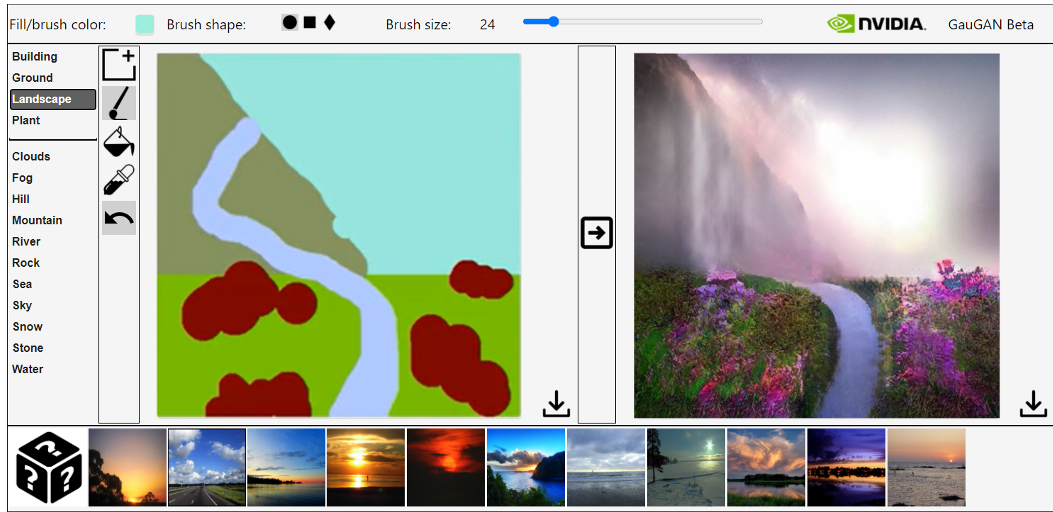
*Fig 1: The GauGAN interface allows participants to bridge the gap between abstract thought and visual reality.*
## Why AI? (The Core Insight)
The choice of AI over traditional art was intentional. AI has a complex relationship with society—it can be revolutionary, yet it often encodes the very biases and power structures the researchers are trying to study.
The interaction with GauGAN provided two unique benefits:
* **Lowering the Skill Barrier**: Participants who felt "limited" by their artistic skills found that AI gave them the "extra creative power" to express surreal or complex emotions.
* **Semantic Resonance**: By focusing on the visual task, participants "quieted" their analytical minds, allowing deep-seated emotions to surface. One participant famously used the analogy of a **"computer stack"** to describe how unprocessed emotions block access to self-understanding—a realization triggered by the AI interaction.
## Results and Tension
The results were not without friction. There was a consistent tension between the **user's intent** and the **AI's generated output**. Some participants found this lack of control frustrating, while others embraced it as a form of "surrealism" or a reflection of life's unpredictability.

*Fig 2: Example outputs demonstrating the varied aesthetic and emotional textures achieved by the students.*
## Deep Insight & Conclusion
This research moves AI beyond the realm of "productivity tool" and into the realm of **"interpretive partner."** In the context of GRSM studies, the AI interaction serves as a "technology of the self"—a way for individuals to take responsibility for their own transformation and search for truth.
**Takeaway for the Industry:**
Researchers and product designers should view generative AI as a "boundary object" that can facilitate difficult conversations. In qualitative research, the *process* of AI frustration and surprise is just as valuable as the *final output*, as it mirrors the messy, often frustrating interactions people have with systemic power in the real world.
**Future Work:**
The team will continue to apply Foucauldian-inspired discourse analysis to these interactions, exploring how AI-generated visual media can act as a form of "truth-telling" (parrhesia) against institutional marginalization.