
Navigating the Algorithmic Shift: A Framework for AI Institutionalization
A Framework for Understanding AI-Induced Field Change: How AI Technologies are Legitimized and Institutionalized
The paper proposes a novel conceptual framework to analyze "AI-induced field change," integrating Institutional Theory and Information Systems (IS) theory. It examines how AI technologies move from being novel agents to established socio-technical systems through processes of legitimization and institutionalization.
TL;DR
As AI moves from "experimental tech" to "social infrastructure," it often breaks existing rules faster than we can rewrite them. This paper by Benjamin Cedric Larsen provides a rigorous framework combining Institutional Theory and Information Systems to map how AI-induced fields (like autonomous driving or facial recognition) move from chaotic fragmentation to stable, legitimate establishment.
The Motivation: The "Pacing Problem"
The fundamental friction in modern tech isn't just "innovation vs. regulation"—it's a structural mismatch in speed. Digital infrastructures (code, servers, APIs) are modular and grow exponentially. Institutional infrastructures (laws, ethics, professional standards) are social and grow incrementally.
This creates a "policy vacuum" where AI agents act with high autonomy, but the power-dependencies and liabilities are undefined. The author’s intuition is clear: to understand why some AI fails socially despite working technically, we must look at the Meso-level—the organizational field.
Methodology: The Digital-Institutional Matrix
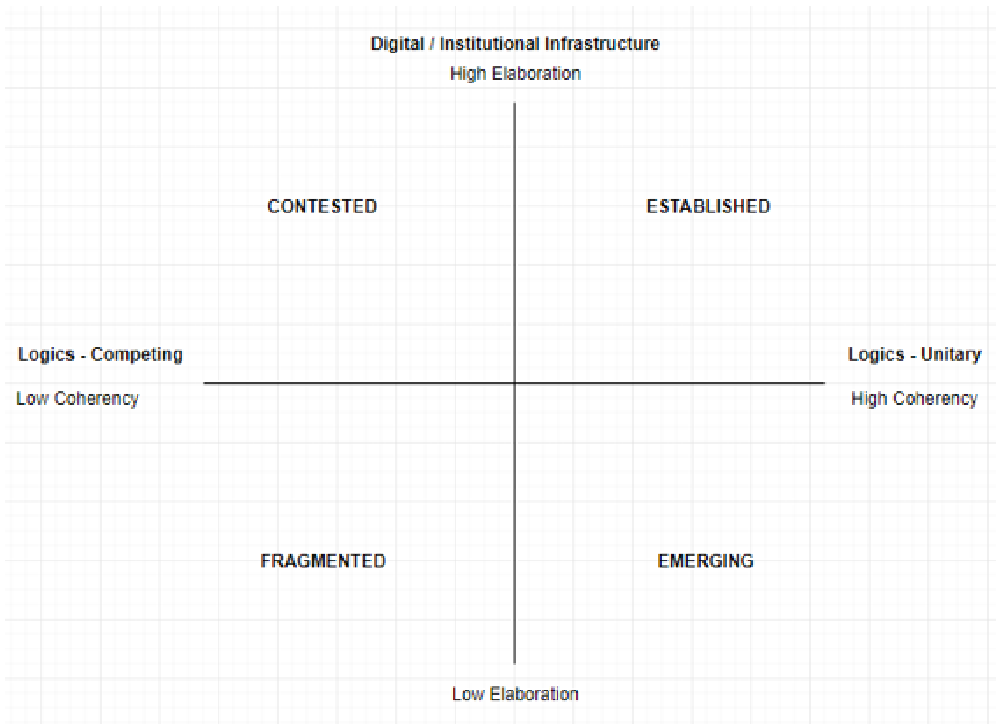
The paper’s core contribution is a 2x2 matrix that defines the "state of the field" based on two axes:
- Coherency of Logics: Do the players (government, tech firms, citizens) agree on the "why" and "how" of the technology?
- Infrastructure Elaboration: Are the rules, standards, and technical benchmarks mature?
The Three Pillars of Digital Infrastructure
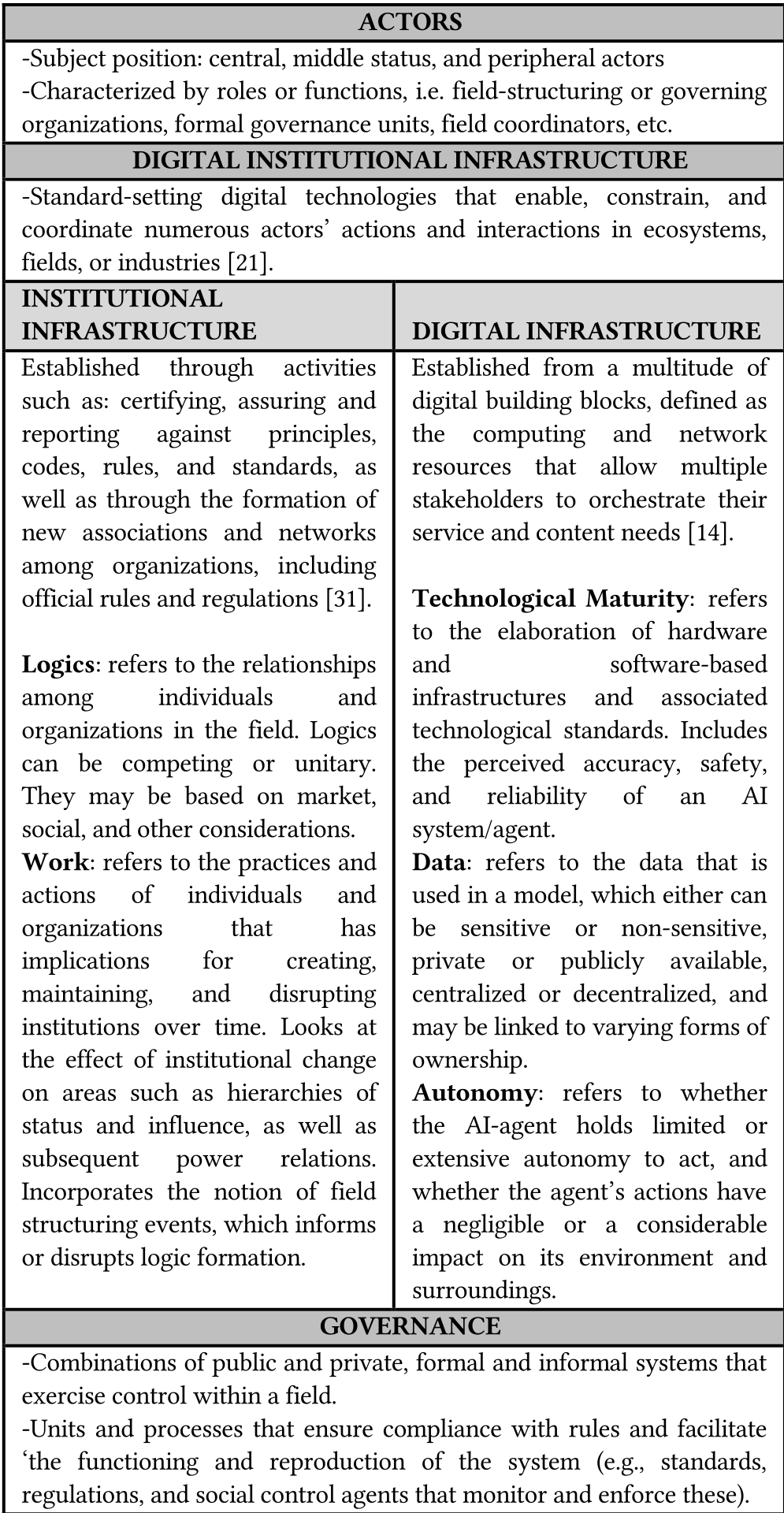
To give this framework teeth, Larsen introduces three analytical constructs to evaluate AI:
- Technological Maturity: It's not just "Does it work?" but "Are there certifications and standards?"
- Data: Is the training data sensitive, biased, or scraped without consent?
- AI Autonomy: Does the agent have the power to make high-stakes decisions (e.g., medical diagnosis vs. Netflix recommendations)?
Deep Dive: The Case of Facial Recognition (FRT)
The paper applies this framework to FRT in the USA, revealing a classic "Fragmented/Contested" field:
- The Conflict: Tech firms (Central Actors) push for market efficiency, while activists (Peripheral Actors) highlight racial bias.
- The Paradox: Technically, algorithms are 99% accurate on standard tests. Socially, they are "immature" because they fail in real-world public feeds and lack a "Right of Redress."
- Field-Structuring Events: The 2020 protests against police brutality served as a shock, forcing IBM and Amazon into self-regulation through moratoria because the institutional infrastructure (federal law) was simply missing.
Experimental Pathways: How Fields Evolve
Larsen maps different trajectories for AI technologies:
- Autonomous Vehicles (AV): Currently "Emerging/Aligning." They inherit the existing "Auto Logics" but are stalled because the "Liability Logic" (who pays when a car crashes?) is being rewritten.
- Recommender Engines: Once "Established," now moving back toward "Contested" as public awareness of "echo chambers" and data privacy grows.
Critical Insights & Conclusion
The paper concludes that we are witnessing an ontological reversal: previously, technology supported humans; now, AI agents increasingly "organize" and "control" human data flows.
Future Outlook: The author argues for Adaptive Governance. We cannot rely on static laws. Instead, we need:
- Algorithmic Auditing: Continual "health checks" for AI systems.
- Institutional Engineering: Co-inventing rules with stakeholders (engineers + ethicists + citizens) to ensure that the "frozen values" in the code align with society.
The takeaway for tech leaders is clear: Legitimacy is a prerequisite for scaling. If you ignore the institutional infrastructure, your "digital" achievement will eventually be rejected by the social system it inhabits.