
Beyond the Black Box: Navigating the Frontier of GeoAI (2020–2026)
AI and Machine Learning in Geospatial Analysis: Advances, Biases, and Future Directions (2020–2026)
This review synthesizes the evolution of Geospatial AI (GeoAI) from 2020 to 2026, highlighting the transition from rule-based statistics to deep learning architectures like Vision Transformers and Foundation Models (e.g., SatMAE, Prithvi). It identifies a shift toward cloud-integrated, data-driven intelligence that enables petabyte-scale Earth observation and urban analytics.
TL;DR
The integration of AI into geospatial sciences has moved from simple classification to the era of Foundation Models and Vision Transformers. While we can now process petabytes of satellite imagery in near real-time, the field faces a "geographic reality check." This review argues that without addressing spatial bias and the "black-box" nature of current models, GeoAI risks becoming a tool that reinforces global digital divides rather than solving them.
The Evolution of Spatial Intelligence: From Rules to Foundation Models
For decades, GIS relied on human-defined rules. The period between 2020 and 2026 has completely upended this. We have moved through the CNN Era (focused on local pixel features) into the Transformer Era, where models capture global dependencies across entire landscapes.
The current cutting edge is defined by Foundation Models like Prithvi and SatMAE. These are pre-trained on massive unlabeled datasets, allowing for "zero-shot" classification—meaning a model can identify land-use changes in a region it has never "seen" during specific training.
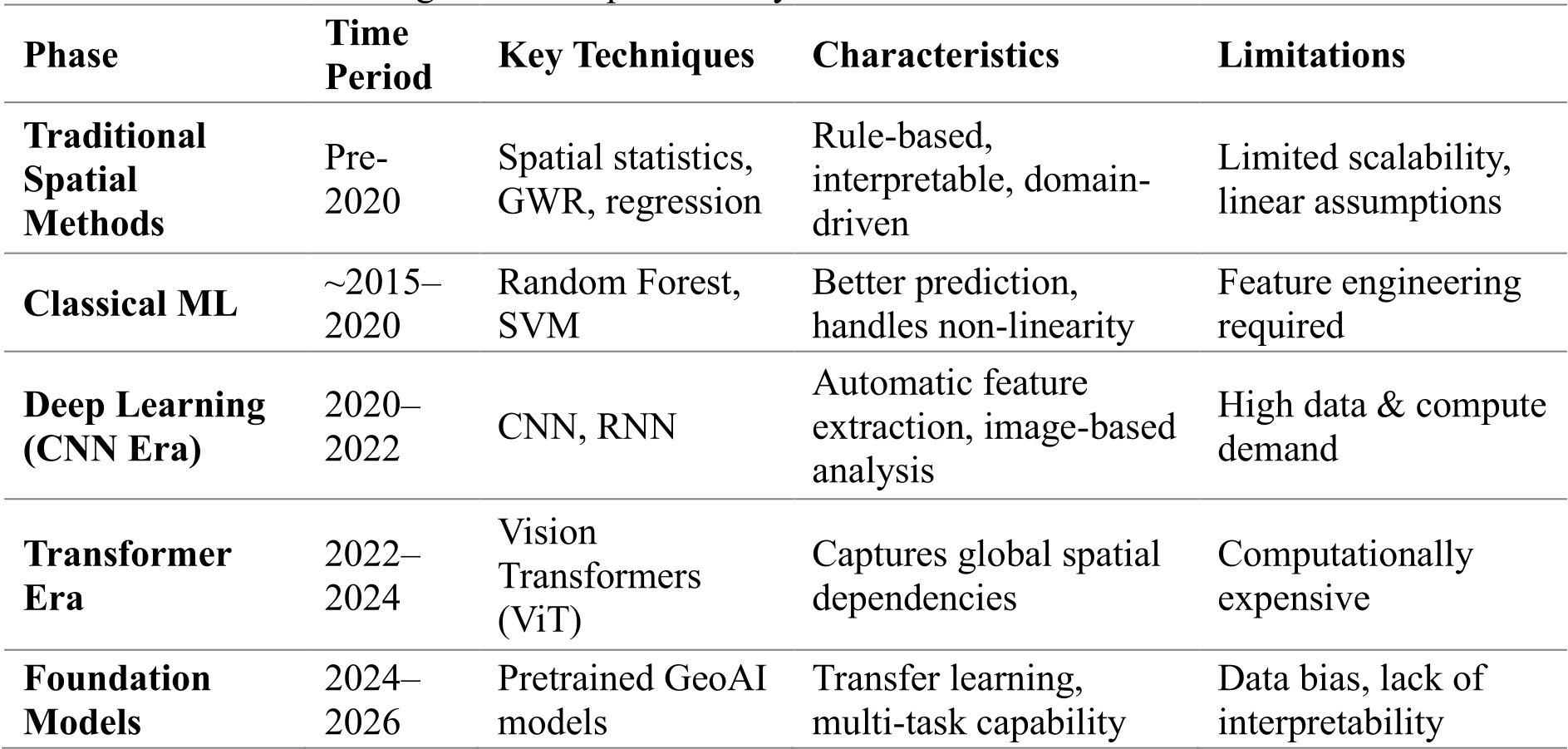
The "Spatial Gap": Why Your Model Fails in the Global South
The paper highlights a critical technical and ethical failure: Spatial Heterogeneity. Conventional ML assumes that data points are independent. Geography tells us the opposite (Tobler’s First Law).
Most SOTA (State-of-the-Art) models are trained on high-resolution data from the Global North. When these models are applied to the Global South, they often fail because they don't understand the local "place-based context." This isn't just a technical bug; it’s a systemic bias fueled by:
- Commercial Data Monopolies: Platforms like Google Earth Engine control the infrastructure.
- Algorithmic Opacity: "Black box" models don't explain why a flood risk was predicted, making them dangerous for policy-making.
Methodology: The Rise of Hybrid and Physics-Informed GeoAI
How do we fix this? The paper points toward Hybrid Process-AI frameworks. Instead of letting the AI guess the laws of physics, we bake them into the loss function.
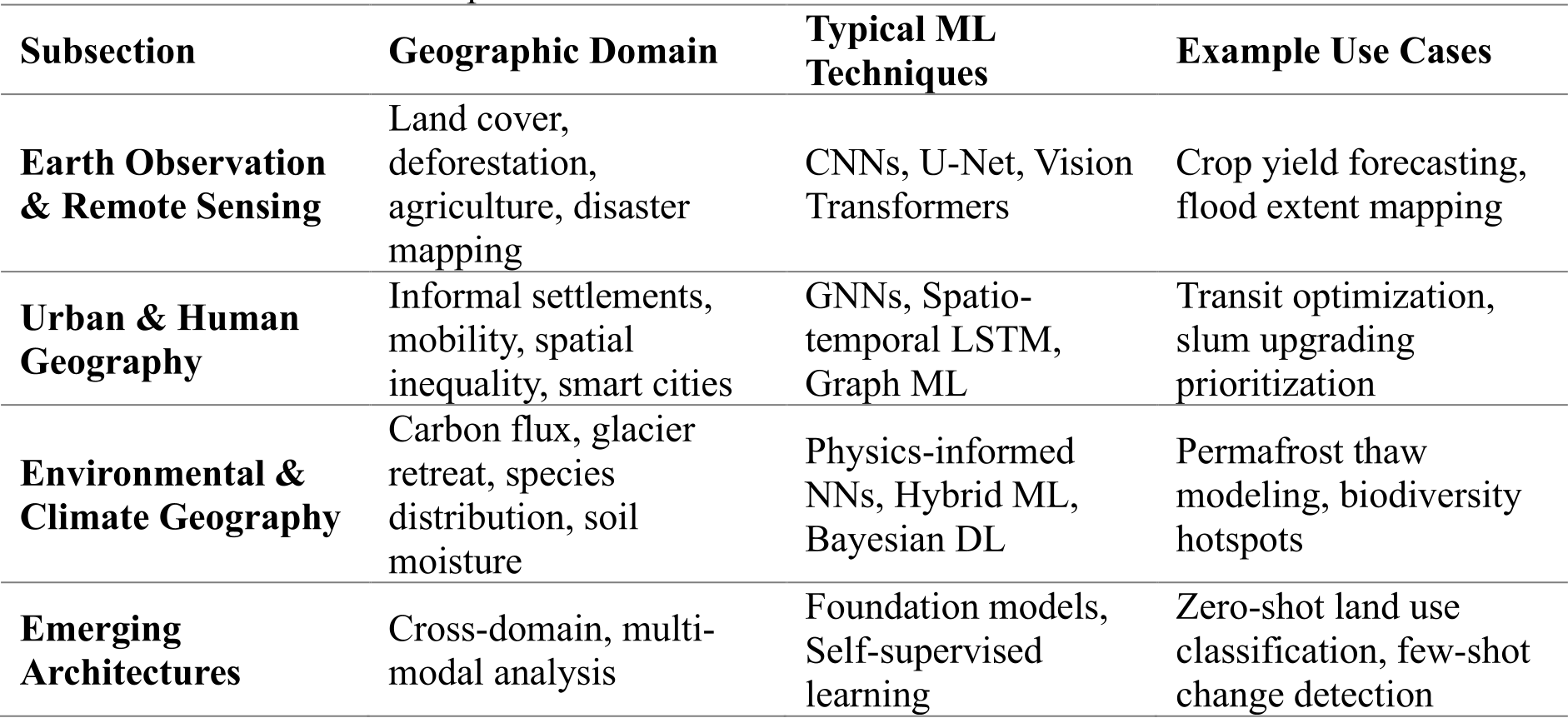
By combining Graph Neural Networks (GNNs) for urban transport and Physics-Informed NNs for climate modeling, researchers are creating models that are shorter on "hallucinations" and longer on scientific validity.
Ethical Governance and Surveillance Risks
As resolution increases, so does the risk of unauthorized surveillance. The paper warns that GeoAI can inadvertently enable mass monitoring in sensitive zones (e.g., informal settlements). The solution lies in Federated Learning, where models are trained locally on devices or regional servers without ever moving sensitive raw data to a central cloud controlled by a foreign entity.
The Roadmap: Toward "Geographic Wisdom"
The author concludes with a 3-step roadmap for the industry:
- Short-term (1-3 yrs): Mandatory "Spatial Bias Statements" in all published research.
- Mid-term (3-5 yrs): Shifting to "Edge AI" to reduce dependence on Western cloud providers.
- Long-term: Achieving Spatial Justice, where local communities participate in the co-design of the algorithms that govern their land.
Critical Analysis & Conclusion
While the technological leaps of the last six years are impressive, this paper serves as a necessary sobering perspective. The "wisdom" in Wisdom Vortex isn't about code—it's about the intersection of human-environment interaction and computational power.
Future Work: The real frontier isn't just "bigger models," but "spatially aware" models that respect scale, culture, and the physical laws of our planet.