
Telecom AI: Turning Big Data into the Engine of Digital Transformation
AI: Opportunities and Challenges - The Optimal Exploitation of (Telecom) Corporate Data
This paper explores the strategic adoption of Artificial Intelligence (AI) and Big Data within the telecommunications industry, specifically focusing on the OTE Group's digital transformation journey. It identifies key operational areas—from network management to customer service—where AI serves as the primary engine for cross-sector innovation and service modernization.
TL;DR
The telecommunications industry is at a crossroads where traditional revenue streams (voice and text) are cannibalized by digital disruption. This paper outlines how AI and Big Data are no longer optional extras but the core fuel for survival. By moving beyond infrastructure management into AI-driven customer centricity and operational automation, telcos can transform from "dumb pipes" into intelligent data hubs.
The Motivation: From Data Rich to Insight Poor
Telecommunications operators sit on a goldmine of data—mobility patterns, billing cycles, sales records, and network logs. However, the paper identifies a paradox: while data volume is reaching Zettabyte scales, European telcos often remain "weak players" compared to US and Asian counterparts. The core bottleneck isn't the lack of data, but the complexity of corporate environments and a lack of digital maturity.
The research intuition here is simple: if data is the fuel, AI is the engine. To remain competitive, operators must shift focus from simply managing a network to providing high-value, personalized services.
Methodology: The Data Exploitation Lifecycle
The authors propose a structured journey to bridge the gap between raw data and business value. This journey isn't just about training a model; it's about the entire pipeline of data preparation, cleaning, and ethical oversight.
The AI-Driven Architecture
The shift from NOC (Network Operation Center) to SOC (Service Operation Center) represents the most critical architectural evolution. In a SOC, AI tools provide real-time diagnostics and predictive capabilities that human administrators simply cannot match.

Key Use Cases Explored:
- AIOps (Network Management): Moving beyond manual troubleshooting to real-time anomaly detection and "self-healing" networks.
- Conversational AI: Implementing NLP to handle 80% of customer queries, allowing human agents to focus on complex problem-solving.
- Machine Vision: Utilizing AI in retail stores (similar to Amazon Go) for stock replenishment and fraudulent behavior detection.
- Sales Forecasting: Leveraging ML to predict hardware demand and optimize supply chain efficiency during global disruptions like pandemics.
Critical Challenges: The "Production Gap"
The paper is brutally honest about the hurdles. It’s relatively easy to build a Proof-of-Concept (PoC), but moving that model into production at a telecom scale involves:
- Infrastructure Silos: Traditional enterprise systems are not built for real-time, streaming big data.
- The Talent Deficit: 42% of organizations list a lack of analytical skills as their top barrier.
- Data Ethics and GDPR: In Europe, AI exploitation must navigate the fine line between personalization and privacy. Trust is "difficult to build but easy to lose."
Experiments & Performance: Measuring the Transformation
The effectiveness of these strategies is tracked through cross-functional Pilot projects at OTE Group.
| Use Case | Core Opportunity | Main Challenge |
|---|---|---|
| Chatbots & NLP | Customer Retension | Privacy/Analytical Skills |
| Robotics | Process Automation | Tech Maturity |
| Predictive Maintenance | Operational Optimization | High Infrastructure Cost |
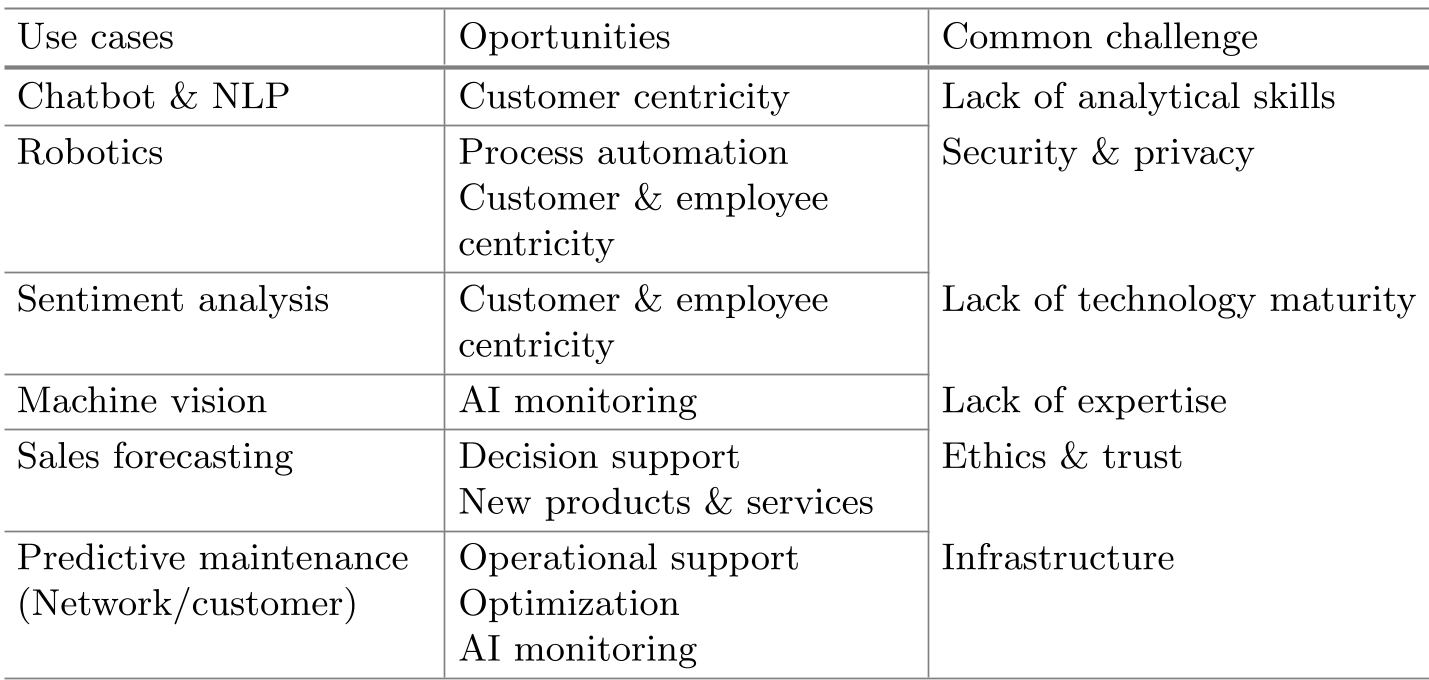
The results indicate that AI is a "game changer" for customer-facing industries, elevating experience through virtual assistants and proactive hardware monitoring, which directly reduces churn.
Deep Insight & Conclusion
The core takeaway is that Digital Transformation is 20% technology and 80% people and process. Telecommunications companies must adopt an "AI Lifecycle" that aligns with business needs rather than chasing hype.
Limitations: The paper reflects work-in-progress, and many use cases are still in the PoC phase. The scalability of these solutions across different regulatory environments (beyond Greece and the EU) remains a challenge.
Future Outlook: As we move toward 5G and 6G, the complexity of network management will exceed human capability entirely. The "Innovation Centers" within telcos must evolve into specialized AI engineering hubs to manage the next frontier of hyper-personalized connectivity.