ERA: Scaling the Scientific Method through LLM-Driven Tree Search
An AI system to help scientists write expert-level empirical software
The Empirical Research Assistance (ERA) system automates the creation of expert-level scientific software by combining Large Language Models (LLMs) with Tree Search (TS) to maximize measurable quality metrics. ERA achieved SOTA results in single-cell genomics (outperforming top human methods on the OpenProblems leaderboard) and epidemiology (beating the CDC's COVID-19 hospitalization ensemble).
TL;DR
The "ERA" (Empirical Research Assistance) system by Google DeepMind and Google Research represents a paradigm shift in computational science. By framing software engineering as a "scorable task," the authors use an LLM-guided Tree Search to autonomously discover algorithms that outperform human-developed SOTA in genomics, epidemiology, and geospatial analysis.
Contextualizing ERA: From AutoML to Auto-Science
Traditional Automated Machine Learning (AutoML) is often a "search for hyperparameters" within a rigid, predefined box. ERA breaks this box. It doesn't just tune a model; it rewrites the software architecture. By treating code as a mutable entity and high-level research ideas (from PDFs and textbooks) as prompts, ERA explores the "manifold of possible algorithms" with a level of rigor and scale that no human team can match.
Methodology: The Architecture of Discovery
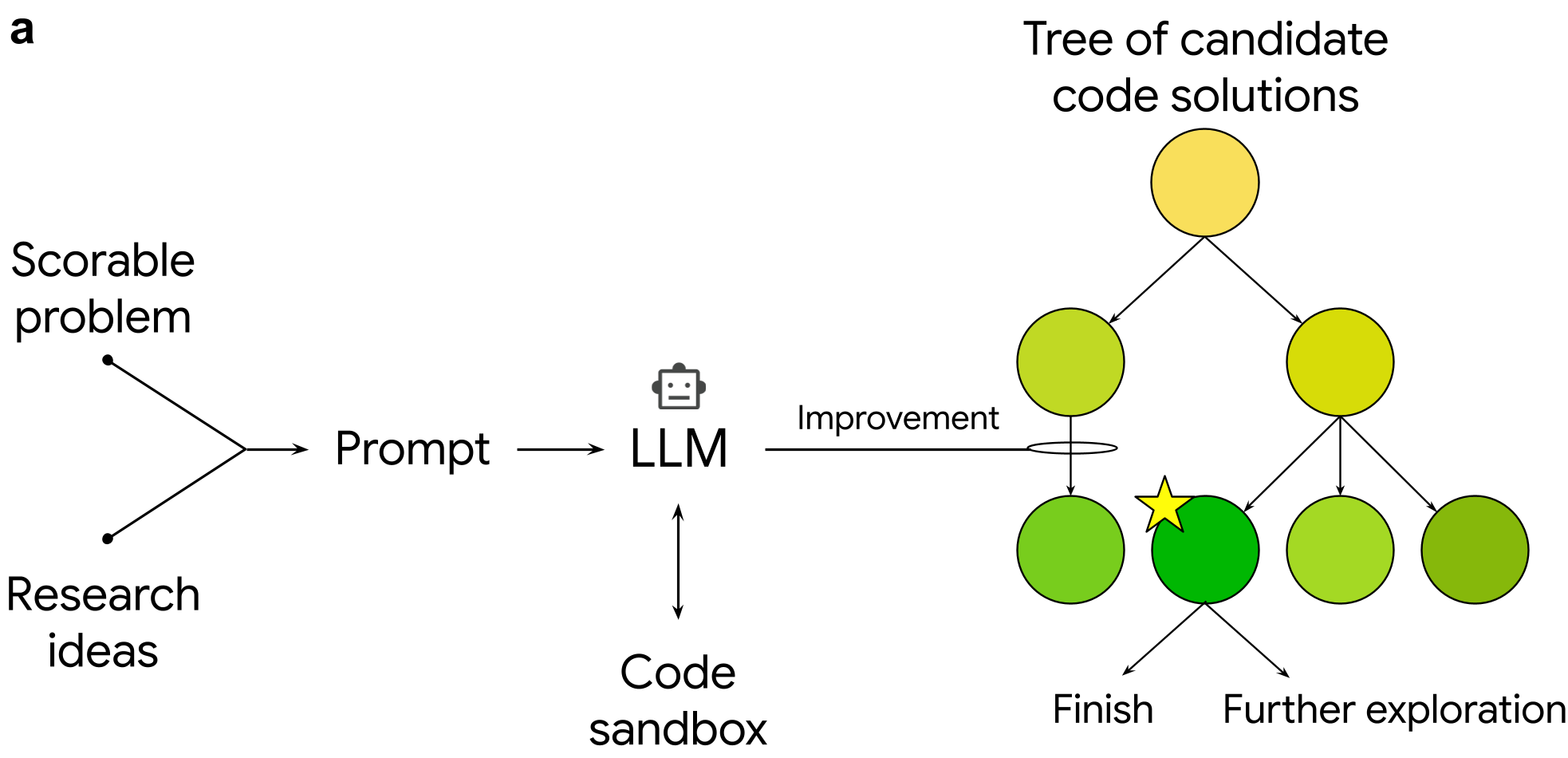
The core of ERA is a closed-loop system:
- Input: A task description, a measurable quality metric (e.g., Accuracy, WIS, mIoU), and external research ideas.
- Tree Search (TS): Utilizing a PUCT-based acquisition score, the system balances exploitation (refining the best-known code) and exploration (trying wild new algorithmic branches).
- LLM-Driven Mutation: Unlike genetic algorithms that use random bit-flips, ERA uses an LLM (Gemini 2.5) to perform semantic mutations—meaningful, logical rewrites of the code.
The Secret Sauce: Idea Recombination
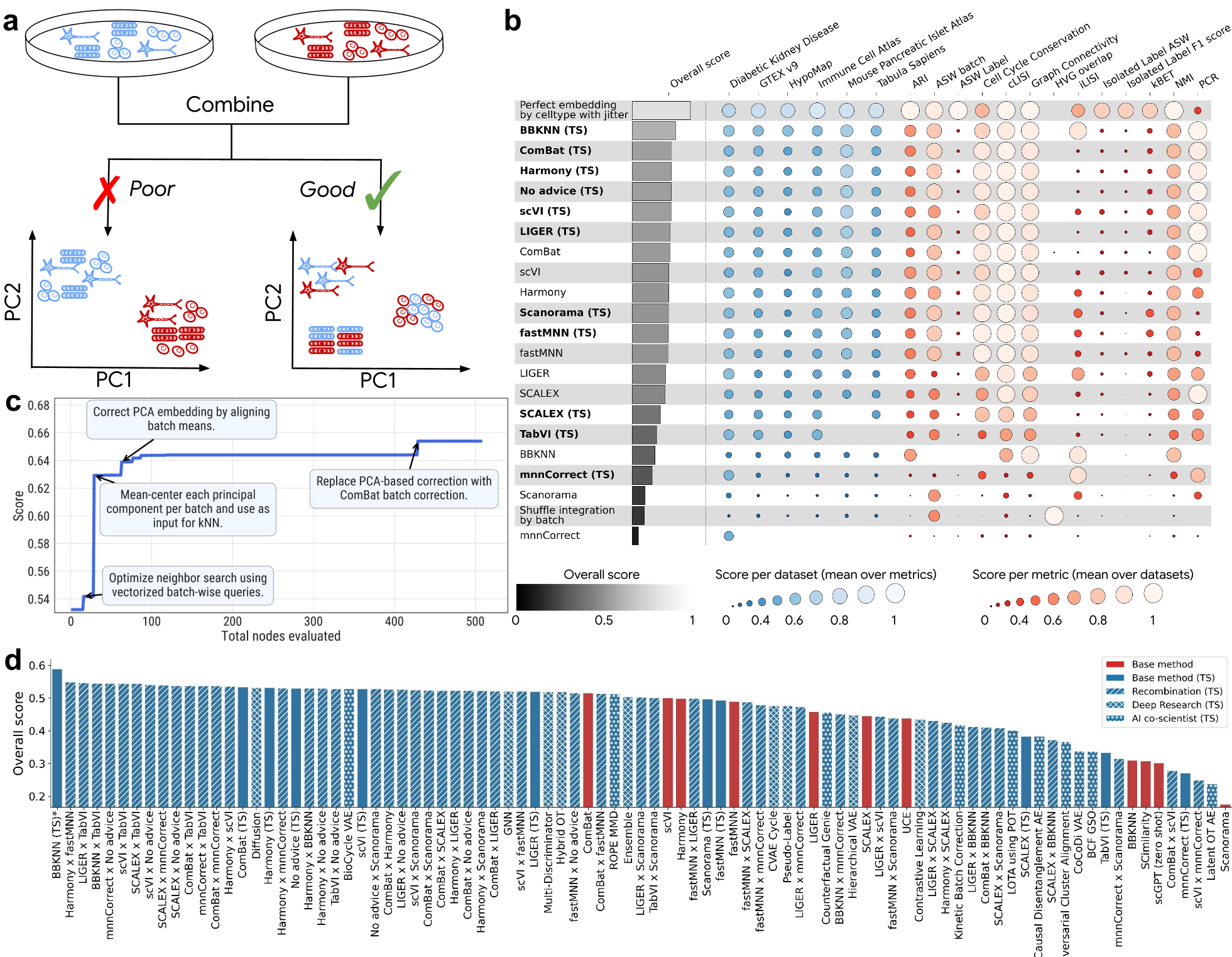
One of ERA's most impressive feats is recombining expert ideas. For instance, it took the concepts from Combat (a linear correction method) and BBKNN (a graph-based method) and merged them into a hybrid that outperformed both. This mimics the human scientific process of "standing on the shoulders of giants," but at machine speed.
Benchmarking Expert-Level Performance
The paper validates ERA across remarkably diverse and difficult fields:
1. Single-Cell Genomics (scRNA-seq)
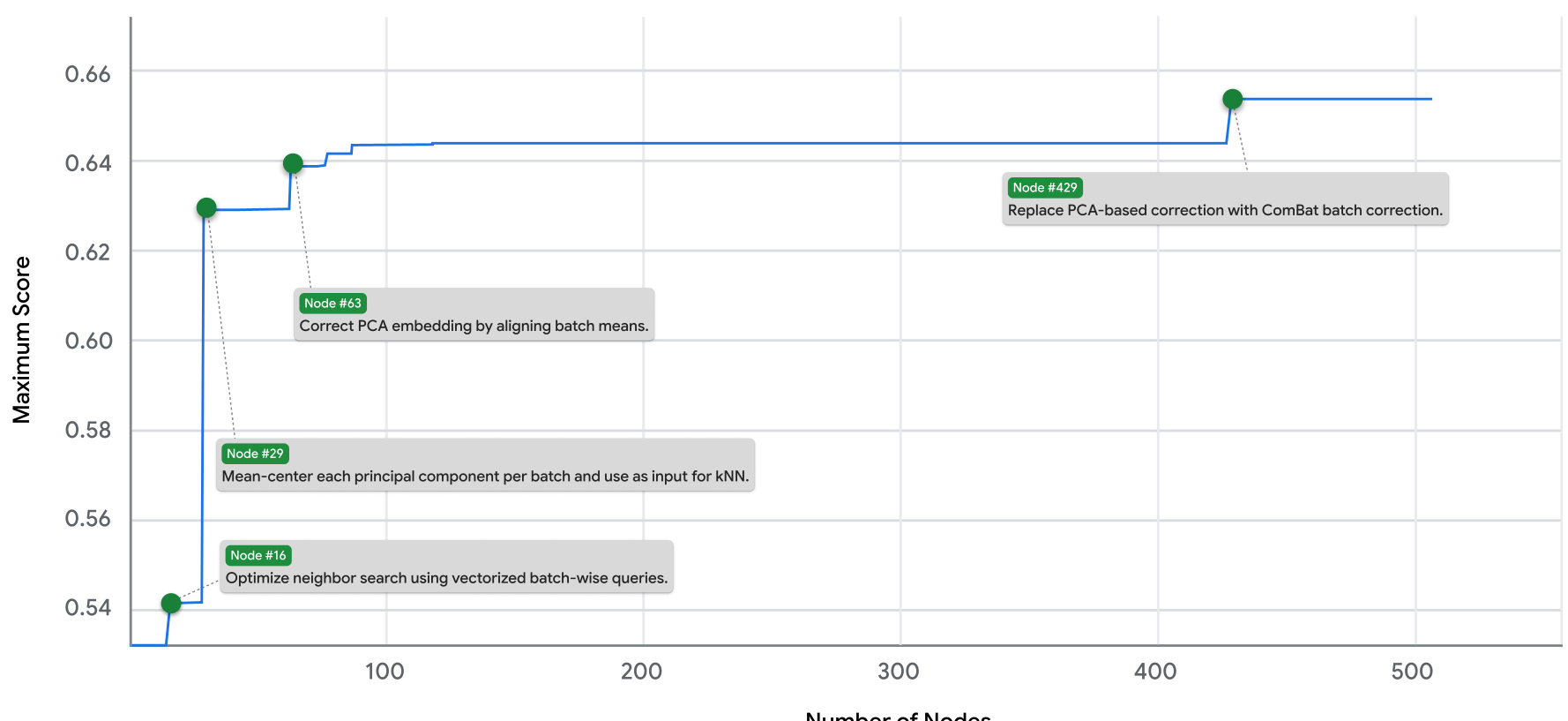
In the task of "Batch Integration"—removing noise while preserving biological signal in millions of cells—ERA created 40 novel methods that sat atop the OpenProblems leaderboard.
- Result: 14% improvement over the best human-published method.
2. COVID-19 Forecasting
Forecasting hospitalizations is notoriously difficult due to noisy, lagged data. ERA’s "Google Retrospective" model achieved a lower Weighted Interval Score (WIS) in the majority of US states compared to the official CDC ensemble.
Critical Insights: Why Does It Work?
- Backtracking: Standard LLM prompting (Best-of-N) is "greedy" and often gets stuck in local optima. ERA’s Tree Search allows it to backtrack and branch out from a month-old idea if the current path plateaus.
- Prompt-Level Innovation: By summarizing academic PDFs using a specialized LLM and feeding that summary into the ERA loop, the system can implement algorithms for which no public code exists (e.g., TabVI).
- Scalability: The system generated solutions in hours or days that typically take PhD students months to refine.
Critical Analysis & Future Outlook
While ERA is a powerhouse for "scorable tasks," the authors rightly note the distinction between empirical optimization and genuine theoretical discovery. ERA is world-class at solving the "How," but the "Why" (causal mechanisms) still largely relies on the initial framing by human scientists.
However, the implications are clear: fields with clear "scoreboards"—like bioinformatics, climate modeling, and quantitative finance—are about to experience a massive acceleration in algorithmic quality.
Takeaway
ERA is a "force multiplier" for science. It proves that the bottleneck of discovery isn't just data, but the speed at which we can iterate on the software that processes that data.