
DriveGAN: Reimagining the Windshield as a Gateway to Artistic Reality
Transformation of Landscape into Artistic and Cultural Video Using AI for Future Car
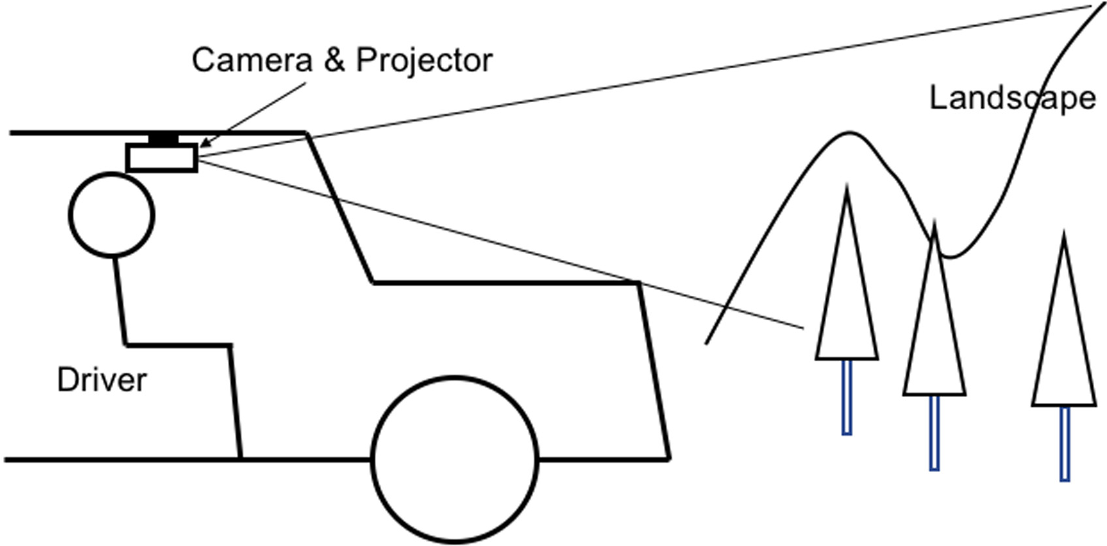
The paper introduces a real-time entertainment system for future autonomous vehicles that transforms exterior landscapes into artistic videos using CycleGAN. By converting real-world road scenes into various styles like Kandinsky or Japanese Ikebana and projecting them onto the car's windshield, it redefines the vehicle interior as an immersive art space.
TL;DR
Imagine cruising through a mundane traffic jam only to see the gray urban sprawl transformed into a vibrant Kandinsky painting on your windshield. This paper proposes a system for future autonomous cars that uses CycleGAN to turn real-time landscape feeds into artistic videos. By introducing a specific Frame Loss (DriveGAN), the authors ensure the art remains smooth and flicker-free even at high driving speeds.
Background: The Car as an Artistic Cocoon
As we approach Level 5 autonomous driving, the interior of a car evolves from a cockpit into a "living room." While others suggest watching movies or gaming, the authors of this study argue for an augmented reality approach. They posit that the scenery outside—often boring or "trashed"—is a raw material for art. By projecting AI-transformed videos onto the windshield, the car becomes a mobile gallery.
The Core Problem: The Flicker of AI Art
While CycleGAN is a SOTA method for unpaired image-to-image translation (e.g., turning a photo into a Monet), it treats every video frame as an isolated image. When these frames are stitched back together, the result is "flickering"—the colors and shapes jump erratically because the AI doesn't know what the previous frame looked like. For a driver, this isn't relaxing; it's a headache.
Methodology: From CycleGAN to DriveGAN
The authors' approach involves a dual-layered contribution:
1. Multi-Style Integration
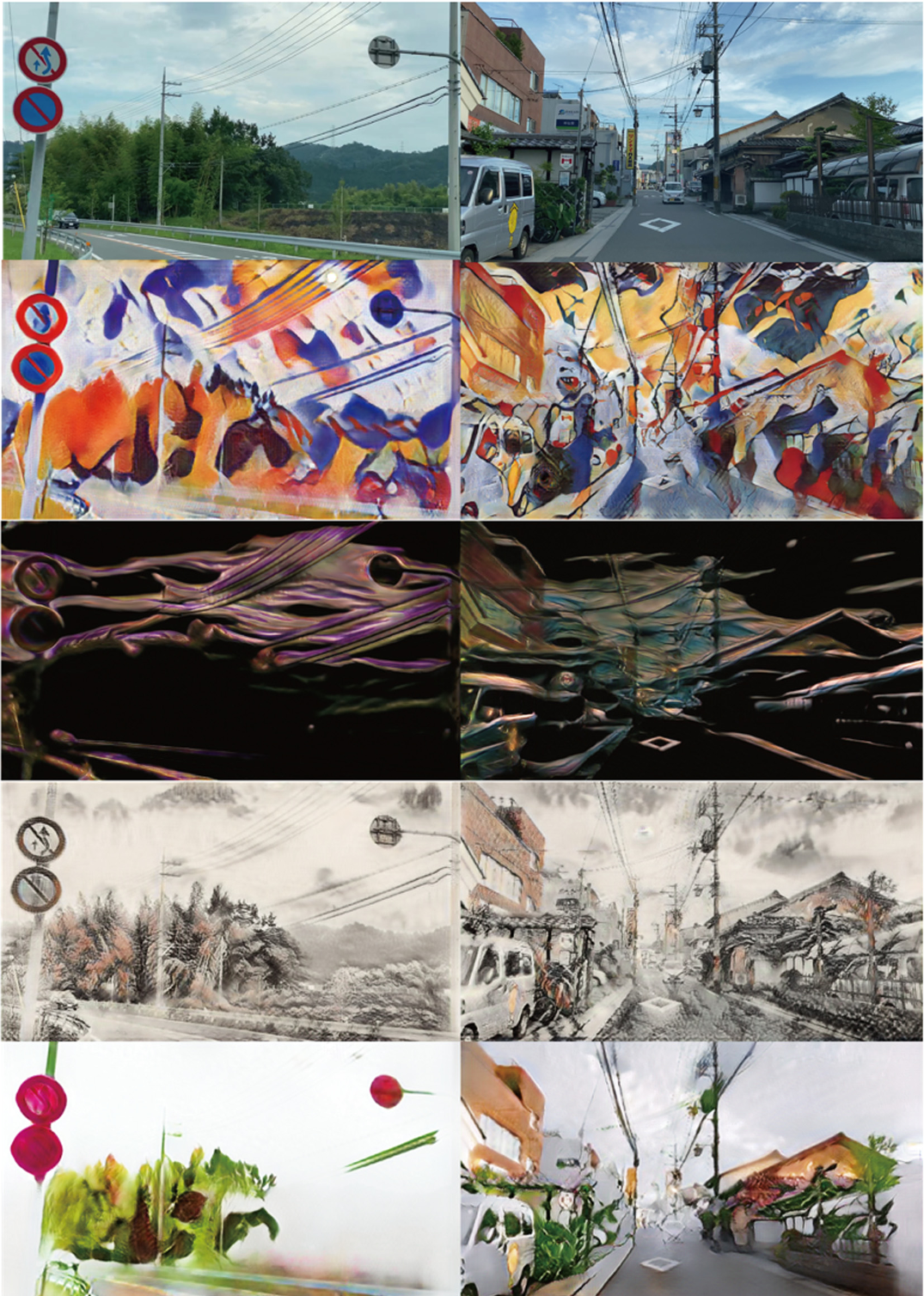
The system maps road scenes (Dataset A) to four distinct artistic domains (Datasets B1-B4):
- Kandinsky: Western abstract art.
- Sound of Ikebana: Japanese liquid-motion art.
- Sansui: Traditional Oriental landscape painting.
- Ikebana: Traditional floral arrangements.
2. DriveGAN and Frame Loss
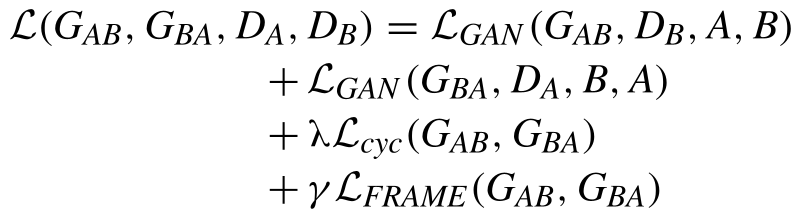
To fix the flickering, the researchers introduced DriveGAN. They added a temporal constraint called Frame Loss () to the standard CycleGAN objective.
The logic is elegant: it forces the generator to ensure that the difference between two consecutive transformed frames () matches the difference between the two original frames (). If the road didn't change much in 1/30th of a second, the art shouldn't either.
Experimental Insights: Urban vs. Rural
The study found a fascinating correlation between the input environment and the effectiveness of the art style:
- Cityscapes: Abstract styles (Kandinsky/Ikebana) performed best because their sharp lines and geometric forms mapped well to buildings and traffic lights.
- Countryside: Oriental Sansui paintings were more effective, as their "ink-wash" aesthetic naturally inherited the organic curves of mountains and trees.
Critical Analysis & Future Outlook
Takeaway: This paper moves GAN research from the lab to the "third space" of the car. It proves that style transfer isn't just for static photos; with the right temporal constraints, it can become a real-time UI/UX element.
Limitations:
- The transformation is currently evaluated via "eye-checked" qualitative assessment rather than quantitative temporal metrics (like warping error).
- The latency of the CycleGAN inference needs to be extremely low to prevent "visual lag" for a driver who can still see the faint outline of the real world behind the projection.
Future Work: The authors plan to explore Anime-style transformations and conduct broader user studies to see if driving in a "Ghibli-esque" world reduces passenger stress.
Main Reference: "Transformation of Landscape into Artistic and Cultural Video Using AI for Future Car" - Kyoto University & Phenikaa University.