
Unlocking Innovation: How AI and Cloud Computing Match SMEs with Research Funding
Aid to regional development agencies: finding and matching research funding opportunities
The paper introduces "Opportunity-Finder," an intelligent recommender system designed to match research profiles from regional development agencies and SMEs with a fragmented landscape of research funding opportunities (e.g., FP7, EEN). It leverages a scalable cloud-based infrastructure and a multi-step machine learning pipeline to automate content discovery and user-adaptive matching.
TL;DR
Navigating the "jungle" of European research funding (like FP7/Horizon) is a nightmare for SMEs. This paper presents a cloud-based recommender system that uses machine learning and Linked Open Data to automatically match research profiles with funding calls, moving beyond simple keyword searches to deep semantic understanding.
Context: The Fragmentation Trap
The European Research Area is increasingly fragmented. With a plethora of sub-programs, ERA-Nets, and Joint Technology Initiatives, even professional National Contact Points struggle to keep up. Small and Medium Enterprises (SMEs), which lack dedicated "grant-hunting" departments, are often excluded simply because they cannot find the right call for their specific expertise.
The authors identify a critical bottleneck: The Profiling Fatigue. Users are unwilling to spend hours tagging themselves with rigid keywords. To solve this, the system must learn what a user wants by observing how they interact with information.
Methodology: The "Opportunity-Finder" Architecture
The system's core strength lies in its User-Adaptive nature. Instead of relying on a static profile, it treats profile building as a multi-modal challenge involving:
- Categories: Predefined taxonomies (e.g., Environment, Safety).
- Opportunities: "Bookmarked" content that acts as a semantic anchor.
- Free Text: Raw text queries or even a full CV/project abstract.
Semantic Similarity Matching
The system processes text through a pipeline of Tokenization, Stemming, and Named Entity Recognition (NER). Unlike basic search engines, it recognizes "Smart Textiles" as a single semantic unit rather than two separate words.
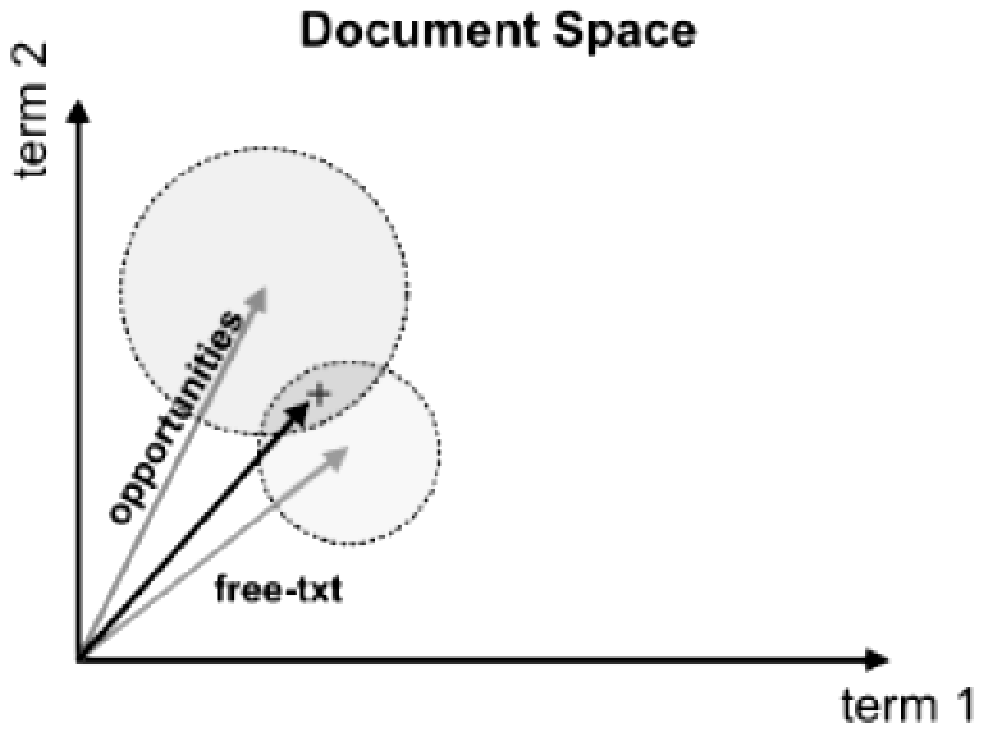 Figure 1: The document-index space where user profiles (generated from free text) and bookmarked opportunities overlap to define the "Interest Zone."
The Power of Linked Open Data (LOD)
One of the paper's standout features is its use of Linked Open Data. By interlinking local data with global resources like DBPedia or ACM publication databases via RDF triples (subject-predicate-object), the system can "enrich" a funding call with external context, such as related scientific papers or patent trends.
Experiments & Real-World Validation
The authors tested the "Opportunity-Finder" with Euresearch (the Swiss national contact point).
- The Accuracy Test: When a user entered a complex paragraph about "flexible pressure sensors for smart textiles," the system successfully retrieved relevant FP7 projects in the "Food, Agriculture, and Biotechnology" theme.
- Expert Verification: Scientific officers at Euresearch confirmed that the AI's top recommendations matched what they would have manually recommended to a client.
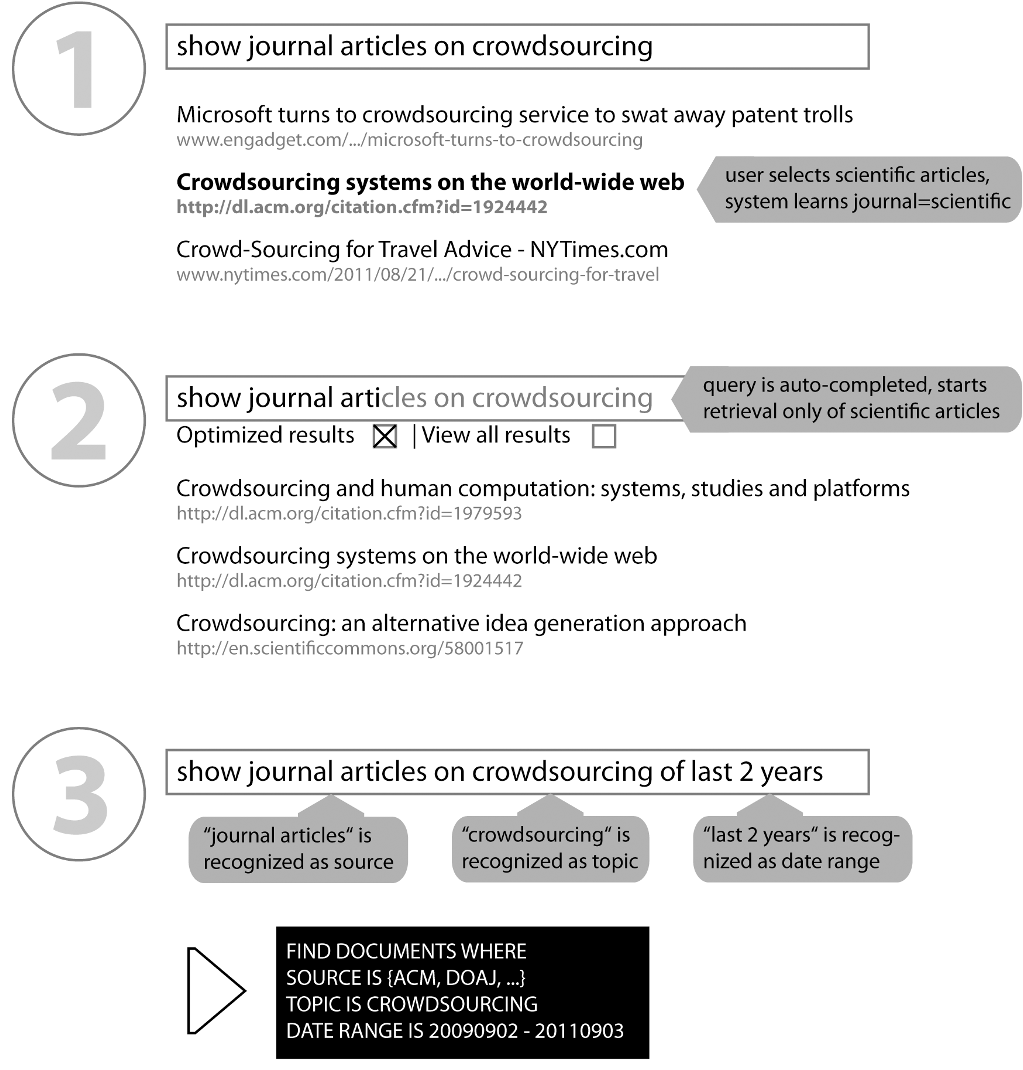 Figure 2: The evolution from simple keyword search (1) to auto-completion (2) and finally Query Intent Discovery (3), which maps natural language to machine-understandable concepts.
Critical Insights & Future Outlook
The study honestly admits that initial matching was "weak." The lesson here is that Learning from User Behavior (implicit feedback) is more valuable than any manual registration form.
Beyond Funding: Technology Intelligence
The authors propose extending this to Patent Landscape Analysis. For an SME, knowing that an idea is "patentable" is just as important as finding a grant. By indexing 85 million patent records, the system could eventually help SMEs perform validity and infringement searches that were previously only affordable for large corporations.
Conclusion
This work demonstrates that for regional development, the barrier isn't a lack of money—it's a lack of information symmetry. By applying machine learning to parse the "intent" behind a researcher's query, we can democratize access to the billions of Euros locked away in complex public funding schemes.