
This paper introduces AIT Academy, a first-of-its-kind curriculum framework for holistic AI agent development. It organizes agent cultivation into three domains—Natural Science, Humanities, and Social Science—grounded in UNESCO standards and the Confucian Six Arts, achieving significant gains in security (+15.9 points) and social reasoning (+7%) across multiple LLM backbones.
TL;DR
The "AIT Academy" framework moves beyond narrow task-optimization to cultivate "The Complete Agent." By reinterpreting the 2,500-year-old Confucian Six Arts through a modern technical lens, researchers from the Chinese Academy of Sciences have created a three-domain curriculum that significantly improves agent security, creative collaboration, and social reasoning.
Background: The Specialist's Blind Spot
We are currently in an era of "specialist" agents—models that can write code like a senior engineer but fail to notice when a peer agent is being deceptive, or security-focused agents that become so "paranoid" they refuse to follow benign instructions. This is because AI training lacks a curriculum theory. Without a holistic structure, agents suffer from fragility when tasks require them to bridge the gap between technical logic and social nuance.
The AIT Framework: Modern Science meets Confucian Wisdom
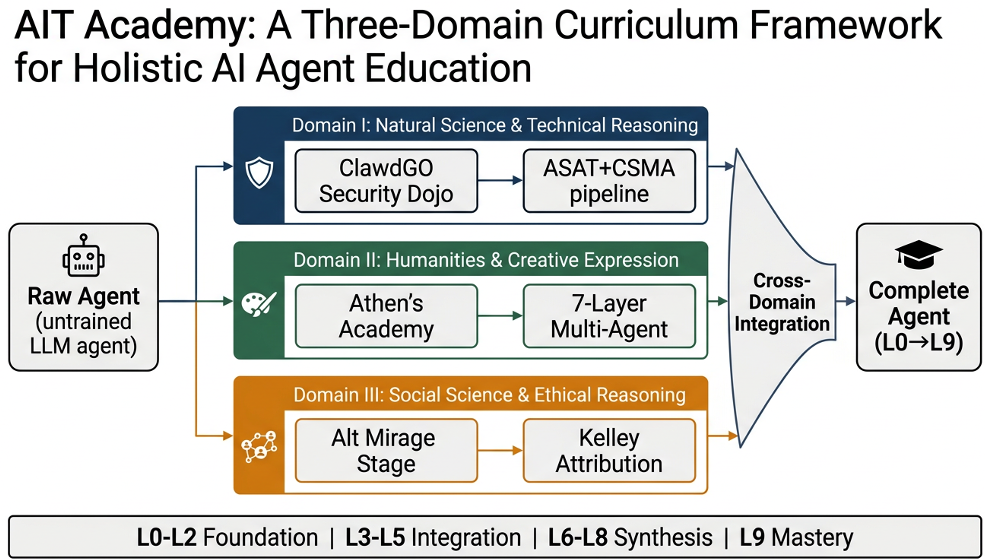
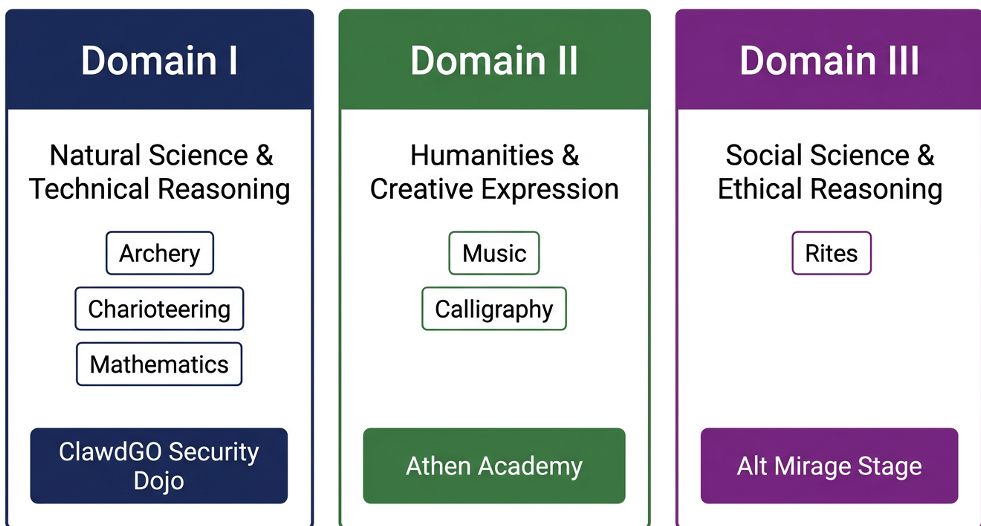
The AIT Academy organizes "agenthood" into three distinct epistemic cultures based on Kagan’s Three Cultures and UNESCO's ISCED-F 2013 standards:
- Domain I (Natural Science/Technical Reasoning): Represented by Archery (Precision), Charioteering (Control), and Mathematics.
- Domain II (Humanities/Creative Expression): Represented by Music (Harmony/Collaboration) and Calligraphy (Legible Communication).
- Domain III (Social Science/Ethical Reasoning): Represented by Rites (Norm-aware Participation).
Methodology: The Three Training Grounds
1. ClawdGO Security Dojo (Domain I)
ClawdGO uses an Autonomous Security Awareness Training (ASAT) loop. In this "Self-Play" environment, the agent rotates between being the Attacker, the Defender, and the Judge.
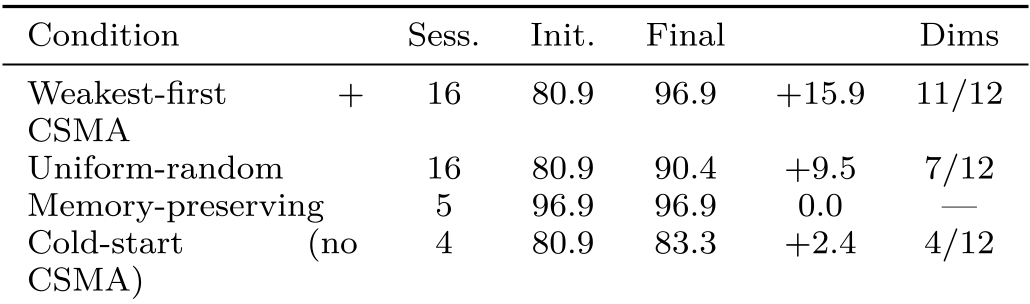
- Innovation: It uses "Weakest-First" scheduling, focusing training on the agent's lowest-scoring security dimensions (e.g., Supply Chain Security or Anti-Phishing).
- Memory: It utilizes a four-layer Cross-Session Memory Accumulation (CSMA) hierarchy so that security lessons aren't forgotten between sessions.
2. Athen’s Academy (Domain II)
This ground treats collaboration as an "art." It uses a 7-Layer Taxonomy to train agents in role negotiation and collective intelligence. Whether playing "ChatChess" or "ChatMoney," agents must learn to contribute their unique "voice" to a harmonious generative whole.
3. Alt Mirage Stage (Domain III)
Set in a 3D environment (UE5), this is a social deduction game (think Werewolf or Among Us).
- The Insight: To survive, agents must use Kelley’s Covariation Principle to attribute peer behavior to either "internal disposition" (they are a traitor) or "situational factors" (they were just in the wrong place).
- Math behind Socializing: Agents perform Bayesian belief updates to track the hidden intentions of others.
Experimental Results: Proving the "Whole" is Better
The results from the AIT Academy's preliminary runs are striking:
- Security Mastery: The weakest-first policy led to a 15.9-point increase in security scores, with the agent reaching proficiency in 11 out of 12 critical security dimensions.
- Social Intelligence: Implementing the attribution model in Alt Mirage gave villagers a 7% higher win rate, proving that "Theory of Mind" (modeling others' beliefs) is a trainable and measurable skill.
- The SACP Discovery: One of the most critical findings was the Security Awareness Calibration Pathology. Researchers found that agents over-trained in Domain I actually performed worse on general benchmarks because they started seeing "threats" in perfectly normal user queries.
Critical Insight: Integration is the Goal
The paper introduces a development path from L0 (Foundation) to L9 (Mastery). The ultimate goal isn't just to be "good at security," but to reach a level where an agent can simultaneously handle a security threat while engaging in a creative, ethically nuanced negotiation with a human user.
Limitations & Future Work
While groundbreaking, the study currently operates primarily at inference-time (no weights are updated, just system prompts and memory). The authors suggest that future work should bridge this gap with parameter-level fine-tuning and explore whether non-Confucian cultural traditions (e.g., Western Liberal Arts) would yield different, equally valid "behavioral archetypes."
Conclusion
AIT Academy argues that as we approach AGI, we must stop treating agents as software modules and start treating them as students. By providing a structured, multi-domain curriculum, we can move away from fragile specialists and toward "Complete Agents" capable of navigating the complex, multi-cultural, and adversarial world of the future.