
AUTrust: Quantifying the Invisible Bonds of Trust in Social Networks
AUTrust: A Practical Trust Measurement for Adjacent Users in Social Networks
AUTrust is a novel measurement model designed to quantify trust between adjacent users in social networks using a multi-dimensional approach. By integrating user similarity, interaction-based familiarity, and social reputation, the model achieves a more realistic, directed, and asymmetric trust assessment on a 10-million-level Tencent Weibo dataset.
TL;DR
Trust is the "dark matter" of social networks—vital yet often unmeasurable. AUTrust shifts the focus from nonadjacent user propagation to the fundamental building block: adjacent user trust. By analyzing user metadata and interaction patterns rather than relying on non-existent ratings, it constructs a directed, asymmetric trust graph that reflects real-world human dynamics.
Problem & Motivation: The "Given Trust" Fallacy
In academic trust modeling, many researchers rely on Transitive Trust: if A trusts B, and B trusts C, then A might trust C. However, this logic collapses if the initial link (A trusts B) is unknown.
Most social platforms like Twitter or Tencent Weibo do not have a "Rate your friend" button. Users are socially discouraged from publicly judging their acquaintances. This creates a data vacuum. Previous SOTA methods (like TidalTrust) often assume these weights are provided by the system, making them functionally useless for standard social network datasets. AUTrust addresses this by asking: Can we calculate trust using only the trails users leave behind?
Methodology: The Three Pillars of Trust
The authors propose that trust is a weighted sum of three distinct dimensions:
1. Similarity ()
Based on the "homophily" principle (birds of a feather flock together), this dimension uses Jaccard Coefficients and Cosine Similarity to compare user profiles (age, education, interests).
2. Familiarity ()
This is the dynamic component. It measures how often users interact (mentions, retweets, comments) and how many mutual friends they share. Crucially, interaction is asymmetric: Alice might comment on every post by Bob, but Bob may rarely reply.
3. Social Reputation ()
This is the base component. It evaluates a user's standing in the digital community based on Follower/Followee ratios and the quality of their content (virality).
 The core AUTrust formula balancing Similarity, Familiarity, and Reputation.
Experiments: Testing on a 10-Million Scale
The model was validated using the Tencent Weibo dataset. The scale of the experiment (2.3 million users and 50 million directed edges) provides significant statistical weight to the findings.
Key Insights from the Data:
- Familiarity is King: The experiment showed a much stronger correlation between comprehensive trust and interaction frequency than between trust and user similarity.
- Filtering the Noise: By setting a threshold (average trust), the authors filtered the noisy SNS graph into a Trust Social Network (TSN). Only about 21% of the original users made the cut, effectively filtering out potential spammers or "low-trust" bots who have many followers but zero meaningful interactions.
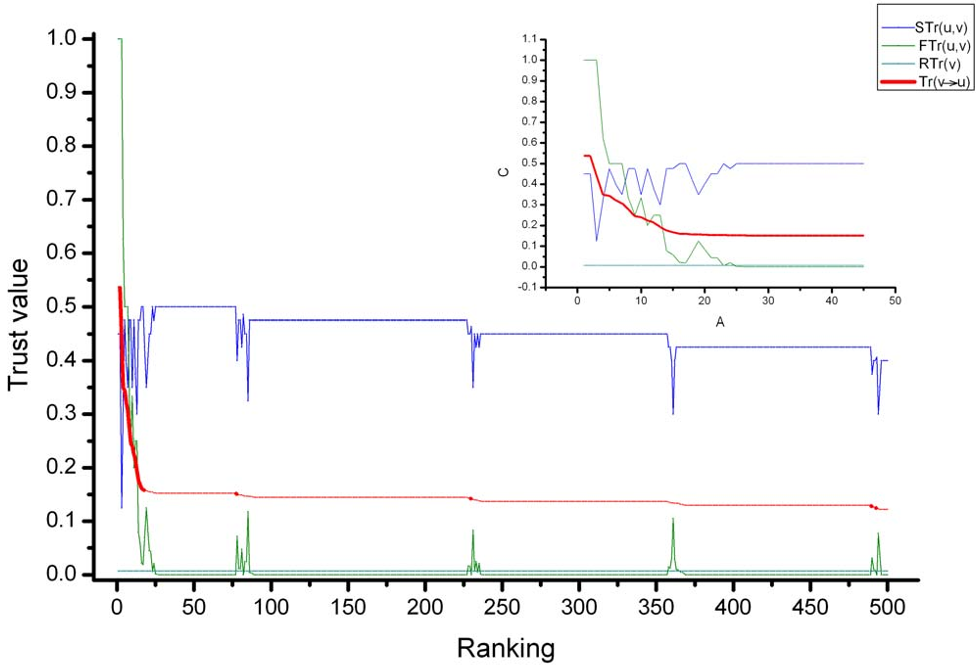 Analysis showing that for the top 500 trusted users, Familiarity (interaction-driven) tracks most closely with general trust.
Critical Analysis & Conclusion
AUTrust provides a practical framework for turning a "flat" social graph into a "weighted" trust graph. Its modular nature—where can be tuned—allows it to adapt to different platforms (e.g., weighing reputation more heavily for LinkedIn but familiarity more for WhatsApp).
Limitations & Future Directions:
- The Distrust Factor: The current model focuses on "degree of trust" but doesn't explicitly handle "active distrust" (blocking or negative interactions).
- Temporal Decay: Familiarity is treated as a static sum; however, trust often decays if interactions cease over time.
- Application to RecSys: The true test for AUTrust will be its integration into Recommendation Systems. If the system knows Alice trusts Bob's taste specifically, the "Word of Mouth" effect can be mathematically amplified for higher conversion rates.
Ultimately, AUTrust moves social computing closer to the nuance of human sociology: trust isn't just a line between two nodes; it's a weighted, directed, and multifaceted signal.