
AITSteg: Redefining Covert Communication in the Era of Social Media
AITSteg: An Innovative Text Steganography Technique for Hidden Transmission of Text Message via Social Media
AITSteg introduces a novel text steganography technique designed for secure end-to-end communication over social media and SMS. It utilizes Unicode Zero-Width Characters (ZWCs) combined with a unique Gödel encoding function and dynamic symmetric keys to achieve high-capacity data hiding that is completely invisible to the human eye.
In an age where every "private" message is stored on a corporate server and monitored by service providers, the quest for true end-to-end privacy has moved beyond simple encryption. AITSteg represents a significant shift in text steganography, moving away from awkward word-shuffling to a high-capacity, invisible metadata approach.
TL;DR
AITSteg is an innovative steganography technique that hides secret text within seemingly innocent social media messages. By using Unicode Zero-Width Characters (ZWCs)—characters that exist in data but have no physical width or symbol—it allows users to embed significant amounts of hidden data without altering the visual appearance of the "cover" text.
The Problem: The Vulnerability of "Plaintext"
Standard messaging (SMS, WhatsApp, WeChat) is fundamentally flawed from a security standpoint. Even with encryption, the existence of a secret message is obvious. Furthermore, many platforms store messages in a format accessible to service provider operators (SPOs).
Existing steganography methods, such as UniSpaCh or AH4S, often require massive amounts of cover text to hide just a few letters, or they create suspicious linguistic patterns that are easily detected by human readers or automated steganalysis.
Methodology: The Secret Sauce of AITSteg
AITSteg's superiority lies in its multi-layered approach to encoding and hiding.
1. Gödel Numbering & Dynamic Keys
Instead of hiding standard ASCII bits, AITSteg uses the Gödel numbering function to transform character codes into unique pairs of numbers (). This acts as an initial layer of obfuscation. To ensure that the same message looks different every time it is sent, the system uses a dynamic symmetric key derived from the message's timestamp.
2. The Invisible Carrier
The core of the "hiding" process involves mapping bit-pairs to specific Unicode ZWCs. Unlike spaces or homoglyphs (characters that look similar like 'o' and 'о'), ZWCs are completely non-printing.
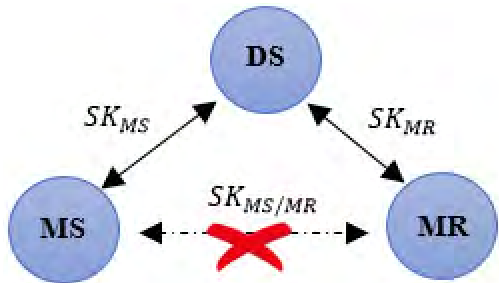 Figure 1: The AITSteg workflow, showing the transition from Secret Message to Carrier Message via ZWC mapping.
3. Bit-to-Character Mapping
The algorithm maps 2-bit combinations to four distinct ZWCs as follows:
00->0x200C(Zero Width Non-Joiner)01->0x202C(POP Directional)10->0x202D(Left-To-Right Override)11->0x200E(Left-To-Right Mark)
Experimental Performance & Comparisons
The authors tested AITSteg across a variety of platforms including Facebook, WhatsApp, Gmail, and WeChat.
High Invisibility and Capacity
While platforms like Twitter and Telegram use exclusive encoding that may strip these characters, the vast majority of SMAPPs (Social Media Apps) allowed the hidden string to pass through unnoticed.
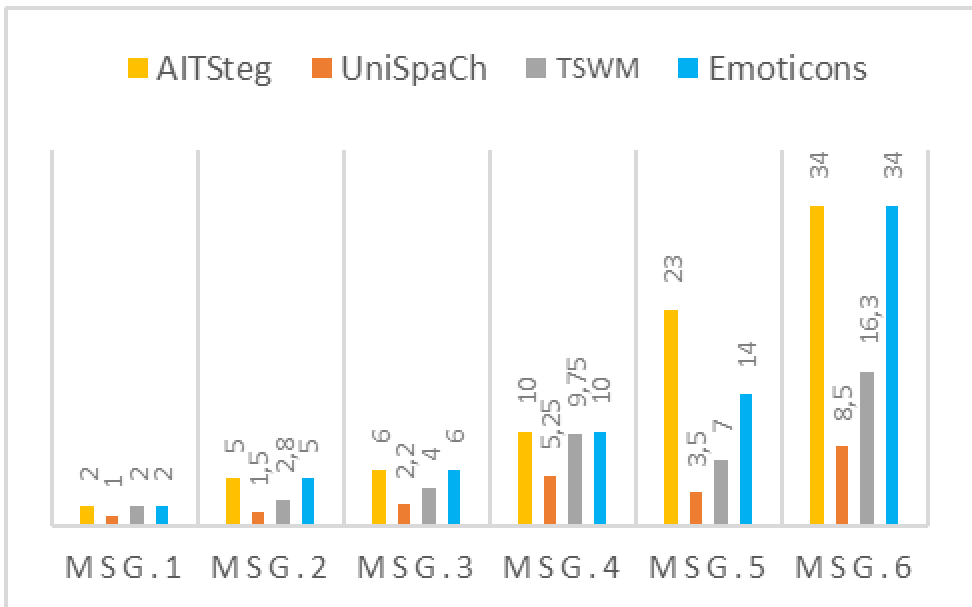 Figure 2: Embedding Capacity (EC) comparison shows AITSteg outperforming traditional methods (UniSpaCh, TWSM) by a wide margin.
Robustness Against Attacks
One of the paper’s most impressive claims is its resistance to Manipulation by Reader (MBR). Because the hidden message (HM) is embedded at the very front of the cover message, even if a reader deletes parts of the visible text, the hidden payload remains intact. The recorded Distortion Robustness (DR) exceeded 97% in common scenarios.
Critical Insight: Why This Matters
The genius of AITSteg is its realization that modern communication is no longer bound by the constraints of a typewriter. We communicate in a "Rich Text" environment where the underlying Unicode standard provides a massive, invisible playground for data hiding.
However, there is a limitation: as platforms become more security-aware, they may begin to "sanitize" ZWCs from incoming text to prevent exactly this type of covert channel. For now, AITSteg offers a sophisticated loophole for anyone needing to transmit highly confidential data—like banking credentials or secret missions—under the nose of global surveillance.
Conclusion
AITSteg proves that steganography doesn't have to be low-capacity. By moving the "battleground" from the visible word to the invisible character, the authors have created a tool that provides both security and deniability. As we look forward, the use of ZWCs in other areas—such as preventing reverse engineering in open-source software—remains a promising frontier.