
AKFIE: Bridging Predictive Estimation and Adaptive Appearance for Robust Hand Tracking
Adaptive Kalman Filter Incorporated Eigenhand (AKFIE) for real-time hand tracking system
The paper introduces the Adaptive Kalman Filter Incorporated Eigenhand (AKFIE), a real-time hand tracking framework that combines a predictive Bayesian model with an online-updated subspace appearance model. It achieves an average detection rate above 97% at a processing speed of 35 FPS, maintaining robustness across cluttered indoor and outdoor environments.
TL;DR
The Adaptive Kalman Filter Incorporated Eigenhand (AKFIE) is a robust framework designed for real-time hand tracking. By merging an Adaptive Kalman Filter (AKF)—which self-tunes its noise parameters based on motion acceleration—with a dynamically updated Eigenhand appearance model, the system solves the common pitfalls of drift during erratic motion and shape deformation. It achieves a 97% detection rate at 35 FPS.
Problem & Motivation: The Chaos of Human Motion
Hand tracking is a cornerstone of Human-Computer Interaction (HCI), yet it remains a "complex problem" due to the hand's high degrees of freedom. Traditional trackers suffer from:
- Erratic Motion: Standard Kalman Filters assume constant velocity, failing when the hand suddenly jerks or changes direction.
- Appearance Sensitivity: Geometric models (contours/splines) are too rigid.
- Environmental Noise: Lighting changes in outdoor scenes and partial occlusions lead to "tracker drift."
The authors' insight was to create a "dual-layer" defense: use a predictive filter for speed and a subspace appearance model for identity verification.
Methodology: The Core Mechanics
The AKFIE architecture operates in a loop of observation, prediction, and rectification.
1. Adaptive Kalman Filter (AKF)
Unlike a standard KF, the AKF uses an acceleration threshold ().
- If (rapid motion), the filter trusts the measurement more by reducing measurement noise covariance ().
- If (stable motion), it trusts the prediction more by reducing process noise covariance ().
2. The Eigenhand Representation
To prevent the tracker from following "any moving skin-colored blob," the system samples candidate windows around the predicted location. These windows are projected onto a low-dimensional eigenspace calculated via Principal Component Analysis (PCA).
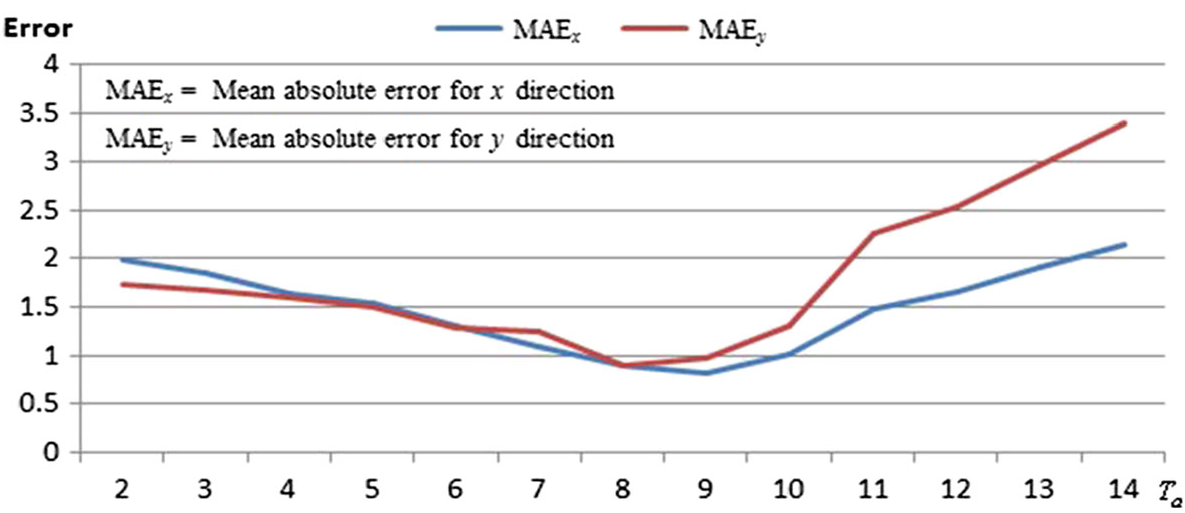 Fig: The refinement process using Eigenhand to rectify AKF predictions.
Crucially, the eigenspace is updated every frame. The reference image is blended into the new training set, allowing the model to "learn" the hand's new pose or lighting conditions in real-time without prior offline training.
Experiments & Results: Real-World Resilience
The system was tested on the IBGHT database, covering indoor and outdoor scenarios.
Performance Benchmarks
- Tracking Rate: > 97% average across cluttered backgrounds.
- Speed: 35 FPS (Real-time).
- Robustness: Handled "under-exposed" outdoor environments and partial occlusions behind moving objects.
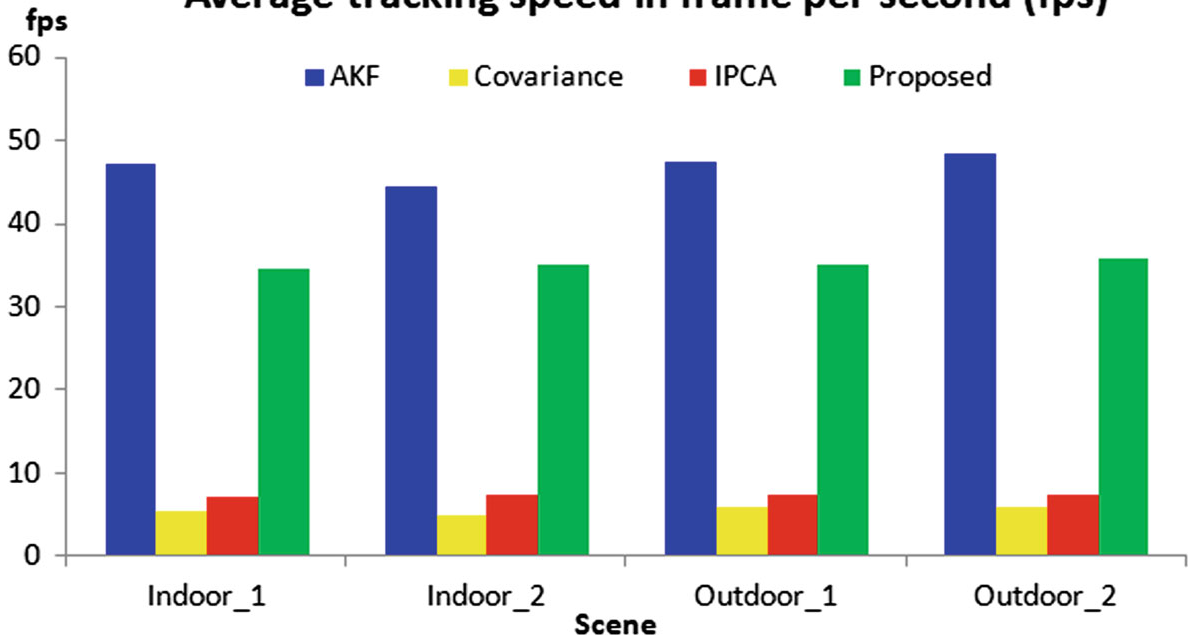 Fig: Computational efficiency comparison showing the proposed method leading in FPS.
Competitive Analysis
When compared to Incremental PCA (IPCA) and Covariance trackers, AKFIE showed superior recovery from drift. While the Covariance tracker often got confused by background pixels identical in color to skin, the AKFIE's integrated motion-skin fusion provided a more discriminative starting point for the eigenspace matching.
Critical Analysis & Conclusion
Takeaway
The genius of AKFIE lies in its simplicity and efficiency. By avoiding heavy geometric modeling and instead using a weighted Bayesian prediction paired with on-the-fly PCA updates, it achieves high-fidelity tracking on modest hardware.
Limitations & Future Work
- Scale/Rotation: The current rectangular ROI lacks an affine transformation model, causing slight accuracy drops when the hand rotates or moves toward the camera (drastic scale change).
- Full Occlusion: If the hand is 100% hidden, the tracker cannot currently recover without a re-initialization phase.
The authors suggest that future iterations could incorporate Particle Filters or Affine Wrap Transformations to handle more complex 3D dynamics.