
Albatross Sampling: Breaking Free from the Topology Traps in Social Graph Analysis
Albatross Sampling: Robust and Effective Hybrid Vertex Sampling for Social Graphs
This paper introduces Albatross Sampling (AS), a hybrid vertex sampling algorithm specifically designed for large-scale social graphs. By integrating a random jump strategy into the Metropolis-Hastings Random Walk (MHRW), it achieves unbiased sampling while significantly improving performance on disconnected or loosely connected networks.
TL;DR
Analyzing modern Online Social Networks (OSNs) is a race against scale and complexity. Albatross Sampling (AS) is a robust hybrid vertex sampling algorithm that solves the "local trap" problem of traditional Random Walks. By combining the unbiased nature of Metropolis-Hastings with a strategic random jump mechanism, it achieves a 90% reduction in convergence time while maintaining high accuracy in estimating degree distributions.
Background: The Sampling Dilemma
In the study of social graphs, researchers face a trilemma: scale, bias, and connectivity.
- BFS (Breadth-First Sampling) is common but heavily biased toward "celebrity" nodes (high-degree vertices).
- MHRW (Metropolis-Hastings Random Walk) attempts to be unbiased but fails miserably when the graph is loosely connected—it gets stuck in a subgraph and cannot see the "forest for the trees."
- Random Jump (RJ) avoids traps but loses the efficiency of local traversal.
Methodology: The "Albatross" Insight
The core of Albatross Sampling lies in its transition probability. The authors recognized that to achieve a truly representative sample of a graph like Twitter or Facebook, the sampler needs the agility of a bird (hence "Albatross") to fly over isolated clusters.
The Formalism
The transition probability is redefined to include a jump probability :

This formula ensures that at any given step, there is a small, fixed probability ( in their experiments) that the walker will teleport to a completely different part of the network. This simple addition makes the Markov Chain ergodic even for disconnected graphs, ensuring the stationary distribution is uniform ().

Performance: Efficiency and Accuracy
The researchers tested AS against BFS and MHRW using two distinct datasets: Buzznet (tightly connected) and Berk-Stan (loosely connected).
1. Accuracy (Lower NMSE)
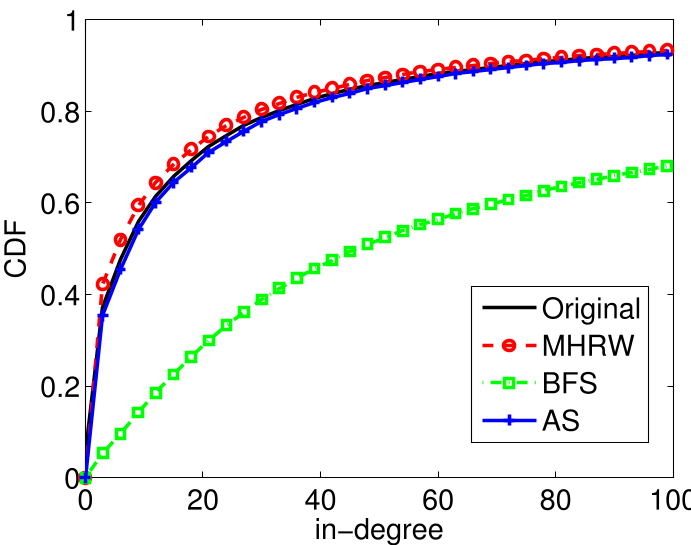
AS consistently outperformed MHRW in estimating degree distribution. As shown in the CDF and NMSE plots below, while BFS deviates significantly (due to high-degree bias), AS tracks the original graph properties with the highest precision.
2. Convergence Speed
This is where AS truly shines. In the Berk-Stan web graph, which is notoriously sparse, AS reached a stable estimation of degree frequency in just 329.6 units of cost, whereas MHRW required 4652.5—a massive 14.1x speedup.
| Method | Buzznet (Tight) | Berk-Stan (Loose) |
|---|---|---|
| BFS | 4371.2 | 6355.2 |
| MHRW | 3361.4 | 4652.5 |
| AS (Ours) | 406.5 | 329.6 |
Critical Analysis & Future Outlook
The primary hurdle for Albatross Sampling is the "Jump-Cost." In platforms like Facebook, where user-IDs are non-sequential (64-bit space), finding a valid "random" user by guessing IDs is expensive. The authors acknowledge this limitation and suggest future work should focus on optimizing jumps for sparse ID spaces.
Final Takeaway
Albatross Sampling is a "best of both worlds" solution. It provides the unbiased theoretical guarantees of Metropolis-Hastings while borrowing the global exploration power of Random Jumps. For researchers dealing with noisy or partially-crawled social data, AS represents the new gold standard for robust vertex sampling.