
Decoupling Ignorance from Chance: A Deep Dive into Aleatoric and Epistemic Uncertainty
Aleatoric and epistemic uncertainty in machine learning: an introduction to concepts and methods
This paper provides a comprehensive introduction to the fundamental distinction between aleatoric and epistemic uncertainty within supervised machine learning. It synthesizes classical statistical views with modern Bayesian and set-based frameworks, categorizing methods for uncertainty quantification across diverse model architectures.
TL;DR
Uncertainty in machine learning is not a monolith. This seminal overview by Hüllermeier and Waegeman argues that we must distinguish between Aleatoric uncertainty (the noise you can't avoid) and Epistemic uncertainty (the knowledge you haven't acquired yet). By separating the "randomness" of the world from the "ignorance" of the model, we can build AI that knows when to be cautious and when to ask for more data.
The Core Tension: Risk vs. Ignorance
In the classical statistical tradition, uncertainty is often flattened into a single probability score. However, consider two scenarios:
- A fair coin flip: You are 50% sure it's heads. This is Aleatoric (statistical) uncertainty. No amount of data will make you more certain of the next flip.
- A word in an unknown language: You might guess there's a 50% chance it means "head," but this is Epistemic (systematic) uncertainty. Here, your uncertainty is purely due to a lack of knowledge—a dictionary would reduce it to zero.
Standard Neural Networks often confuse these two, leading to "overconfident" failures where the model makes a bold prediction on data it has never seen (high epistemic uncertainty) or in regions where classes naturally overlap (high aleatoric uncertainty).
Taxonomy of Uncertainty in Supervised Learning
The paper meticulously breaks down the sources of error in the learning pipeline:
- Aleatoric: Arises from . It is context-dependent. Adding a new feature might turn aleatoric noise into a predictable pattern (e.g., measuring the force of a coin toss).
- Model Uncertainty: Uncertainty regarding the choice of the hypothesis space .
- Approximation Uncertainty: The gap between our estimated hypothesis and the best possible hypothesis , driven by limited training data .
 Figure: The pipeline from data to prediction, showing where different types of uncertainty enter the system.
Methodology: How to Measure "Ignorance"?
The authors compare several high-level paradigms for representing this distinction:
1. The Set-Based Approach (Version Spaces)
In a "Version Space," the learner maintains all hypotheses consistent with the data. If different valid hypotheses give different answers, the prediction is a set of possible outcomes. This is the purest form of epistemic capture—the larger the set, the more the model admits it doesn't know.
2. Bayesian Deep Learning
Instead of single weights, Bayesian Neural Networks (BNNs) learn distributions over weights.
- Total Uncertainty: Measured by the entropy of the predictive posterior.
- Epistemic Uncertainty: Captured through the Mutual Information between the weights and the prediction. It measures how much information the model would gain about its own parameters if it knew the true label.
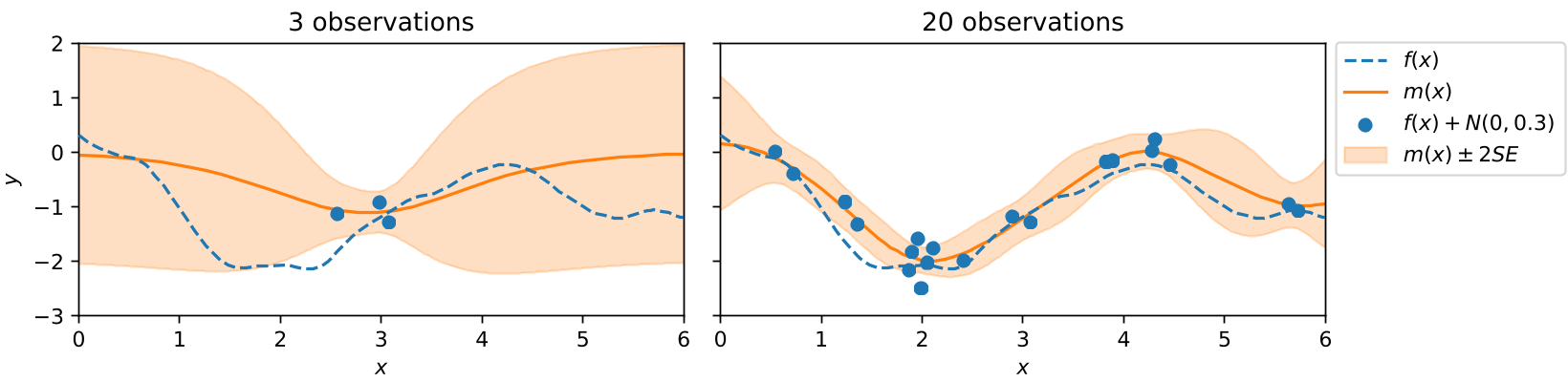 Figure: In Gaussian Processes, the width of the confidence band reflects epistemic uncertainty, which narrows as more data points are observed.
3. Credal Sets and Imprecise Probabilities
Rather than a single prior, "Credal" methods use a set of priors. This addresses a major critique of Bayesianism: a uniform prior (e.g., 50/50) isn't the same as "not knowing." By using a set of all possible distributions, we can represent "complete ignorance" without making arbitrary assumptions.
Critical Insight: The "Reject Option"
One of the most practical applications discussed is Reliable Classification. When a model encounters high epistemic uncertainty (e.g., a "stone wall" image that looks nothing like its training "typewriter" data), it should have a "reject option."
- If Aleatoric is high: The model tells you it's a toss-up.
- If Epistemic is high: The model admits it is "out-of-distribution" and should not be trusted.
 Figure: EfficientNet failing with high confidence on ImageNet samples—a classic case of missing epistemic awareness.
Conclusion & Future Outlook
Hüllermeier and Waegeman conclude that the field is moving toward a more mathematically rigorous "axiomatic" decomposition of uncertainty. The next frontier involves Open World scenarios where new classes emerge over time, and the "Closed World" assumptions of current models (that the truth must be one of the classes) are fundamentally violated.
For practitioners, the message is clear: if you are building for medicine or safety, don't just optimize for accuracy—optimize for the model's ability to say, "I don't know."