
Towards Fluid Organizations: An Algebraic Approach to OOMAS
An algebraic specification language for organizational behavior of OOMAS
The paper introduces a formal algebraic specification language for modeling Organization-Oriented Multi-Agent Systems (OOMAS). It leverages Abstract Data Types (ADT) and behavioral functions to represent complex organizational behaviors, specifically targeting large-scale, mutable systems like cyber-attack cliques.
TL;DR
Current Multi-Agent Systems (MAS) are often too rigid, relying on fixed hierarchies designed at compile-time. This paper breaks that mold by introducing an Algebraic Specification Language for Organization-Oriented MAS (OOMAS). By treating behaviors as Abstract Data Types (ADTs) and functions, the authors provide a mathematical framework for agents to reorganize from the bottom-up, a critical requirement for simulating dynamic entities like cyber-attacker groups.
The Motivation: Why Conventional MAS Fails in Cyber-Security
In traditional MAS design, specialized roles and organizational structures (like military hierarchies) are defined top-down. However, in the realm of cyber security—specifically when modeling botnets or cliques of attackers—the "organization" is often invisible, mutable, and highly adaptive.
The authors argue that existing frameworks like Medee or OragentL are insufficient because:
- They depend on pre-established structures.
- They focus on simple action sequences rather than functional state transformations.
- They lack a formal mathematical foundation to preserve behavioral relationships during reorganization.
Methodology: Behavior as a Mathematical Function
The core insight of this work is the shift from What an agent does (sequences) to How an agent transforms a state (functions).
1. The Behavioral Function
The authors define a behavior as a mapping: where (Environmental State Subject State) represents the combined space of the world and the agent. This allows for a much more robust abstraction than simple "Move" or "Attack" commands.
2. Hierarchical Composition (BNF Grammar)
To scale this from individual agents to complex organizations, the paper introduces a grammar for "Synthesis Behaviors." Using operators derived from process calculi (like CCS and CSP), behaviors can be combined:
- : Parallel execution.
- : Sequential execution.
- : Conditional behavior.
 (The above figure illustrates the structural context of OOMAS behavior as presented in the ASE'16 conference)
3. Behavioral Algebra and Homomorphism
By grouping these functions into a Behavioral Algebra , the authors can use Category Theory concepts like Homomorphism to ensure that when an organization reorganizes, the fundamental logic of its roles remains preserved.
Experiments & Theoretical Contributions
The paper validates its approach through formal proofs and logical consistency checks:
- Algebraic Axioms: It proves that the operators satisfy associative and commutative laws (e.g., the order of parallel behaviors does not change the semantic outcome).
- Bottom-Up Abstraction: It demonstrates how individual leaf-node behaviors can be recursively grouped into high-level organizational types.
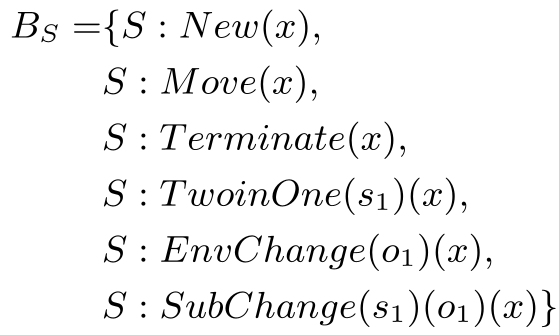 (Example 2: Formally defining a Behavioral Set for an administrative agent, showcasing the transition from theory to specific agent roles.)
Critical Analysis & Conclusion
Takeaway
This work moves OOMAS from an "engineering craft" toward a "formal science." By using ADTs, the authors provide a path for guaranteed correct formal abstract algebra in agent development. This is a significant step for systems that need to be verified for safety and security.
Limitations & Future Work
While the algebraic foundation is solid, the paper is primarily theoretical. The current framework lacks:
- Real-time Performance Benchmarks: How does the overhead of algebraic mapping impact large-scale simulations?
- Grammar Implementation: While the BNF is defined, a production-ready compiler or interpreter for this language is still a "future work" item.
In conclusion, this research provides the necessary "math-logic" for the next generation of self-organizing systems, particularly those operating in the adversarial and unpredictable landscapes of cyberspace.