
Decoding Social Friction: Predicting Negative Links via Sentiment Analysis
Algorithm for prediction of negative links using sentiment analysis in social networks
This paper introduces a novel framework for predicting negative links in social networks by integrating Sentiment Analysis with traditional social network theories. By classifying user interactions into five granular sentiment categories using SVM and SentiWordNet, the method uncovers latent "hostile" relationships even when platforms do not explicitly provide a "dislike" feature.
TL;DR
While social media platforms encourage "Likes," the "Dislikes" remain hidden in the shadows of comments and status updates. This paper proposes a methodology to expose these hidden negative links by combining Support Vector Machines (SVM) for sentiment classification with an Extended Structural Balance Theory. By moving beyond binary logic to a 5-level sentiment scale, the authors provide a more accurate reflection of human social dynamics.
Problem & Motivation: The "Hidden" Side of Social Networks
In the world of social computing, most research has historically focused on positive link prediction—how to suggest new friends or products. However, the absence of an explicit "distrust" button on major platforms creates a data sparsity problem.
The authors argue that negative links are equally valuable. Predicting who dislikes whom can:
- Refine Recommendation Systems: Prevent awkward or hostile friend suggestions.
- Cybersecurity: Identify malicious nodes that coordinate despite having no formal "friendship."
- Market Mentality: Understand the true trend of public dissent.
Methodology: From Text to Triads
The paper’s core innovation lies in its two-step pipeline: Sentiment Extraction followed by Structural Prediction.
1. Granular Sentiment Analysis
Rather than a simple +/- classification, the authors use SentiWordNet and SVM to categorize posts into:
- Extremely Positive
- Positive
- Neutral
- Negative
- Extremely Negative
Specifically, they highlight the importance of hashtags. A sentence like "My flight got delayed, Wonderful!" might be flagged as positive by a naive algorithm, but the tag #sarcasm provides the critical corrective weight.
2. The Extended Structural Balance Theory (ESBT)
Traditional Balance Theory posits that "the enemy of my enemy is my friend." The authors extend this to accommodate their 5-level scale. If a triad (a group of three users) contains two known links, the third is predicted based on the range of social "tolerance."
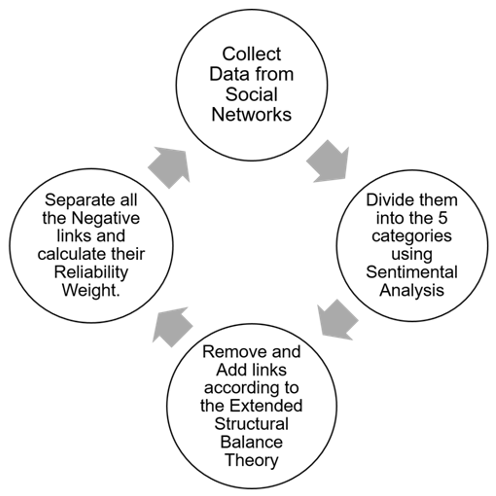 Fig 1: The workflow from raw social data to negative link separation.
Experiments & Results
The authors tested their approach on Twitter datasets. By analyzing triads where two edges were known, they predicted the third edge using a sentiment-averaging function adjusted for the ESBT.
Key Findings:
- Reliability Weighting: The algorithm assigns a "Reliability Weight" () to predicted links. Predicted negative links with more negative neighbors are mathematically treated as more "reliable."
- Triadic Completion: The model successfully identified missing links in cases where users shared common interests but had not yet interacted directly.
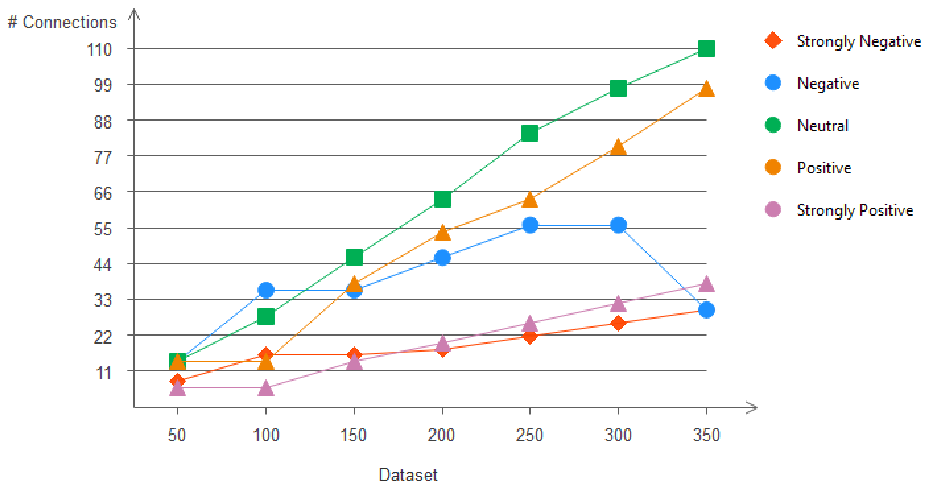 Fig 2: Visualization of the comparison between original data and predicted sentiment links.
Critical Insight: Why This Matters
The fundamental takeaway here is that content is context. While a graph structure tells you that two people are connected, sentiment analysis tells you how they are connected. By integrating social psychology (Status Theory) with NLP, the authors bridge the gap between "social physics" and "linguistic nuance."
Limitations & Future Work
While the SVM approach is robust, it relies heavily on manual lexicon mapping (SentiWordNet). Future iterations could benefit from Transformer-based models (like BERT or RoBERTa) to better capture long-range dependencies and complex sarcasm without relying solely on hashtags. Additionally, expanding the dataset beyond Twitter to more "hostile" environments (like political forums) would further validate the ESBT's predictive power.
Conclusion
This research underscores that social networks are not just maps of friendship, but complex webs of varying degrees of trust and distrust. By quantifying the "hidden" negative links, we can build digital environments that are not only more connected but more socially aware.