
Balancing Utility and Privacy: Steering Information Diffusion in Social Search
Algorithm to trade off between utility and privacy cost of online social search
The paper introduces a quantitative framework and a selection algorithm to balance information utility (finding experts) against privacy costs in Online Social Search (OSS). It proposes the Utility Privacy Cost Ratio Discount Algorithm, which optimizes seed node selection to maximize expert reach while minimizing the spread of sensitive personal data across a social network.
TL;DR
Online Social Search (OSS) is a double-edged sword: it connects your questions to global experts but exposes your personal data to every node in the chain. This paper proposes a mathematical framework to quantify this tension and introduces the Utility Privacy Cost Ratio Discount Algorithm—a smart seeding strategy that maximizes expert discovery while minimizing the "privacy footprint" of a query journey.
Background & Positioning
In the ecosystem of Social Computing, we often treat "Influence Maximization" as a pure optimization of reach. However, in the context of sensitive queries (e.g., medical or financial advice), Reach = Risk. This work moves beyond traditional privacy settings (who can see my profile) to address the dynamic privacy cost incurred during information diffusion. It sits at the intersection of Network Science and Data Privacy, providing a practical heuristic for safer social discovery.
The Core Conflict: Why Simple Seeding Fails
Most recommendation systems focus on finding the most connected nodes (High-Degree) to spread a query. While this leads to high utility (finding experts quickly), it causes a "privacy explosion" because these nodes act as hubs that broadcast the sender's identity to thousands of unintended recipients.
The authors argue that we need an Inductive Bias in our selection process: favoring nodes that lead to expert clusters while specifically avoiding "loud" nodes that provide diminishing returns on utility relative to the privacy cost they incur.
Methodology: From Influence to Ratio Optimization
The paper utilizes the Independent Cascade (IC) Model to simulate how a question spreads. The breakthrough lies in the adaptation of the Degree Discount heuristic.
The Algorithm Logic:
- Label Recognition: The system identifies nodes labeled as "experts" for a specific query domain ().
- Cost Incorporation: Unlike standard algorithms that only look at (degree), this approach looks at the ratio of potential experts reachable through a node versus the total degree (privacy cost).
- Dynamic Discounting: Once a seed is selected, the potential of its neighbors is "discounted" to prevent redundant privacy costs for the same area of the network.
 The objective function: Maximizing the ratio of expected utility over expected privacy cost.
Experimental Validation
Using the Facebook Ego-network dataset, the authors applied Louvain Community Detection to simulate expert clusters.
Key Insights from Figures:
Comparing the Utility Degree Discount (UDD) (red/blue lines) and the Utility Privacy Cost Ratio Discount (UPCRD) (the proposed method):
- Efficiency: Both algorithms reach most experts with surprisingly few seeds.
- The Trade-off: As shown in the performance comparison below, the Ratio-based approach maintains a significantly higher utility-per-cost efficiency, especially when the initial seed set is small.
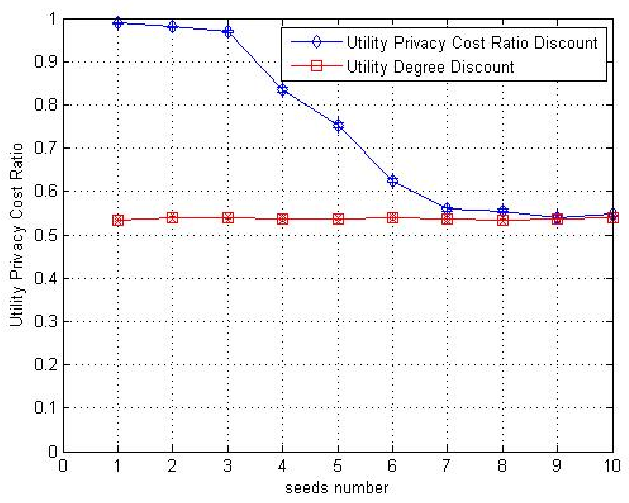 Fig 3. Performance analysis showing the Utility-Privacy Ratio across different community settings.
Critical Analysis & Future Outlook
While the paper provides a robust first step, it relies on the assumption that the social graph and expert labels are fully known to the system. In real-world scenarios, this data is often partial or noisy.
Takeaway for the Industry: Platform architects at Quora or LinkedIn should consider "Cost-Aware Recommendations." Instead of simply connecting users to the "most influential" expert, systems should optimize for the shortest, most private path to an answer. Future work in this area will likely integrate Differential Privacy into the diffusion model itself, ensuring that even if a node receives a question, they learn nothing about the questioner's broader profile.
Conclusion
Privacy is not a static state but a dynamic cost of interaction. By treating privacy as a "budget" to be spent wisely, the authors prove that we can still enjoy the collective intelligence of social networks without an absolute surrender of personal anonymity.