
Algorithmic Targeting of Social Policies: Balancing AI Accuracy with Distributed Governance
Algorithmic targeting of social policies: fairness, accuracy, and distributed governance
The paper introduces an AI-driven framework for the algorithmic targeting of social policies (e.g., Cash Transfers) in developing countries. Utilizing Gradient Boosting and advanced feature engineering on household survey data from Colombia and Costa Rica, the authors demonstrate a significant reduction in poverty misclassification compared to traditional econometric methods.
TL;DR
In the developing world, determining who receives social benefits is a high-stakes algorithmic task. This research demonstrates that replacing legacy econometric models with AI (Gradient Boosting) can correctly identify nearly one million more people in poverty across Colombia and Costa Rica. However, accuracy isn't everything—the paper also introduces a first-of-its-kind interactive platform to help government agencies navigate the thorny ethical trade-offs between different definitions of "fairness."
The "Invisible" Poverty Trap
In many developing nations, "informal" economies mean that official income data is non-existent or unreliable. To allocate Cash Transfers (CTs) or health subsidies, governments use Proxy Means Tests (PMT)—algorithms that guess a household's poverty level based on assets (e.g., "Do you have a fridge?") and demographics.
For decades, these have relied on simple linear regressions. The cost of this simplicity? High Exclusion Errors, where the truly needy are denied aid because the model couldn't capture the nuance of their specific hardship.
Methodology: The Shift to AI
The researchers moved beyond the status quo by introducing a machine-learning pipeline focused on three pillars:
- Feature Engineering: They generated "Deep Features" using Recursive Neural Networks to condense individual-level data of all family members into a usable household signature.
- Gradient Boosting: Unlike linear models, this captures non-linear interactions (e.g., how the impact of "education" changes depending on "geographic region").
- Out-of-Sample Validation: Ensuring the model works on new households, not just the data it was trained on.
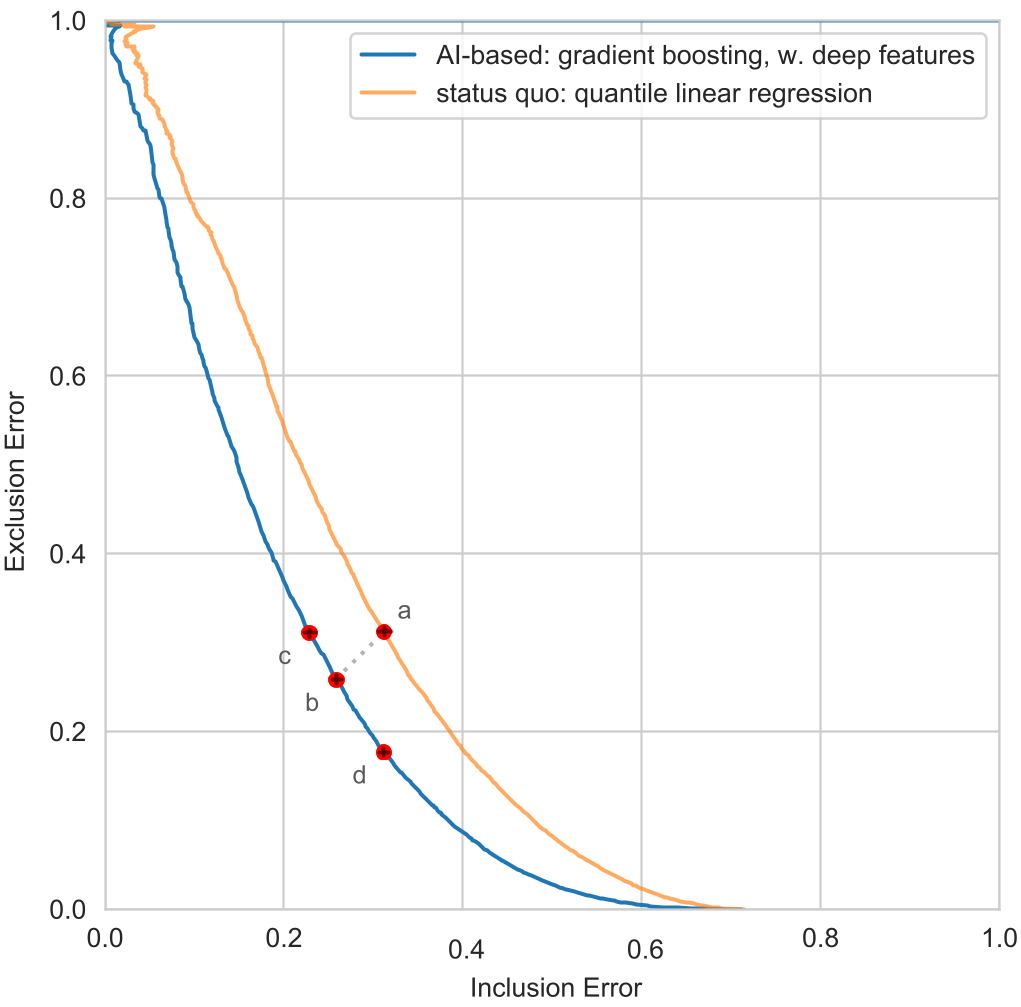 Graph (a) showcases for Colombia how the AI method (blue) dominates the status quo (red), significantly reducing both inclusion and exclusion errors.
The Fairness Dilemma
Even the best AI can be "unfair." If an algorithm is overall 90% accurate, but only 60% accurate for rural households, it creates a systemic bias. The study found that while AI is generally more fair than old methods, it still exhibits performance disparities.
The challenge is that "fairness" is not a single mathematical definition. Some agencies want Demographic Parity (equal representation), while others prioritize Error Rate Parity (equal chance of a mistake). In many cases, social workers prefer Positive Discrimination—intentionally giving a "bump" to victims of violence or people with disabilities.
Solution: Distributed Governance
To solve the tension between central data and local needs, the authors developed an Interactive Decision Support Platform. This tool allows local managers to:
- Segment the population into specific subgroups (e.g., single mothers).
- Adjust thresholds in real-time to see how it affects the budget.
- Toggle fairness constraints to automatically achieve parity across groups.
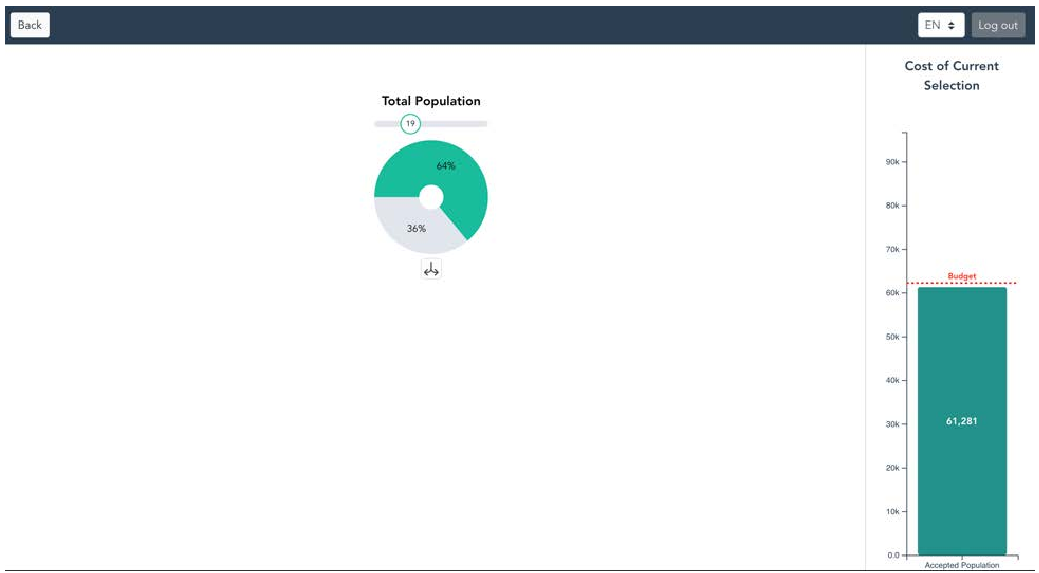 The platform enables policy-makers to visualize the trade-offs between coverage, cost, and positive discrimination.
Critical Insight & Conclusion
The core takeaway is that accuracy and ethics are not mutually exclusive, but they require a "human-in-the-loop" framework. By providing a high-accuracy AI "engine" but leaving the "steering wheel" (thresholds and parity definitions) in the hands of social institutions, we can achieve a system that is both technically superior and democratically accountable.
As AI continues to expand into the Global South, this paper serves as a blueprint: optimize the math, but democratize the decision.
Key Performance Metrics
| Country | Reduction in Misclassification (AUEIC) | New People Covered (Poor) |
|---|---|---|
| Colombia | 26.4% | ~728,000 |
| Costa Rica | 37.1% | ~110,000 |