
DGA Detection Mastery: Balancing Deep Learning and Random Forests in Malware Defense
Algorithmically Generated Domain Detection and Malware Family Classification
The paper presents a comprehensive comparison of machine learning models for detecting Domain Generation Algorithms (DGA) and classifying them into malware families. The authors utilize both feature-based Random Forests and featureless Deep Learning architectures (CNN, LSTM) on the DMD2018 dataset, achieving 1st place in two out of four competition categories.
TL;DR
This research provides a definitive blueprint for defending against Domain Generation Algorithms (DGAs). By competing in the DMD2018 challenge, the authors demonstrate that while Deep Learning (CNN/LSTM) is the undisputed king of binary detection (99% accuracy), Random Forests with expertly crafted features still dominate when it comes to the complex task of classifying domains into specific malware families.
Context: The Cat-and-Mouse Game of DNS
In the cybersecurity landscape, DGAs are a weapon of choice for botnets like Conficker or Cryptolocker. Instead of hard-coding a single IP address—which is easily blocked—malware generates thousands of random-looking domains daily. To catch these, security researchers have split into two camps: those who painstakingly curate lexical features (entropy, consonant ratios) and those who let Deep Neural Networks (DNNs) learn from raw character strings.
Problem & Motivation: The Weakness of Singularity
Most existing literature focuses on one approach. However, the authors noticed a gap: DNNs require massive datasets to distinguish between subtle malware family variations, while human-engineered features might miss the "subconscious" patterns that a neural network can find in raw ASCII sequences. This paper aims to bridge that gap by testing both against the unbalanced, real-world datasets of the DMD2018 competition.
Methodology: Featureless vs. Featureful
The study explores two distinct paradigms:
1. The Featureless Approach (Deep Learning)
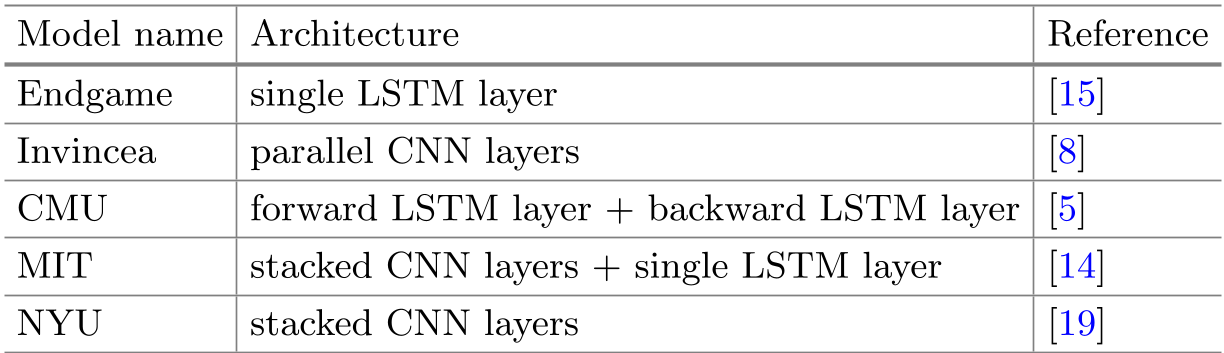
The authors utilized five state-of-the-art architectures, including:
- Endgame (LSTM): Sequential processing of characters.
- Invincea (CNN): Parallel convolutional layers to pick up local character n-grams.
- MIT (CNN+LSTM): A hybrid approach capturing both local patterns and long-term dependencies.
All models start with an embedding layer that maps ASCII characters into a 128-dimensional latent space, allowing the model to learn that 'a' is semantically closer to 'b' than to a special character like '-'.
2. The Featureful Approach (Random Forest)
For more granular classification, 28 lexical features were extracted, including:
- 2-gram/3-gram Circular Median: Measuring the "randomness" of character pairs and triplets.
- Consonant/Digit Ratios: High consonant density often signals an algorithmically generated string.
- TLD Analysis: Tracking top-level domains frequently used by malicious actors (e.g., .biz, .top).
Experiments & Results: A tale of two tasks
The results from the DMD2018 competition revealed a fascinating "division of labor" between the two techniques.
Subtask 1: Binary Detection (Benign vs. DGA)
The Deep Learning Ensemble (a combination of Invincea, Endgame, and NYU models) reigned supreme. By pre-training on large datasets like Alexa-Bambenek and fine-tuning on specific challenge data, they achieved a 99% accuracy.
Subtask 2: Multiclass Classification (Malware Family)
Interestingly, DNNs struggled here. The champion for identifying the specific malware family was a "one-vs-rest" Random Forest (RFmulti_3).
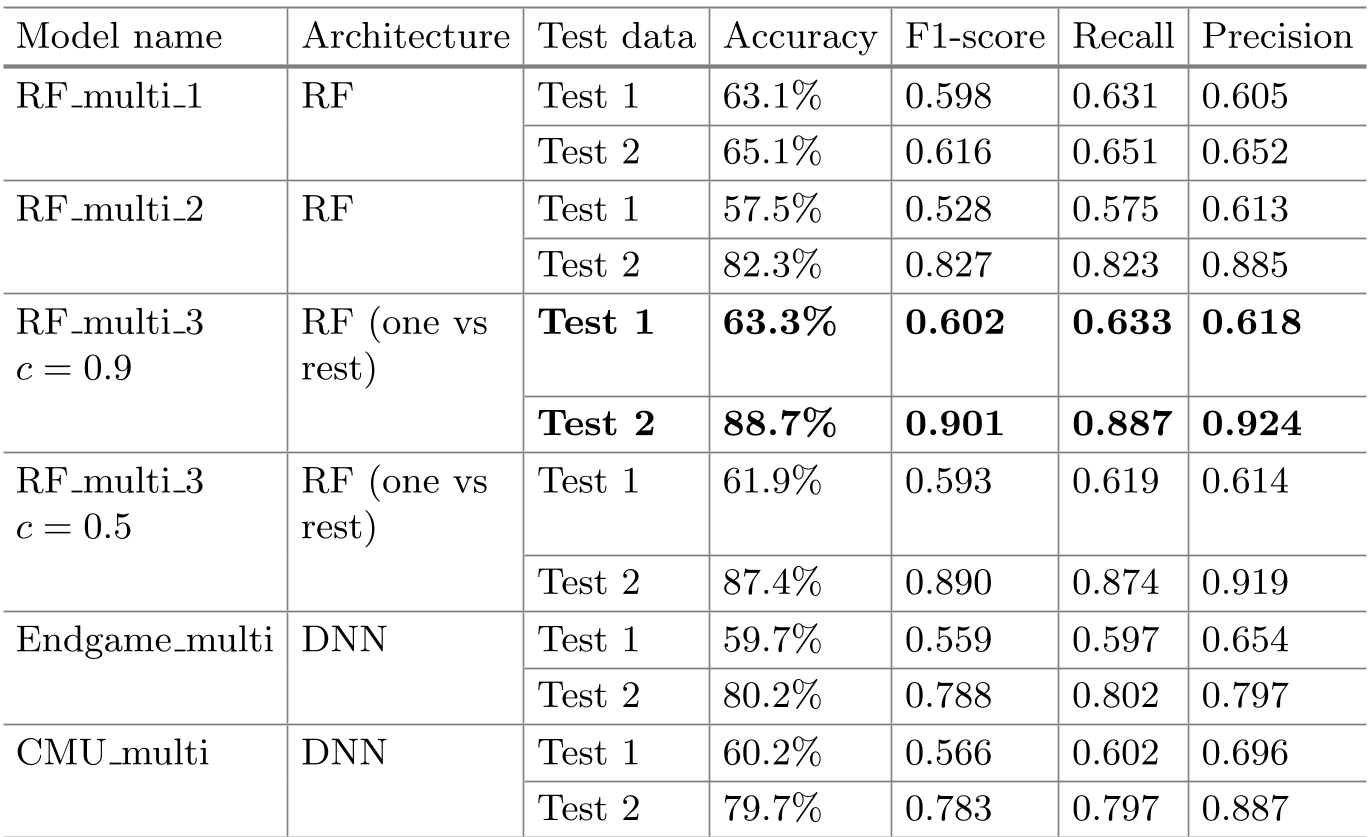
As shown in the table above, the RF approach reached an accuracy of 88.7% on Test 2, significantly outperforming the LSTM-based Endgame model (80.2%). The authors attribute this to the fact that Random Forests handle small-sample multiclass problems more robustly than data-hungry DNNs.
Critical Analysis & Conclusion
Takeaway
The core insight of this paper is that task complexity dictates architecture. For a "yes/no" maliciousness check at scale, character-level DNNs are the most efficient. But for digital forensics and identifying which botnet is attacking (family classification), feature engineering still holds the upper hand.
Limitations & Future Work
- Overhead: Extracting 28 features in real-time for millions of DNS queries can be computationally expensive compared to a raw DNN forward pass.
- Evolution: As DGAs move toward "dictionary-based" generations (using real words), simple consonant ratios will fail, likely requiring the deep learning models to shift toward Transformer-based architectures with pre-trained word embeddings.
In conclusion, the defense of the future isn't just "AI"—it's a calculated ensemble of specialized models tailored to the specific granularity of the threat.