
The Double-Edged Sword: AI Alignment as a Censor’s Toolkit
Position: The Alignment Community is Unintentionally Building a Censor's Toolkit
This position paper identifies AI alignment as a dual-use technology, arguing that methods designed to ensure "helpfulness and harmlessness" are being repurposed for censorship and manipulation. It maps the technical "control stack" (pre-training, post-training, and inference-time) to their potential for informational dominance by state actors and private entities.
TL;DR
A new position paper warns that the very tools we use to make AI "safe"—like RLHF and data filtering—are effectively dual-use technologies. In the wrong hands, these "safeguards" become sophisticated instruments for state-sponsored censorship and corporate manipulation. The authors argue that as AI becomes our primary information source, the risk of a centralized "informational monopoly" is no longer a fringe theory, but a documented reality.
Background: The "Good Side" of History?
For years, the AI alignment community has operated under the assumption that we are the "protectors," building shields against toxic output and dangerous instructions. However, the history of science (e.g., nuclear physics) shows that well-intentioned tools can be weaponized. The authors assert that alignment methods are purpose-agnostic: whether they stop a user from making a bomb or from learning about a historical massacre depends entirely on who defines the "values."
The Anatomy of the Censor’s Stack
The paper breaks down how alignment techniques can be repurposed across the development lifecycle:
1. Pre-Training Filtering (The Memory Hole)
By removing specific domains or keywords during the pre-training phase, actors can ensure a model is "born" without certain knowledge.
- Impact: Fundamental. If the data isn't there, the model cannot discuss it.
- Evidence: Chinese authorities blocking Hugging Face and promoting "mainstream values corpora" to replace diverse datasets.
2. Post-Training Alignment (Ideological Sculpting)
Techniques like RLHF (Reinforcement Learning from Human Feedback) or Constitutional AI are used to steer models toward specific perspectives.
- Impact: Persistent. It trains the model to refuse certain topics or favor specific "socialist core values" or corporate agendas.
- Evidence: The Cyberspace Administration of China (CAC) requiring vast datasets of "refusal prompts" focusing on political ideology.
3. Inference-Time Intervention (The Speed Dial)
The most "superficial" but agile level involves system prompts and output classifiers.
- Impact: Immediate and easy to iterate.
- Evidence: Rapid shifts in Grok's behavior via system prompt changes to promote "politically incorrect" or specific political stances.
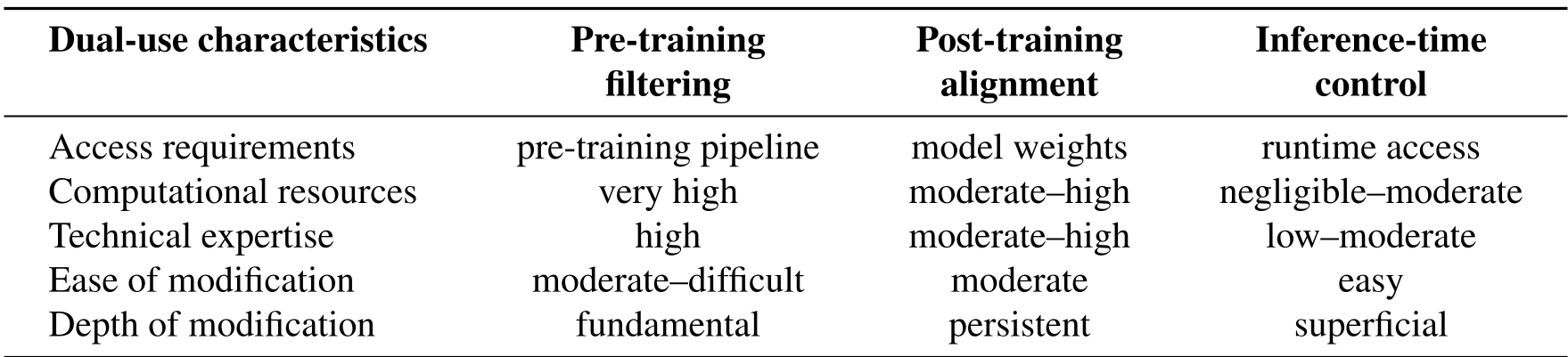 Table 1: Comparison of alignment techniques and their misuse characteristics.
Why the Risk is "Exponential" Right Now
The authors identify three factors creating a "perfect storm" for misuse:
- Information Dependency: Massive shifts toward using LLMs for news and search (usage doubled in some regions between 2024-2025).
- Oligopolistic Control: A handful of companies in the US and China control the foundation models, creates a "bottleneck" where a single regulator's rules can affect global users.
- Authoritarian Tide: Global democratic backsliding and declining digital freedom make the "Censor's Toolkit" an attractive asset for regimes.
Critical Perspective: Beyond the "Ethics Statement"
The paper offers a scathing critique of current academic culture. While conferences like ICML and NeurIPS require "Ethics Statements," the authors find these are often superficial checkboxes.
The proposed solutions move from technical to systemic:
- Verifiable Alignment: Moving beyond "trust us" to standardized benchmarks that audit models for information suppression.
- Neutrality through Diversity: Accepting that total neutrality is impossible. The solution is Model Pluralism—ensuring no single entity holds a monopoly on "the truth."
- Researcher Literacy: Alignment researchers must acknowledge the dual-use nature of their work rather than assuming inherent benevolence.
Conclusion
The quest for a "perfectly aligned" model is inherently a quest for a perfectly controlled model. As we refine the safeguards of today, we must ensure we aren't inadvertently building the shackles of tomorrow. The community's goal must shift from simply "aligning" models to ensuring that the power to align remains decentralized and transparent.
Disclaimer: This blog post is a technical interpretation of the position paper "The Alignment Community is Unintentionally Building a Censor’s Toolkit" (2026).