
All My People Right Here, Right Now: Navigating the Chaos of Group Co-Presence
14931_All My People Right Here, Right Now management of group co-presence on a social networking site.
This paper explores "group co-presence" on Facebook, a phenomenon where diverse social circles (work, family, friends) converge in a single digital space. Using qualitative interviews and observations, the study identifies how users navigate potential identity conflicts through specific behavioral and mental management strategies.
TL;DR
Social networking sites like Facebook force our separate worlds—college friends, colleagues, and family—into a single visual space. While this "group co-presence" threatens our ability to manage different social identities, users aren't passive victims. This study identifies the invisible labor and specific strategies (like self-censorship and mental recategorization) that users employ to keep their social lives from exploding.
The Problem: The Collapse of Social Boundaries
In the physical world, we have the luxury of segregation. You don't usually invite your boss to your college frat party. However, SNSs create a "context collapse." When you post a status update, you are performing for an undifferentiated audience.
The authors argue that this isn't just a privacy issue; it’s an identity crisis. Human beings maintain different "social identities" depending on who they are with. When everyone is watching at once, how do you choose which "you" to be?
Methodology: Peeking Behind the Profile
The researchers looked at 20 active users—half medical students and half IT professionals. They distinguished between:
- Explicit Groups: Technical features like Facebook "Groups" or "Networks."
- Implicit Groups: The mental categories users keep (e.g., "my high school friends").
By using tools like the Friend Wheel, they visualized these clusters and interviewed users on how they managed the overlapping boundaries.

How We Cope: 6 Strategies for Social Survival
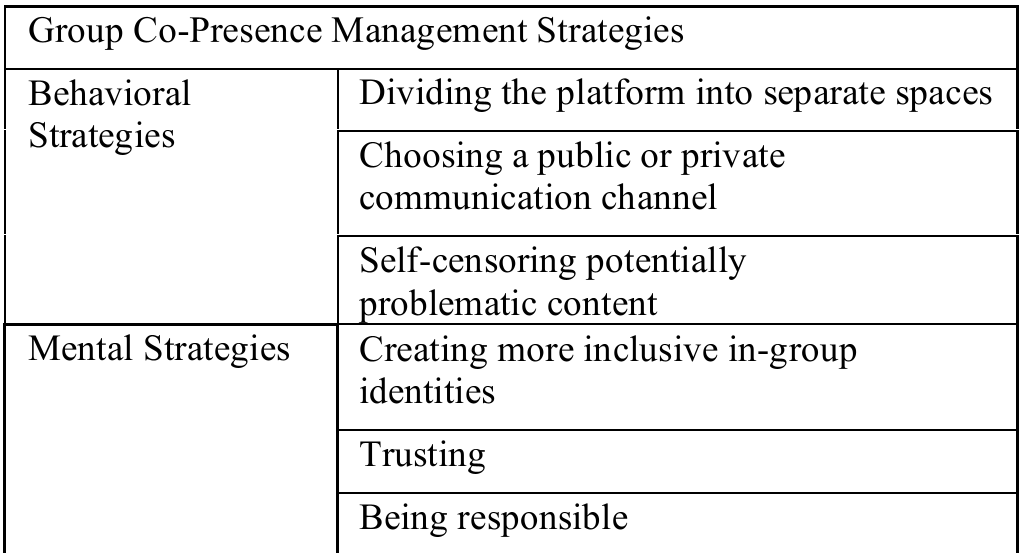
The most fascinating insight of the paper is the "Table of Management Strategies." Users don't wait for a conflict to happen; they proactively prevent it.
Behavioral Strategies (The "Do-ing")
- Dividing the Platform: Using closed groups or specific photo albums to gate-keep information.
- Channel Switching: Moving a risky public conversation to a private message (or "taking it offline").
- Self-Censoring: The "pause" before posting. If a post might offend a certain subset of friends, the user simply decides not to post it at all.
Mental Strategies (The "Thinking")
- Inclusive Identities: Viewing all "friends" as one big happy family to lower the stakes.
- Trusting: A conscious decision to assume friends will act with goodwill.
- Being Responsible: An unspoken social contract where users act as "filters" for each other’s reputations.
The "Least Common Denominator" Risk
The study highlights a grim reality: when we manage group co-presence by self-censoring, we often default to the "least common denominator." We only share things that are so safe and so bland that they couldn't possibly offend anyone.
If SNS platforms don't provide better tools for group segregation, the authors warn that social media might become a place where deep, authentic shared identity goes to die, replaced only by superficial updates.
Critical Insight & Conclusion
This 2009 study was prophetic. It identified the "labor of identity" that has become a defining characteristic of the modern internet. While Facebook later introduced features like "Lists" and "Audience Selectors," the fundamental tension remains: the more people we connect with, the less "ourselves" we can truly be in public.
Takeaway for Designers: Privacy is social, not just individual. Tools must support the mental groups users have in their heads, not just the technical networks they belong to.