
Deciphering the Blueprint of Human Connection: Are All Social Networks Structurally Identical?
Are All Social Networks Structurally Similar?
This paper presents a comparative structural analysis of five semantically diverse social networks (Twitter, Epinions, Wikipedia, EU Email, and Co-authorship). By applying a rigorous set of graph metrics and statistics, the study confirms that despite differing contexts of interaction, these networks exhibit remarkably consistent structural signatures.
TL;DR
Is a network built on "trust" (like Epinions) fundamentally different from one built on "emails" or "voting" (like Wikipedia)? This paper conducts a deep dive into five semantically distinct social datasets. The verdict: While their "reasons" for existing differ, their mathematical skeletons are strikingly similar, characterized by the same patterns of hubs, small-world shortcuts, and community pockets.
Background: The Social "Signature"
In the realm of network science, we often contrast social networks with protein interaction networks or power grids. Famous properties like Assortativity (popular people hang out with other popular people) were thought to be uniquely social. However, the explosion of niche platforms raises a new question: Does the type of social interaction—be it a "like," a "vote," or a "trust" signal—change the geometry of the network?
The Methodology: Multi-Tiered Structural Analysis
To answer this, the authors compared five distinct datasets:
- Twitter: Mutual friendship (Interpersonal).
- Epinions: Trust-based (Judgmental).
- Wikipedia: Voting (Procedural).
- EU Email: Communication (Transactional).
- Author Network: Co-authorship (Collaborative).
They didn't just look at averages; they looked at Distributions. By sampling the networks and plotting the frequency of various metrics, they sought to see if the "shape" of these metrics matched across different domains.
Core Insights: Where They Align
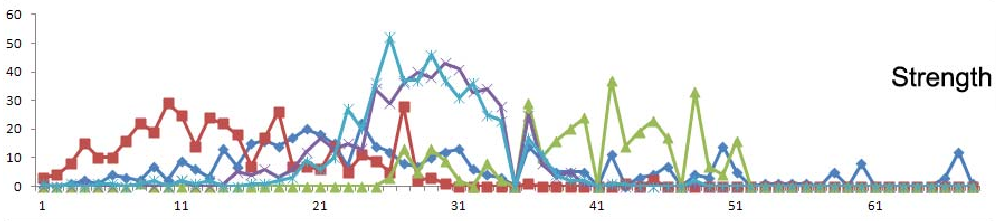
The study found that Betweenness Centrality and Eccentricity were nearly identical across all platforms. This is likely due to the "Core-Periphery" structure:
- Hub Influence: A few highly connected individuals act as universal bridges.
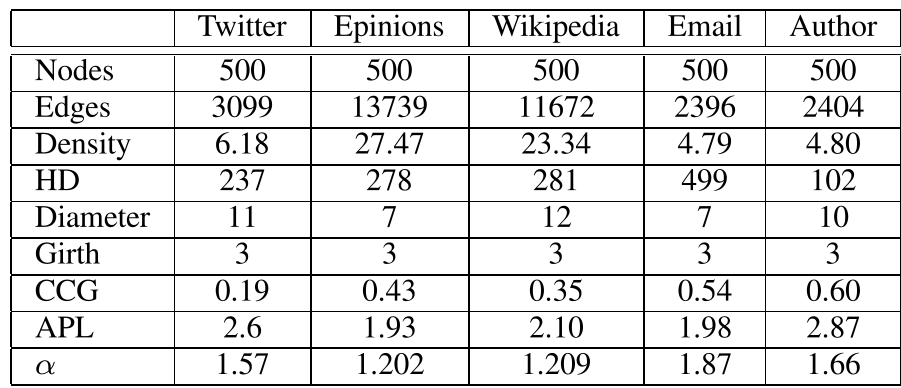
- Small World: Most networks exhibited an Average Path Length (APL) between 1.9 and 2.8, confirming that even in specialized groups (like computational geometry authors), everyone is just a few handshakes away.
The Subtle Dissimilarities
Despite the general trend of similarity, two specific areas showed divergence:
1. The Scale-Free Debate
Most social networks are "Scale-Free" (following a Power Law). However, Wikipedia and Epinions showed a more linear decay in degree distribution. With an value near 1.2, these networks don't strictly follow the classic scale-free model, suggesting that "trust" and "administrative voting" may have different growth constraints than "friendship."
2. Closeness Centrality
Closeness—how "far" a node is from everyone else—showed the most variation. The Email network had unique peaks because it contained "Hyper-Hubs" (nodes connected to almost everyone), which significantly collapsed the distance for the entire network compared to the more distributed Twitter friendship graph.
Conclusion & Takeaway
The study reinforces the Invariance Hypothesis: humans tend to self-organize into specific structural patterns regardless of the medium. Whether we are co-authoring a paper or sending an email, we instinctively create "Small Worlds" anchored by "Hubs."
Research Implications: For developers and researchers, this means that algorithms (for recommendation or information diffusion) designed for one social platform are highly likely to be transferable to another. However, one must remain cautious of the "Closeness" variance—information might spread much faster in a transactional email network than in a curated friendship network.
Limitations: The study used a fixed sample size of 500 nodes. Future work is needed to see if these structural similarities hold at the scale of millions of nodes, where "Long-Tail" effects become more pronounced.