
All the News That’s Fit to Post: Decoding the Profile of the Social Media News User
All the news that’s fit to post: A profile of news use on social networking sites
This study investigates news consumption habits on Facebook by analyzing a diverse sample of university students, staff, and faculty. It identifies that while news is a secondary activity on social networking sites (SNSs), specific demographic and psychological factors—primarily gender and life satisfaction—significantly predict using these platforms for news purposes.
TL;DR
In a world where 30 billion pieces of content are posted monthly, social networking sites (SNSs) have evolved from simple "friend-finders" into critical news conduits. This study reveals that news use on Facebook is driven more by platform immersion than age, with women and those reporting lower life satisfaction being the most likely to leverage the site for keeping up with events.
The Shift: From Socializing to Informing
The digital landscape has undergone a tectonic shift. What started as a niche for "digital natives" to share personal updates has become a "common cultural media outlet." But a fundamental question remained: Is news on Facebook a deliberate choice or a byproduct of high usage?
Prior work categorized SNS users as young and extroverted, but this research digs deeper into the intent behind the scroll. The authors argue that SNSs act like "soft news" programming—television shows that entertain but inadvertently educate—providing a gateway for citizens who might otherwise ignore traditional journalism.
Methodology: Beyond the Surface
The researchers surveyed 1,050 individuals at a major Midwestern university, spanning students, faculty, and staff (ages 18–78). To get a granular view, they measured two key metrics:
- Facebook Intensity: The emotional and functional importance of the site to the user.
- Facebook Presence: The user's active footprint (number of friends and frequency of posts).
By using a Hierarchical Regression Model, the authors were able to peel back the layers of behavior. They didn't just look at who uses Facebook, but who uses it for news after accounting for how much they use the site in general.

Challenging the "Youth" Narrative
The most striking finding is the "Disappearing Age Factor."
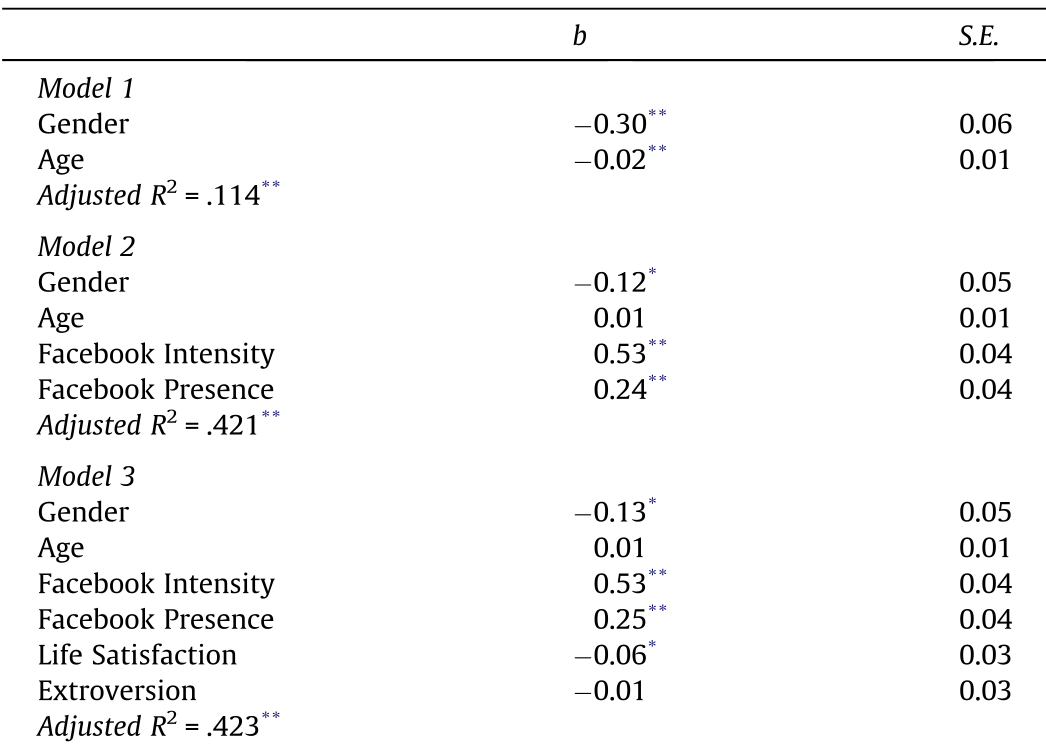
Initially, correlations suggested that younger people use Facebook for news much more than older adults. However, once the researchers controlled for Facebook Intensity, age ceased to be a significant factor. This implies that the only reason young people seem to get more news from Facebook is that they spend more time on it. If an older user adopts the platform with the same intensity, they are just as likely to use it as a news source.
Key Insights:
- Gender Polarity: Women were significantly more likely to use Facebook for news related purposes, even when controlling for how active they were on the site.
- The Life Satisfaction Paradox: Interestingly, people less satisfied with their lives were more likely to seek out or share news on Facebook. The authors suggest these users might be seeking "alternative accounts" because they are dissatisfied with mainstream portrayals of reality.
- Extroversion: While extroverts are more active on the site, they aren't necessarily more likely to share news. For them, the platform remains primarily a social playground.

The Regression Breakthrough
Model 3 in the researchers' analysis (R² = .423) proves that news usage is a specific behavioral subset. The unstandardized beta coefficients show that while general intensity (b=0.53) and presence (b=0.25) are the strongest drivers, personal psychology—like life satisfaction—is a quiet but significant influencer.
Final Analysis: The New Virtual Newsroom
The study concludes that Facebook may be the "last remnant of a common cultural media outlet." In an era of fragmented cable news and specialized blogs, the SNS "wall" is where diverse content converges.
Takeaways for the Future:
- For News Organizations: The strategy should focus on "shareability" rather than "searchability." Users encounter news incidentally.
- For Political Campaigns: Resources shouldn't just target the youth; the growing demographic of "over-30" users is becoming equally reliant on digital social feeds for information.
- Limitations: The study's focus on a single university population provides a strong baseline but may not reflect broader regional or global ideological variances.
As SNSs continue to evolve, they are moving beyond "staying in touch" to becoming the primary lens through which we view and verify the world's events.