
AlphaEvolve: Bridging the Gap Between Symbolic Alphas and Deep Learning in Quant Trading
AlphaEvolve: A Learning Framework to Discover Novel Alphas in antitative Investment
AlphaEvolve is a novel AutoML-based learning framework designed to discover a new class of "Alphas" for quantitative investment. It evolved trading signals that combine the simplicity of formulaic expressions with the predictive power of data-driven machine learning models, achieving SOTA risk-adjusted returns (Sharpe Ratio > 20) on NASDAQ data.
Executive Summary
TL;DR: AlphaEvolve is a groundbreaking framework that applies AutoML to the high-stakes world of quantitative investment. By evolving "hybrid" alphas—mathematical expressions that can handle scalar, vector, and matrix data—it discovers trading signals that are more predictive than traditional formulas and more interpretable (and diversifiable) than deep learning models. In benchmarks on NASDAQ data, AlphaEvolve-generated signals achieved a Sharpe Ratio of 21.32, effectively quadrupling the performance of human-designed baselines.
Market Positioning: This work represents a shift from "hand-crafting" features to "discovering" computational graphs. It sits at the intersection of Symbolic Regression and AutoML, specifically targeting the "Multi-Alpha" problem where hedge funds need a diverse set of uncorrelated signals to manage risk.
Problem & Motivation: The "Alpha" Dilemma
In quantitative finance, an "Alpha" is a model that predicts stock returns. Historically, quants have faced a binary choice:
- Formulaic Alphas: Simple algebraic expressions (e.g.,
Moving_Average(Close, 30)). They generalize well and are easy to combine, but they are "shallow" and often ignore complex multi-dimensional data. - Machine Learning Alphas: Black-box models (LSTMs, Transformers). They are powerful but "brittle." They are notoriously difficult to mine into a weakly correlated set, meaning if one ML model fails, they often all fail together.
The authors observed that existing AutoML-Zero approaches fail in finance because the search space is too vast and stock tasks are highly noisy and interrelated. They identified the need for a framework that can evolve simple structures capable of "learning" from long-term history.
Methodology: How AlphaEvolve Discovers Novelty
The core of AlphaEvolve is an evolutionary loop that mutates three components: Setup(), Predict(), and Update().
1. The Architecture of a Hybrid Alpha
Unlike previous methods that only use arithmetic, AlphaEvolve introduces:
- ExtractionOps: Operators that allow the model to selectively "pick" a specific scalar or vector from a large feature matrix.
- RelationOps: These inject Relational Domain Knowledge. Instead of just looking at Stock A, the alpha can ask: "How does Stock A rank against others in the Technology sector?" (e.g.,
RelationRankOp).
2. Efficiency via Pruning
Searching through candidates is impossible in the volatile world of finance. AlphaEvolve uses a Graph-based Pruning Technique. It represents each alpha as a directed graph and removes any operation that doesn't eventually contribute to the final Prediction node. This prevents wasting CPU cycles on "dead-end" mutations.
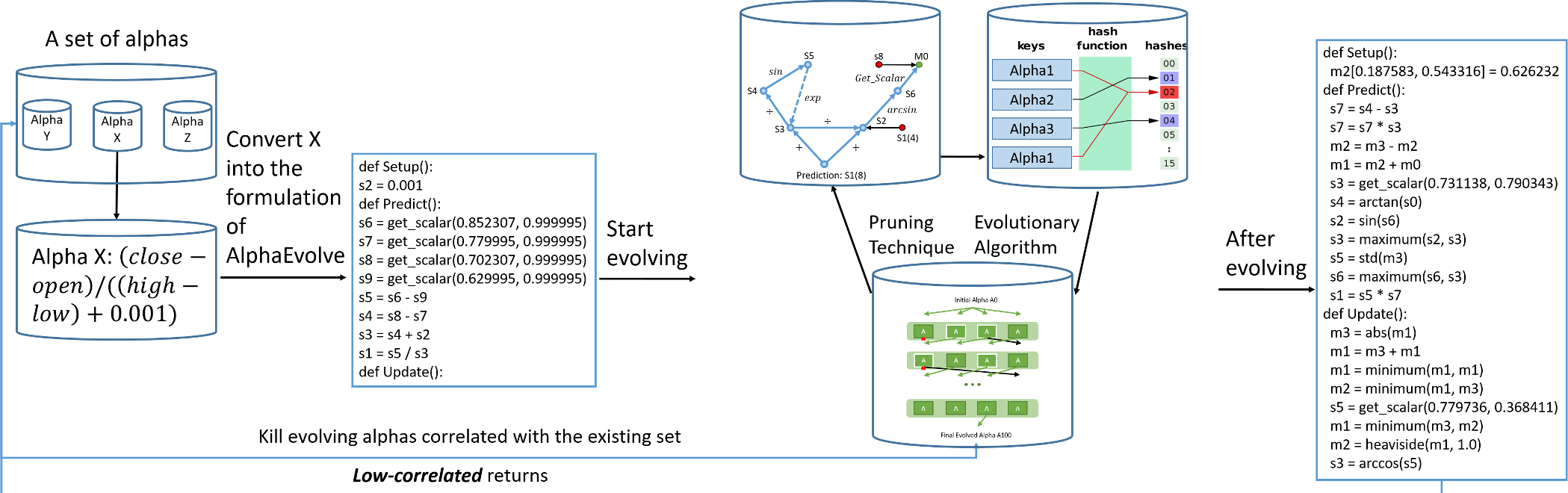 Figure 1: The AlphaEvolve architecture, illustrating the transition from a domain-expert formula to an evolved, high-performance hybrid alpha.
Experiments & Results: Crushing the Baselines
The authors tested AlphaEvolve against both traditional Genetic Algorithms (GA) and state-of-the-art Deep Learning models like RSR (Relational Stock Ranking).
Key Findings:
- Performance: AlphaEvolve achieved a Sharpe Ratio of 21.32, compared to 13.03 for GA and a lowly 5.64 for RSR.
- Correlation Control: The framework successfully generated a set of alphas with correlations below 15%, proving it can find diverse ways to "alpha" the same market.
- The Power of Updates: Alphas that utilized the
Update()function (allowing them to maintain "memory" of long-term training features) significantly outperformed those without it.
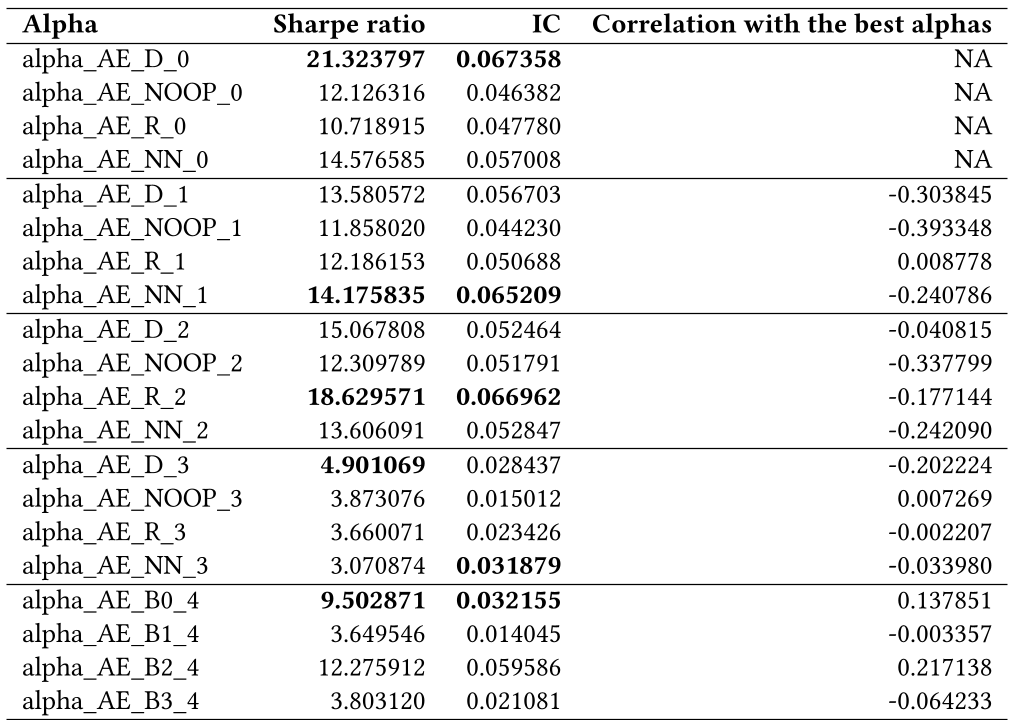 Figure 2: Multi-round results showing AlphaEvolve’s ability to maintain high returns even as it is forced to find uncorrelated (diverse) signals.
Critical Analysis & Conclusion
Takeaway
AlphaEvolve proves that the "intelligence" in trading doesn't necessarily require billions of parameters. Instead, it requires the right search space and dynamic memory. By allowing simple formulas to update themselves and compare across sectors, AlphaEvolve finds the "hidden math" of the market.
Limitations & Future Work
While impressive, the strategy relies on a Long-Short strategy that assumes high liquidity and low transaction costs—factors that can erode returns in the real world. Future iterations could integrate transaction cost awareness directly into the fitness function of the evolutionary process. Furthermore, applying this to high-frequency data (intraday) remains an open challenge due to the computational cost of the search.
Final Thought: AlphaEvolve is a major step toward the "Self-Driving Hedge Fund," where the role of the quant shifts from writing formulas to designing the environments where formulas evolve.