
AlphaStock: Bridging the Gap Between Deep RL and Interpretable Investment Logic
AlphaStock: A Buying-Winners-and-Selling-Losers Investment Strategy using Interpretable Deep Reinforcement Attention Networks
AlphaStock is an interpretable Reinforcement Learning (RL) based quantitative trading framework that implements a "Buying-Winners-and-Selling-Losers" (BWSL) strategy. It utilizes an LSTM with History state Attention (LSTM-HA) and a Cross-Asset Attention Network (CAAN) to achieve superior risk-adjusted returns, significantly outperforming traditional baselines with an Annualized Sharpe Ratio (ASR) of 2.132 in the U.S. market.
TL;DR
AlphaStock is a state-of-the-art quantitative trading framework that fuses Deep Reinforcement Learning with an interpretable attention mechanism. By moving beyond simple price prediction to a "Buying-Winners-and-Selling-Losers" (BWSL) strategy, it manages to achieve an Annualized Sharpe Ratio of 2.13, offering a rare combination of high returns, low drawdown (2.7%), and transparent decision-making logic.
Problem & Motivation: Beyond the "Black Box" Predictor
Modern quantitative trading (QT) is caught between two worlds. Traditional strategies (like Momentum or Mean Reversion) are grounded in solid financial theory but are often too rigid for volatile, multi-state markets. Conversely, Deep Learning models are powerful feature extractors but suffer from three critical flaws:
- Risk Blindness: Most models optimize for Accuracy (MSE), which doesn't account for the volatility-adjusted returns investors actually care about.
- Asset Isolation: Stock prices don't move in a vacuum. Existing models often ignore the Relative Value and interrelationships between different assets.
- Opacity: Institutional investors are hesitant to trust "black boxes" with billions of dollars without knowing why a trade is being made.
AlphaStock addresses these by treating the market as a relational system and optimizing directly for the Sharpe Ratio through Reinforcement Learning.
Methodology: The Anatomy of AlphaStock
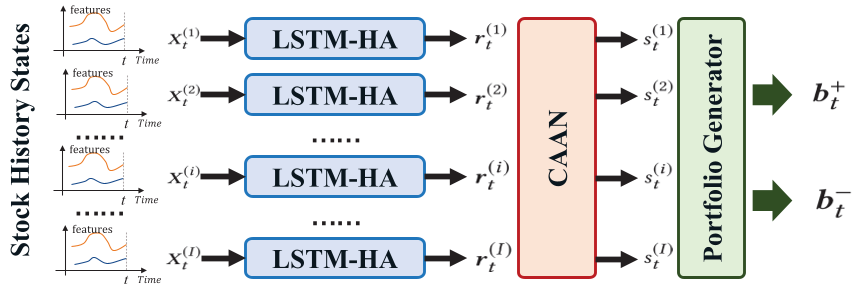
The framework is composed of three sophisticated neural modules that mimic the workflow of a professional portfolio manager.
1. LSTM-HA: Capturing the Narrative of a Single Stock
Instead of just looking at the last few days, the LSTM with History state Attention (LSTM-HA) looks at a long-term "look-back window" (e.g., 12 months). It uses an attention mechanism over the LSTM's hidden states to identify which historical periods are most relevant to current performance, capturing both short-term momentum and long-term trends.
2. CAAN: Modeling the Market Ecosystem
The Cross-Asset Attention Network (CAAN) is the "secret sauce." It treats the entire pool of assets as a graph where every stock can "attend" to others.
- Self-Attention: Learns how the representation of Stock A relates to Stock B.
- Rank Prior: It incorporates the relative rank of price changes as a "positional encoding," helping the model understand which stocks are current leaders vs. laggards.
3. RL Optimization: Far-Sighted Investing
AlphaStock doesn't just try to guess tomorrow's price. It uses Policy Gradient RL to maximize the Sharpe Ratio over a long horizon (e.g., 12 months). This "far-sighted" approach ensures the model prefers steady growth over high-risk, speculative spikes.
Experiments: Superior Resilience
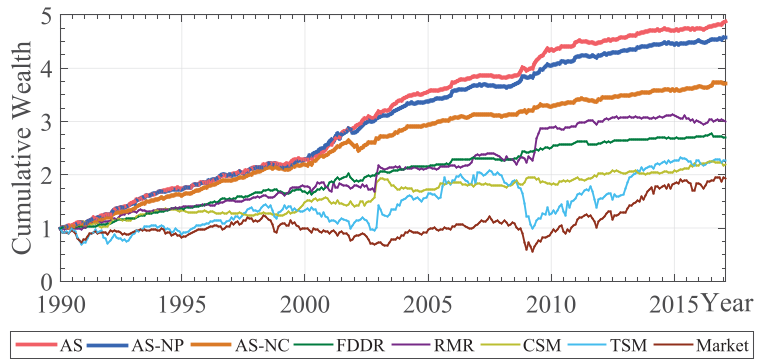
The developers tested AlphaStock on nearly 50 years of data from U.S. markets (including the Dot-com bubble and the 2008 Financial Crisis).
- Performance: AlphaStock achieved an ASR of 2.132, nearly double that of its closest deep RL competitor (FDDR, ASR 1.141).
- Risk Control: While traditional momentum strategies (TSM) crashed during bear markets, AlphaStock’s Maximum Drawdown (MDD) was only 2.7%, showcasing its ability to switch to defensive "selling-loser" positions effectively.
Deep Insight: What is the Model Actually Learning?
One of the most impressive parts of this work is the Sensitivity Analysis. By calculating the gradient of the "Winner Score" with respect to input features, the authors "decoded" the model's brain.
The analysis revealed that AlphaStock isn't just gambling; it has "rediscovered" fundamental investing principles:
- Long-term Momentum + Short-term Reversion: It buys stocks with steady 12-month growth but looks for a slight recent "dip" (undervalued) to enter the position.
- Quality over Hype: It favors high Intrinsic Value (high Book-to-Market ratio) and low Volatility.
- Size Matters: It tends to prefer companies with healthy Market Capitalization.
Conclusion & Limitations
AlphaStock proves that Deep RL can be both high-performing and interpretable. It moves the needle from "AI as a predictor" to "AI as a strategist."
Limitations: The current model ignores transaction costs and slippage in its core mathematical derivation (though it includes a 0.1% cost in experiments). In high-frequency environments, these costs might erode the Alpha. However, for monthly rebalancing—the setting used in the paper—AlphaStock offers a robust blueprint for the next generation of AI hedge funds.