
User Taglines: Bridging the Interaction Gap in Expert Recommendations
User Taglines: Alternative Presentations of Expertise and Interest in Social Media
The paper introduces a systematic framework for automatically generating short, informative "taglines" to describe Twitter experts within UI space constraints. It proposes three distinct methodologies—Occupation-Pattern, Link-Triangulation, and User-Classification—outperforming the simple profile bio baseline by up to 88% in summary quality.
TL;DR
When Twitter or news sites recommend "Who to follow," they often present a raw profile bio that is either too long, empty, or uninformative. This paper presents a specialized system to generate concise, high-quality "taglines" (max 70 characters) using occupation lexicons, Wikipedia triangulation, and behavioral classification. The result is a massive jump in summary quality—from 30% to nearly 93%.
Background: The Problem with Self-Descriptions
In the ecosystem of "Meformer" data (where users describe themselves), social media bios are notoriously messy. A user might be a world-renowned scientist but write "I love coffee and sunshine" in their Twitter bio. This creates a "discovery gap": a recommendation engine might know a user is relevant to your search, but the UI fails to tell you why.
The authors identify three main failure modes of current systems:
- Space Constraints: UI designs (like sidebars) truncate long bios, losing the most critical info.
- Missing Data: Many experts leave their bios blank.
- Noisy Content: Humor or irrelevant personal details mask professional expertise.
Methodology: The Three-Pronged Attack
To solve this, the researchers moved beyond simple text extraction and looked toward Knowledge-Enhanced Computing.
1. Occupation-Pattern Extraction
Instead of summarizing the whole bio, the system looks for "anchors"—specific job titles (e.g., "Editor", "Physicist") from a pre-defined lexicon rooted in US Bureau of Labor statistics. It then extracts the specific N-grams surrounding that title.
- Example: From a long bio, it extracts "Senior Media Reporter for The Huffington Post" instead of the whole paragraph.
2. Link-Triangulation (The Wikipedia Factor)
This is the most "academic" and effective insight. The authors argue that "Informer" data (what the world says about you) is more authoritative than "Meformer" data.
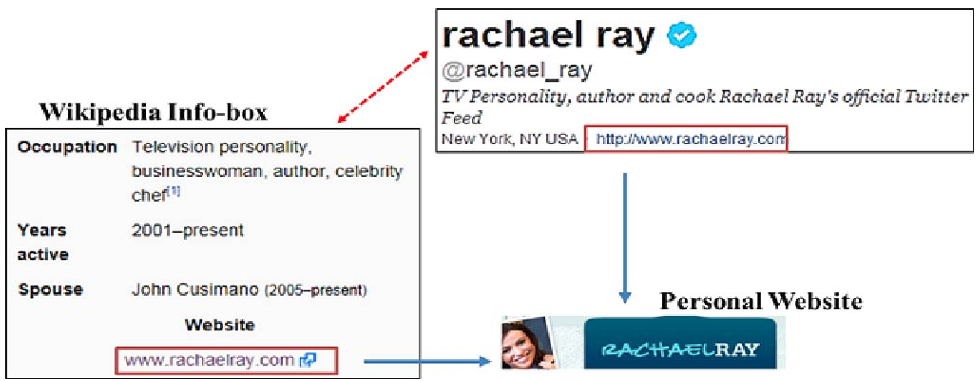 The system resolves identity by finding a match between a Twitter profile, a personal homepage, and a Wikipedia entry. Once a link is confirmed, it pulls high-quality data from the Wikipedia Infobox.
3. Behavioral Classification (The Fallback)
If a user has no bio and no Wikipedia page, the system analyzes their network behavior—Mentions, Tweets, and Retweets—to label them.
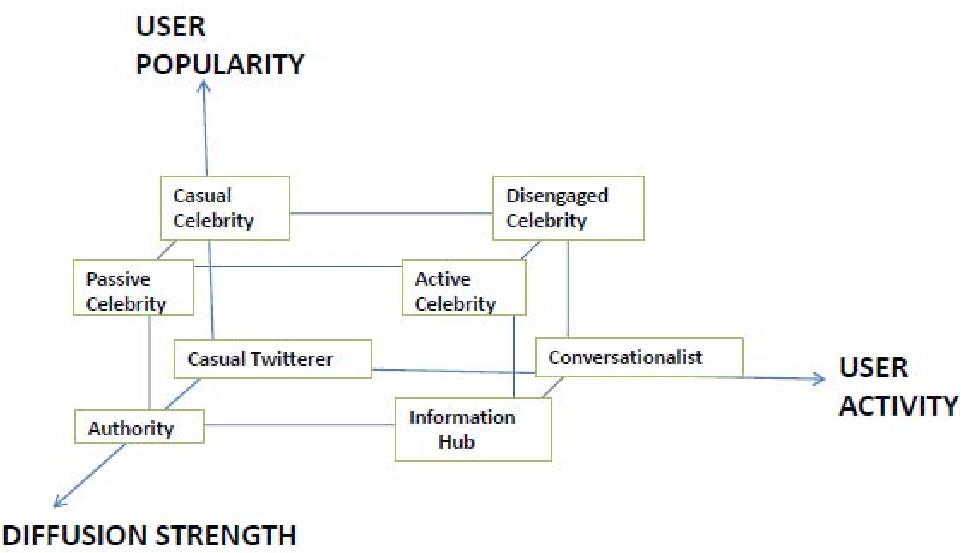 A user might be tagged as an "Information Hub" or a "Conversationalist," ensuring every recommended user has at least some context.
Experiments & Results
The evaluation was conducted via human judges (native English speakers) to assess "Readability," "Specificity," and "Interestingness."
| Method | Good Summaries (Majority Agreement) |
|---|---|
| Baseline (Original Bio) | 30% |
| Occupation-Pattern | 70-74% |
| Link-Triangulation | 91-92% |
The Link-Triangulation method is the clear winner, highlighting the value of structured external knowledge bases in summarizing social media entities.
Critical Insight & Analysis
The "why" behind this transition to external data is profound: Expertise is a social construct. While one can claim expertise in a bio, it is validated by external sources (Wikipedia) or demonstrated through network influence (retweets). By leveraging these external signals, the authors moved from "Surface Summarization" to "Identity Validation."
Limitations & Future Work
The study focuses heavily on English-speaking users and relies on the existence of Wikipedia pages for its best results. Future iterations could benefit from LLM-based zero-shot classification to interpret more nuanced bios that don't follow standard occupation patterns.
Conclusion
This research provides a blueprint for making social media recommendations more human-friendly. By distilling complex identities into 70-character taglines, we can significantly improve user engagement and the clarity of expert discovery.