
The Architecture of Kindness: How Social Integration Drives Altruism
Altruism and social integration
This study investigates the link between social network structure and prosocial behavior using a two-stage experiment involving network elicitation and a standard Dictator Game. The authors demonstrate that "social integration"—measured by betweenness centrality and reciprocal degree—is a significant predictor of altruism, independent of traditional factors like social distance and framing.
TL;DR
Why do some people give more than others? While a decade of behavioral economics suggests it’s about "who you know" (social distance) or "how you're asked" (framing), this study reveals a deeper structural truth: it's about where you sit in the social web. Using real-life student networks, researchers found that people who act as "bridges" in a network (High Betweenness Centrality) are significantly more altruistic and less likely to be selfish.
Beyond the Dictator: The Context of Connection
For years, the Dictator Game has been the gold standard for measuring altruism. A "Dictator" is given money and decides how much to share with a "Recipient." Traditionally, research has focused on:
- Framing: Using language like "they rely on you" to trigger empathy.
- Social Distance: Knowing the recipient is a friend versus a stranger.
However, these studies treat individuals as isolated points. This paper argues that we are embedded in complex social architectures. The authors ask: Does your global position in a social network—your "social integration"—independently influence your generosity?
Methodology: Mapping the Social Fabric
The study was conducted in two distinct stages at the Universidad de Granada:
Stage I: Network Elicitation
79 students mapped their friendship networks. Unlike previous studies that incentivized naming many people, this protocol limited the benefit to only one randomly selected friend. This forced subjects to name only "close" friends, resulting in a high-quality, high-reciprocity graph.
Stage II: The Dictator Game
Subjects were then placed into three treatment groups:
- Baseline: Giving to a random non-friend.
- Frame: Giving to a random non-friend with "dependency" language.
- Friends: Giving to a randomly selected friend from their Stage I list.
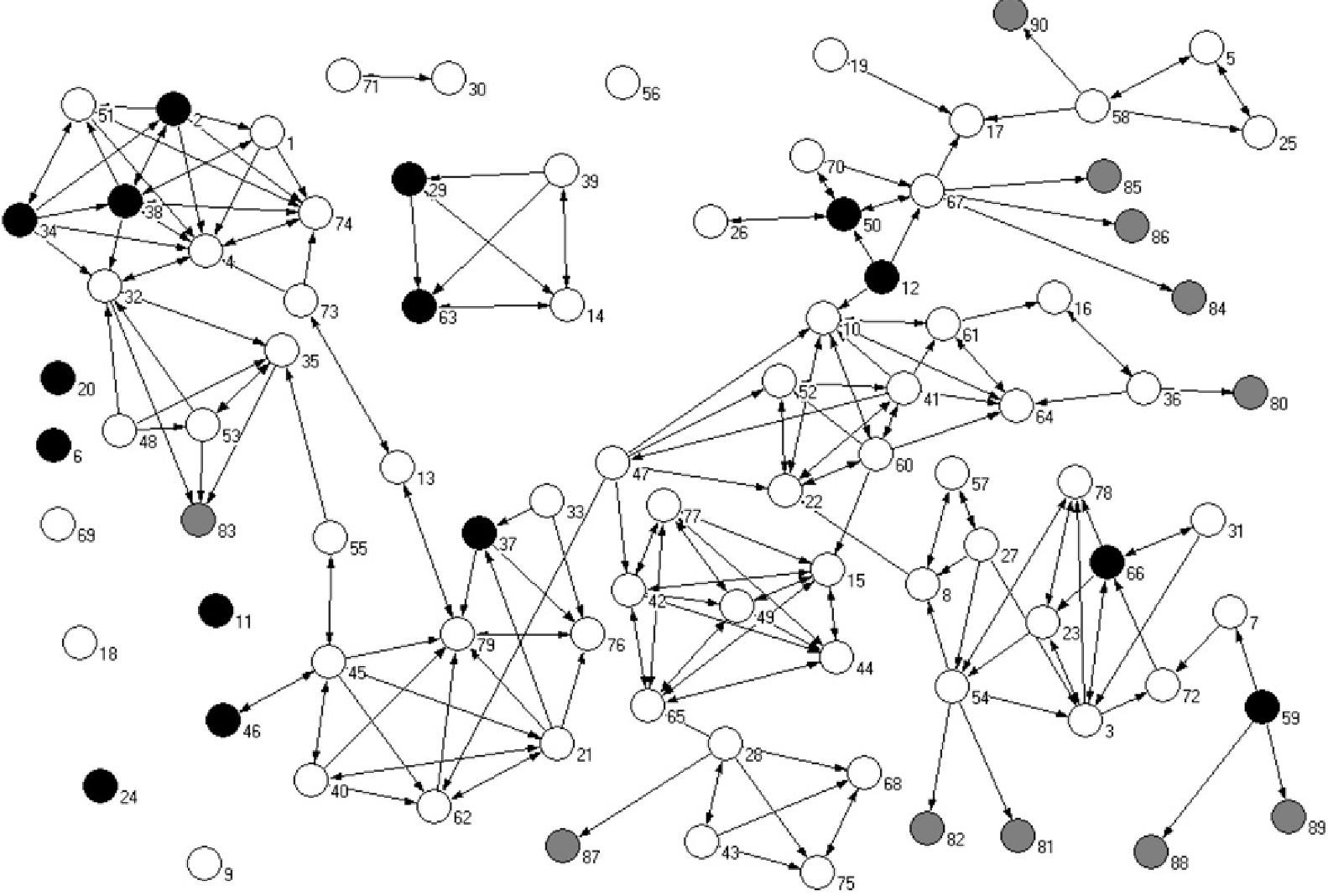 The image above displays the elicited social network, where node color/size often correlates with giving behavior and connectivity.
Core Findings: The Integration Effect
The results provide a nuanced look at why we give. While giving to a friend increased offers by 49%, the most striking data came from the structural metrics:
- Betweenness Centrality Is Key: This measure identifies people who lie on the shortest paths between other people—the "brokers" of the network. These individuals were 2.83 times more likely to give more money.
- Reciprocity Counts: Local integration (Reciprocal Degree) also significantly boosted altruism.
- Selfishness is Peripheral: "Selfish" subjects (those giving 0 or 1 coin) were almost exclusively located at the network's periphery or in isolated, redundant clusters.
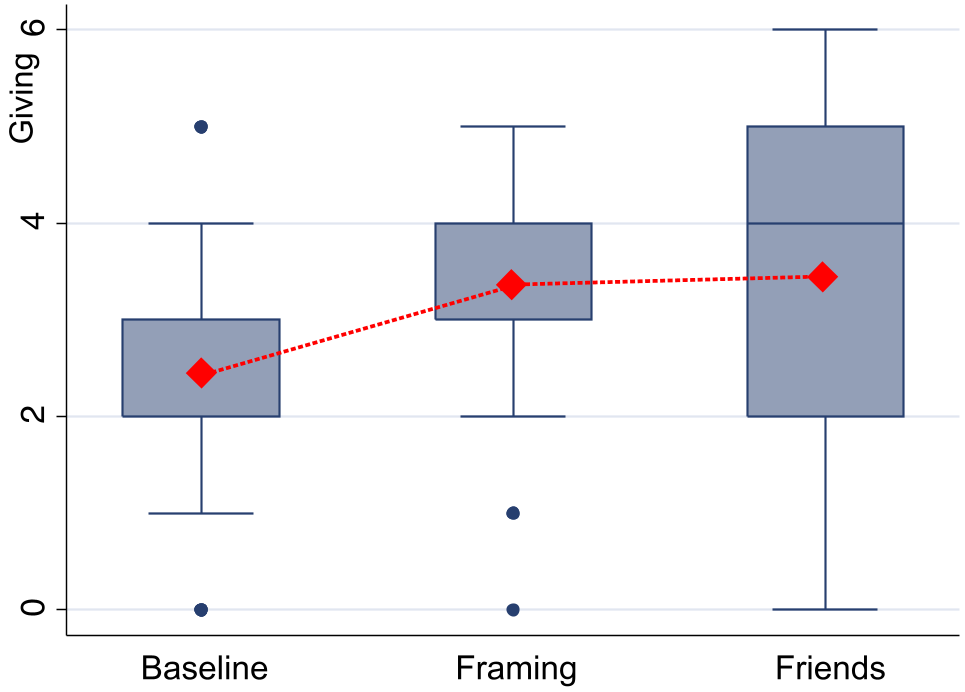 This box plot illustrates how Framing and Friendship shift the median offer upward compared to the Baseline.
Why Does Integration Lead to Altruism?
The authors suggest that social integration and altruism are complementary. Being "pivotal" in a network might expose an individual to more social pressure or help them internalize prosocial norms more effectively.
While the study cannot definitively prove causality (does being altruistic make you central, or does being central make you altruistic?), it proves that the two are tethered. In a network, "weak" measures of integration (just knowing many people) didn't matter; only "strong" integration (mutual friendships and global centrality) moved the needle on generosity.
Conclusion & Future Outlook
This work shifts the focus of behavioral economics from the individual's psychology to the topology of the community. It suggests that to foster a more altruistic society, we should look at ways to increase social integration and bridge "peripheral" individuals into the communal core.
Limitations: The study is confined to a university setting. Future research should explore if these "centrality effects" hold true in digital environments or different cultural contexts where social ties are governed by different norms.