
P&A-A: Beyond Reactivity — Proactive Congestion Control for Urban VANETs
An Altruistic Prediction-Based Congestion Control for Strict Beaconing Requirements in Urban VANETs
This paper introduces P&A-A, a proactive congestion control protocol for Urban VANETs that jointly adapts transmission rate (TR) and power (TP). By integrating an altruistic short-term density prediction algorithm, the method achieves SOTA performance, keeping collision rates below 8% and improving density perception accuracy by up to 55% compared to ETSI standards.
TL;DR
Vehicular Ad-hoc Networks (VANETs) rely on "beacons" (Safety Messages) to function. However, in crowded urban areas, the Control Channel (CCH) often becomes congested. This paper presents P&A-A, a protocol that doesn't just react to congestion but predicts it using an altruistic neighbor-based algorithm. By jointly tuning transmission rate and power, it maintains strict safety requirements while slashing collision rates by up to 14% compared to standard ETSI models.
The "Reactive" Trap: Why Current Standards Struggle
Standard protocols like ETSI’s Decentralized Congestion Control (DCC) are reactive. They wait for the channel load to spike before scaling back. In a high-speed urban intersection, this is too late—by the time the system reacts, critical safety beacons have already collided and vanished.
The core challenge is the Inductive Bias of existing systems: they assume the current channel state represents the future. In reality, a vehicle entering an intersection can see its local density jump by 50% in just 400ms.
Methodology: Proactive Intelligence through Altruism
The authors break the problem into two distinct modules: Short-term Density Prediction and Joint TR/TP Adaptation.
1. Altruistic Prediction
The "Altruistic" label comes from the fact that vehicles perform calculations on behalf of their neighbors.
- The Logic: A vehicle ahead has a better "View" of what’s coming into the radio range of the vehicle behind.
- The Mechanism: By piggybacking 4 bytes of data (incoming/outgoing vehicle counts) on standard beacons, nodes can build a 100ms-ahead map of the local density.
2. The Adaptation Loop
Instead of a simple linear drop-off, the P&A-A algorithm follows a prioritized hierarchy:
- Density First: Bring the predicted local density into the "Optimal Zone" (22-28 vehicles).
- TR before TP: Adjust the Transmit Rate first to preserve the safety frequency (min 10Hz).
- Power as the Lever: If TR hits the 10Hz floor, the system reduces Transmit Power (TP) to shrink the conflict domain and leverage spatial reusability.
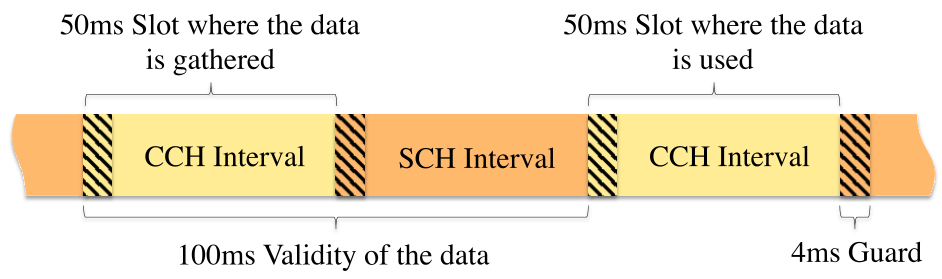 Fig 1: The Altruistic Prediction Mechanism showing how vehicles ahead report incoming traffic to those behind.
Experimental Results: Stability in Chaos
The researchers tested the protocol in simulated Manhattan and Kirchberg environments using a coupling of SUMO (traffic) and NS-3 (network) simulators.
- Collision Rate: While ETSI schemes suffered from massive 40%+ collision spikes during "cluster meetings" (intersections), P&A-A held steady below 10%.
- Channel Utilization: P&A-A maintained a "Busy Ratio" of ~35%, which is remarkably close to the theoretical optimal efficiency for 802.11p systems.
- Perception Accuracy: P&A-A improved the accuracy of a vehicle's "Local View" by 55% over ETSI models, effectively eliminating the "skewed vision" caused by processing delays.
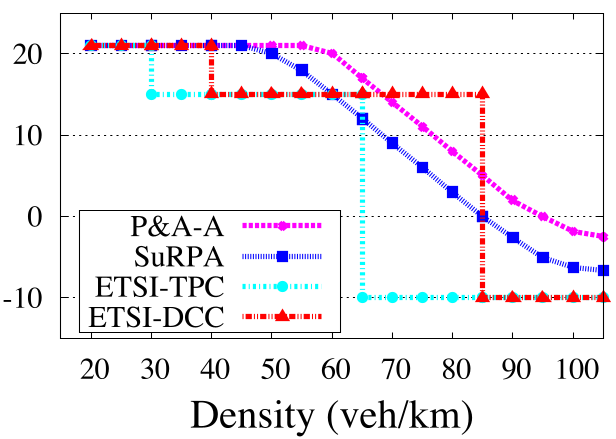 Fig 2: Comparison of collision rates. Note the high stability of P&A-A (solid black line) compared to the volatile ETSI variants.
Critical Insight & Conclusion
The genius of P&A-A isn't just in the math, but in the System Design. By identifying that "awareness" requires strict frequency, the authors correctly prioritized Rate control over Power control.
Limitations: The reliance on GPS/Positioning accuracy means that in severe "Urban Canyons" where GPS signals drift, the altruistic prediction might provide false density counts.
Future Outlook: The shift toward proactive adaptation is the necessary precursor to autonomous driving. This work proves that we can treat the wireless channel not just as a pipe, but as a predictable resource.