
OP-MIX: Unifying Language Model Training Through Efficient On-Policy Data Mixing
Always Learning, Always Mixing: Efficient and Simple Data Mixing All The Time
This paper introduces OP-MIX (On-Policy Mix), a unified data mixing algorithm designed for the entire language model lifecycle, including pretraining, midtraining, and continual instruction tuning. By interpolating Low-Rank Adapters (LoRA) trained directly on the current model, OP-MIX efficiently simulates candidate data mixtures without requiring expensive separate proxy models or retraining.
TL;DR
Language model training is typically treated as a sequence of fragmented stages (pretraining, finetuning, etc.), each requiring bespoke data mixing strategies. OP-MIX (On-Policy Mix) shatters this paradigm by introducing a single, lightweight algorithm that works across the entire model lifecycle. By interpolating LoRA adapters trained on the current model, OP-MIX discovers optimal data mixtures for a fraction of the cost—matching retraining performance in continual learning tasks while saving up to 95% of compute.
The Problem: The High Cost of "Proxy" Models
In modern LLM development, determining the "recipe" (data mixture) is often more expensive than the training itself. Standard practice involves:
- Training dozens of small proxy models on various data ratios.
- Extrapolating those results to the full-scale model.
Why this fails:
- Divergent Dynamics: Small models don't always learn like big ones, leading to "off-policy" errors.
- Phase-Specific: Methods designed for pretraining often break in continual learning settings where new domains are added on-the-fly.
- Compute Explosion: Retraining a proxy for every new combination of data leads to a combinatorial explosion of costs.
Methodology: The Insight of On-Policy Interpolation
The authors propose a radical shift: Stop using separate proxy models. Instead, use the model you are currently training as its own proxy via LoRA (Low-Rank Adaptation).
How OP-MIX works:
- On-Policy Probes: When new data arrives, train a lightweight LoRA adapter for the new domain and one for the "old" data pool directly on the current model weights.
- Linear Interpolation: Instead of training on new mixtures, simply interpolate the weights of these LoRAs. Based on the principle of Linear Mode Connectivity, the loss of an interpolated model is a reliable proxy for the loss of a model trained on a data mixture.
- Optimization: Fit a log-linear regressor to the results of these interpolations to find the "sweet spot" (the alpha) that minimizes loss across all domains.
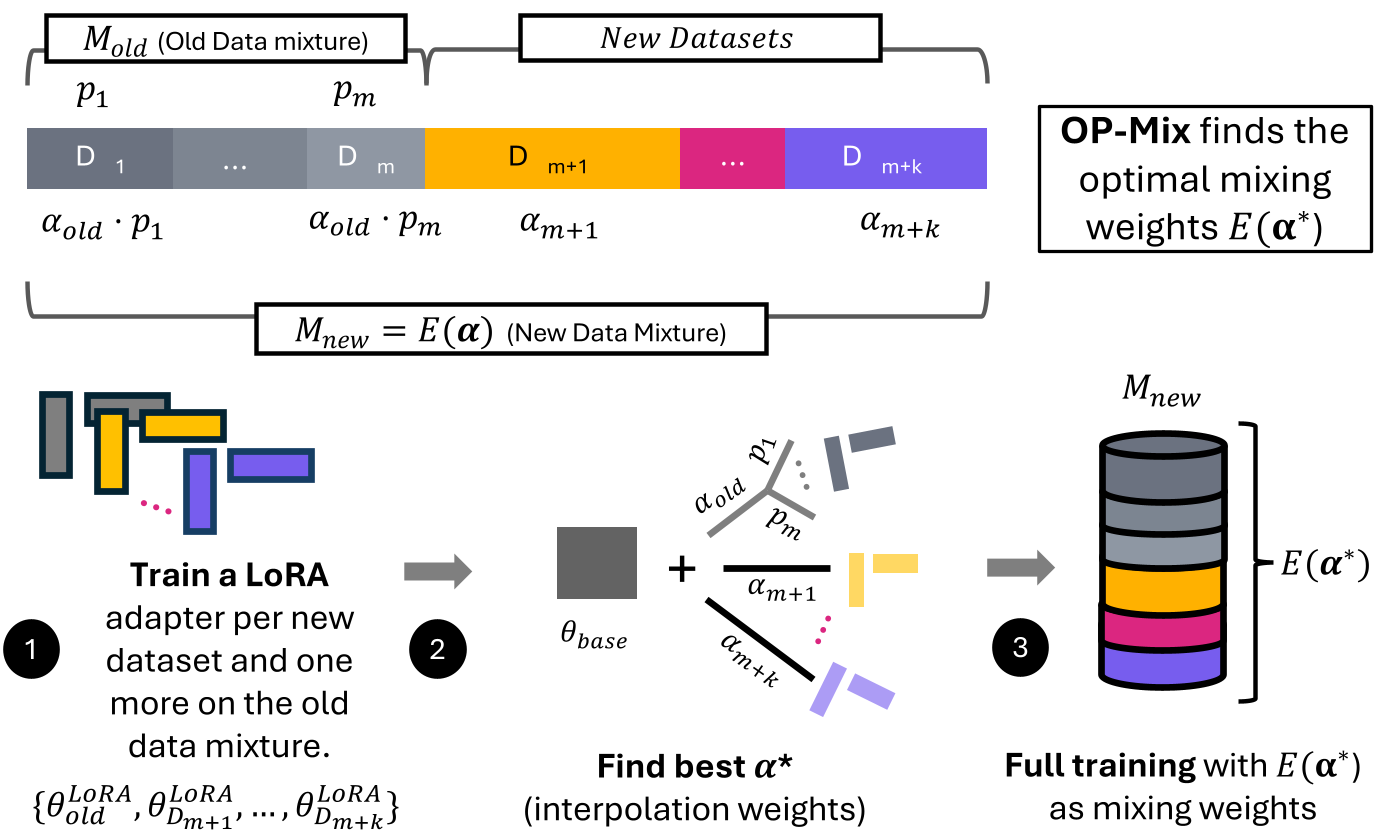 Figure 1: The OP-MIX workflow involves training domain-specific LoRAs, interpolating them to simulate mixtures, and then applying the optimized ratio to the base model training.
Experimental Mastery: Dominating the Pareto Frontier
The beauty of OP-MIX lies in its versatility. The researchers tested it across three distinct scenarios:
- Pretraining: It improved perplexity by 6.3% over uniform sampling and matched the most expensive baselines while being 14% more efficient.
- Continual Midtraining: It mitigated "catastrophic forgetting" almost as effectively as full retraining (the gold standard), but used 66% less compute.
- Instruction Tuning: When applied to Qwen2.5-7B, it matched the gains of sophisticated self-distillation algorithms using 95% less compute.
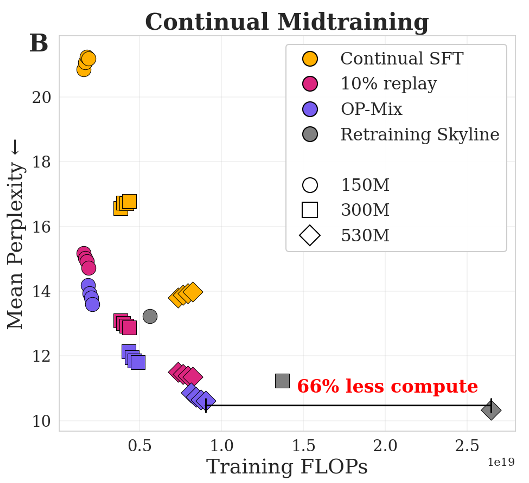 Figure 2: OP-MIX (purple) Pareto-dominates across all tasks, proving that you don't need to sacrifice performance for efficiency.
Deep Insight: Why Does It Work?
The core mathematical contribution is the validation that the LoRA loss surface closely tracks the true data mixing loss surface. Even as model sizes scale from 150M to 7B parameters, the "regret" (the gap between OP-MIX and a brute-force grid search) remains remarkably low (usually <1%).
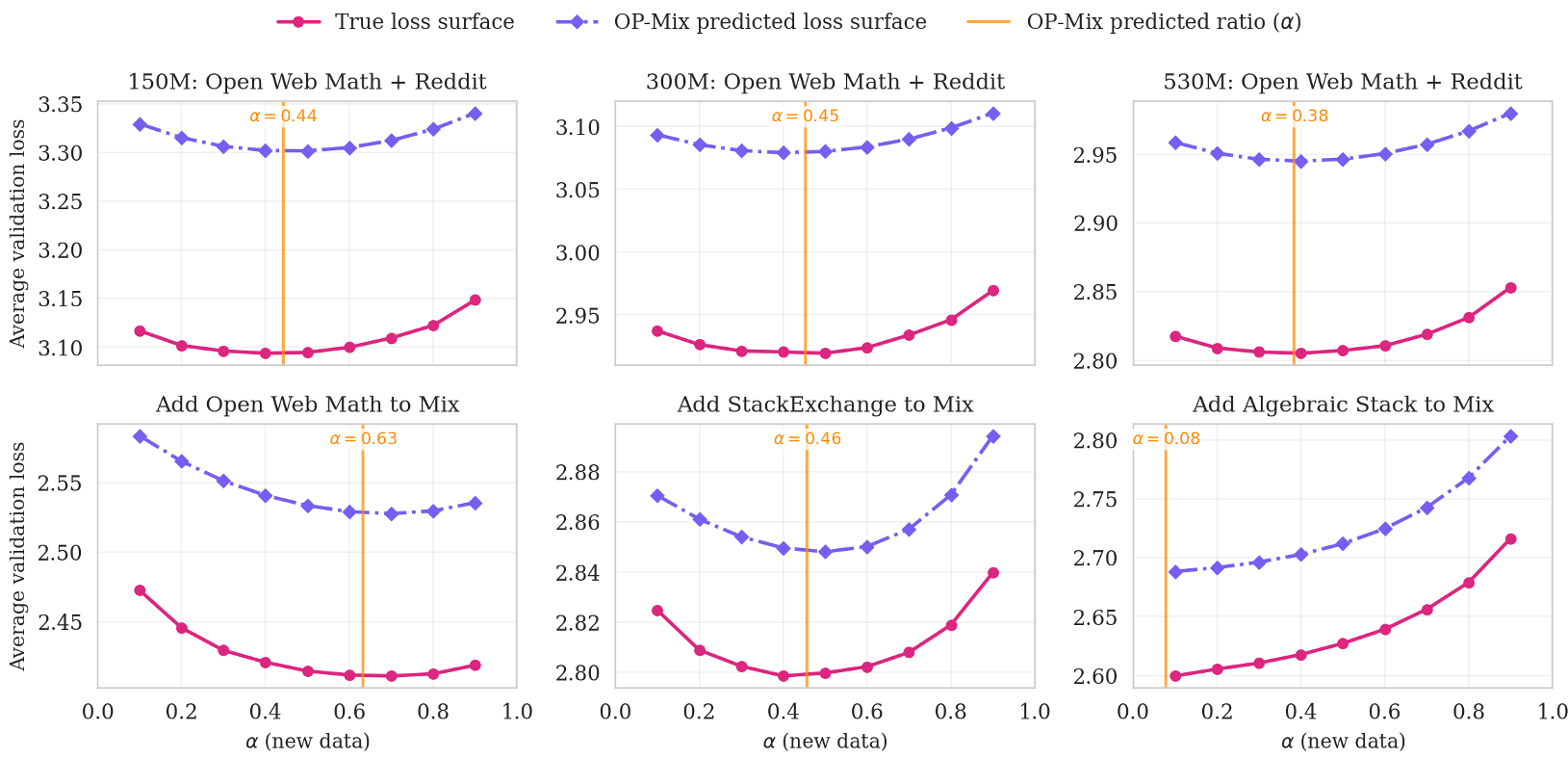 Figure 3: Empirical evidence that LoRA interpolation (purple) provides a high-fidelity estimation of the actual training loss (red).
Critical Analysis & Future Outlook
While OP-MIX is a significant leap forward, some questions remain:
- Frontier Scaling: Does the LoRA-to-Full-Model approximation hold at the 70B+ parameter scale?
- Domain Density: How does the interpolation behavior change when dealing with 100+ tiny domains vs. 5 large ones?
Takeaway: OP-MIX suggests that we should stop viewing LLM training as a sequence of distinct "checkpoints" and start seeing it as a continuous, online adaptation process. By making data mixing "lightweight," it enables models that can truly learn all the time.
Conclusion
OP-MIX proves that we don't need massive compute to find massive gains. By leveraging the internal geometry of the model's own weight space, we can navigate the complex landscape of data composition more efficiently than ever before.